DFR Outcomes Save Time, Money, Resources, Lives
In this webinar, public safety experts explored how Drone as First Responder (DFR) programs are transforming law enforcement operations by reducing response times, enhancing situational awareness, and improving resource allocation.
Real-world examples from agencies like NYPD, Las Vegas Metro PD, and OKCPD showcase how drones arrive first on scene, providing officers with critical, live-streamed aerial views before they step out of their vehicles. Speakers also covered the financial impact of DFR, including cost savings on dispatches and air support, as well as key steps for launching or expanding a program. The session concluded with an engaging live demo, demonstrating DFR technology in action.
- Hey, good afternoon, everybody. My name is Angad Singh, and I lead public safety
- partnerships here at Skydio, America's largest drone
- manufacturer. Today, we will be presenting a webinar
- titled DFR Outcomes, showing how agencies can save time,
- money, resources, and most importantly, lives with the
- implementation of drone as a first responder programs.
- Today, I just want to say thank you so much for
- joining us.
- We have a tremendous number of folks that have joined this webinar, ranging
- from executive staff from fire and police departments
- to our fellow brethren that fly drones in the field.
- Today, I'm going to be co-hosting this webinar
- with a good friend and
- longtime, uh, industry colleague, Brian King, who's a solutions
- engineer here at Skydio, and he's doing a great job solution
- engineering right now because he's on the road.
- He's been with three different agencies today, and he's actually helping present
- this demo or present this live webinar here from his
- vehicle. So we really appreciate him for joining
- in.
- Really appreciate all of you for joining in.
- Just a general reminder that here in the Restream platform,
- you have
- the ability to send questions. We have staff that will be bringing those
- questions forward, allowing me to see them so
- that we can dish them out.
- If they're relevant to the conversation, we'll address them right there.
- If not, we'll address them at the very end.
- Please send your questions in.
- We want this to be, this is for... You know, we want this to be interactive.
- This is for you to ask questions as we share stories about
- implementing drone as a first responder into the real world.
- Um, and just so everyone's aware, we're going to go through these slides,
- and then
- we're going to launch into a live demo of our DFR
- command system, um, that is accompanied, of course, by
- our AI-powered hardware that is our drones and our docks.
- Um, so just quickly, my name is Angad Singh.
- I, uh, I've been doing drones for about 10 years
- in the industry.
- I spent the first few years teaching primarily collision and crime scene, uh,
- with drone in the field. Taught about 3,500 police officers how to
- do that work.
- Worked with a lot of, um, you know, fire agencies as well.
- From there, I worked on tactical UAVs, that's drones for SWAT teams, and then
- I've been here at Skydio for about three years now.
- Um, before we pop into the first slide, I just thought, hey, Brian, you want to
- give the, give the folks an intro of yourself
- and why you're here today with us?
- Sure thing. Thanks, Angad. Uh, Brian King here, solutions engineer with
- Skydio. Uh,
- been with Skydio for just about four years now.
- Um, prior to that, I had prior service Army.
- Uh, I worked in manufacturing for a while.
- Um, and then I entered the drone space, uh, working with a, a
- Canadian company called Aerium Labs.
- Uh, moved over to FLIR, a couple other little small companies here
- and there.
- So definitely been in the trenches, um, with the industry, uh,
- with Angad, with others. Um, it's been a great...
- It, it's, it's a, it's a fun, exciting job, and, uh, I look forward to
- sharing those experiences with you all today.
- Awesome. Really appreciate it, Brian.
- And so just to set the stage, I think that law
- enforcement and public safety as a whole is in a pretty interesting
- place. Um, I've heard this word crisis independently
- stated by a lot of the individuals that I talk with on a daily basis,
- and it really comes down to the fact that we do have a
- workforce that is being stretched thin.
- We know that the vast majority of communities around the United States
- have X sworn count, but most of those heads are, are...
- that have been budgeted for are not filled.
- Um, we do know that the risks to officer
- safety are rising.
- We see that around the country with stories that, that we hear, uh, every
- day. We know that there's a declining public
- trust in law enforcement, which is,
- I believe, a sentiment that hopefully we're changing here
- and something
- that has been changing a little bit in the last few months.
- And then we know that emergency response times
- are increasing.
- Um, and we believe that fundamentally drones are a force
- multiplier for agencies, and drones are a technology force
- multiplier that addresses all of these, you know, fundamental
- aspects that are a part of this growing crisis in public
- safety, and we really do believe that drones have the ability to address
- that. I mean, 10 years ago, and, and Brian echoed this sentiment for
- me, um, when we would go into agencies and say, "Hey, let's start a drone
- program," you wouldn't be able to get chiefs to come to the
- table. You wouldn't be able to get executive
- command staff to say, "No, that we're
- missing the boat if we don't have these programs and we aren't implementing this
- type of technology." And Brian, you're on the road today, right?
- You're seeing this every week. How has this changed in the last 10 years?
- Oh, it's, it's changed a lot. I mean, just like what you said, you,
- you know, seven, 10 years ago, um, and you know, this doesn't
- take away from what was being done out there,
- but a lot of people saw drones as a
- toy, right? They didn't see it as a tool, uh, in the toolbox, some people like
- to say. But, um, you know, it was a, it was a fun,
- uh, thing that you could put up and see, you know, down from the sky.
- Had a great camera on it, and then the story kept going like, "Oh,
- well,
- how do I get that footage elsewhere?
- Oh, can I use this at night with thermal?
- Oh, can I map this?" You know, uh, the interest started growing and, and
- this is, this is the testament to a lot of people
- out there.
- You know, I could sit here and name off
- who knows how many names I could name off, but there, there's a lot of people out
- there that did a lot of work over the years to get the, to get
- drones where they are and to get them into the hands of the
- people that needed them
- the most, and to, to get it in the eye and on the desktop of a chief or a
- sheriff so they can see the powerful message and powerful
- tool that the drone can actually be for that agency.
- Yeah, absolutely. And I think that just with the number of chiefs
- that are on
- this webinar here today, it's a testament to how the industry has
- changed.
- And I think we spent the last 10 years really showing folks that
- drones were valuable. And this next decade is
- about showing folks that drones are essential, right?
- I mean, just to parallel it to another movement in
- public safety technology, it's
- been that cameras document outcomes, right?
- We have body-worn cameras that have become very prolific and,
- and are
- being utilized by officers all over the country and all over the world.
- But when we look here at, at drones, we fundamentally
- believe that the next decade about implementing drone as a first
- responder is a process that's going to change those
- outcomes, right? We know that the use of force is
- often a byproduct of walking into the unknown, and
- body-worn ca- cameras had been able to capture that.
- They were so powerful and are still so powerful today to
- adding a level of transparency between the community and law
- enforcement. But here with drones, we believe that that
- flying camera, that drone showing up on scene first
- and allowing folks to know what the unknown is, to know...
- have that right picture at that right time from the right place,
- that's gonna
- fundamentally give officers that information that they need in the
- moment to make their lives safer and that they're gonna make
- more informed decisions, um, before they arrive on scene,
- before they walk
- into what was unknown and now is known.
- Um, and, and that parallel in technology
- is really important.
- I mean, Brian-
- And-
- Go ahead, sorry.
- No, no, not only, you know, getting on scene and having aerial
- intelligence, but it's also post-event, right?
- Um, speaking with a, uh, a prosecutor in a major metro area,
- and they're needing more evidence.
- They need more cameras because, uh, things are going to, to ca-
- to cour- cases are going to court, and they don't have enough information to
- prosecute, right? So your... the drone is adding that much more perspective.
- You know, as it's flying there, it could see other things.
- It could, uh, help, uh, you know, put a benchmark on timing
- and, and, and weather and surroundings.
- There's just so many things you can get from that aerial perspective.
- But in some cases, especially in DFR, you're talking about getting there
- within 40 seconds of when the call comes in.
- So there's a lot of, of value add, not just in being able to get
- that video feed out, but there's a v- a value add in the entire process of
- document- documenting, uh, the incident,
- uh, for whatever case it may be.
- Yeah, absolutely.
- Um, next slide, please. So I think that we used to say that,
- you know, DFR was the vision for the future,
- but it's the vision of today.
- You know, imagine an incident occurs.
- A fire alarm goes off, or a ShotSpotter detects a
- gunshot. That incident is reported.
- That incident has a GPS location. It goes to the
- dispatcher. That dispatcher knows where
- that incident occurred,
- and that dispatcher can launch a drone.
- And so now on the rooftops of communities around the country, we have a drone that
- is launched and going to scene. That real-time intelligence, that
- video feed can go to the phones of the patrol officers or the
- tablets on the firefighters that are arriving on scene.
- And hopefully, they go in and it's not an unknown,
- and they're able to
- resolve that call in a more peaceful capability and to
- really, you know, enable a positive outcome with a member of
- community, whatever
- that may look like. And that DFR vision, it used to be for the future, but
- it's not. It's the vision of today. Um, and I think that's super important, right?
- I mean, Brian, do you wanna just talk about Miami Beach's
- real-time,
- um, you know, crime center and what that looks like and, and how this is an
- agency that's leading the way right now?
- Yeah. I mean, I have a couple stories I wanna actually
- touch on because you, you
- really brought up some good points there.
- But Miami Beach, for ins- for example, they, um...
- You know, when I met Sergeant Labrafido several
- years ago, um, they had a drone
- program. Uh, they did not have a real-time intelligence
- center.
- Um, now they have a real-time intelligence
- center and a Skydio dock on their
- rooftop, right? So they are not only responding to calls using
- drones, but they're doing it from a real-time
- intelligence center
- with individuals that maybe not, uh, maybe, maybe a
- couple weeks ago or a couple months ago, they weren't part of the drone team.
- But now they're like, "Hey, uh, that looks really cool.
- Uh, I wanna be a part of it." You know, they go through the DFR training process
- with Skydio, and they become a, a real-time, real-time, uh, a
- drone pilot for the real-time crime center. So it's pretty awesome.
- And to touch on some other things you said, you know, um, especially dealing
- with things like, uh, a, a fire department or, or, or,
- or fire rescue,
- right? Um, Pasco County, they have a very broad stroke of a county.
- You have... along the coast, you have, uh, hundreds of thousands of people that
- live along the coast, and then there's a lot of rural area,
- right?
- So along the coast, city-like area, lots of population,
- lots of things going on. Easy, easy check the box for DFR.
- But what about the rural area, right? What happens out there?
- And, um, just like, you know, if a car accident were to happen, uh, in,
- in, in a rural part and you're able to get a drone there in a
- couple minutes and
- assess the situation, um, you could roll out the right gear with the
- right trucks, the right people, versus having to call in other people or
- maybe sending too many. You know, maybe there's a cost savings there.
- I know Tulsa Fire was looking to do that from their, from their park.
- They have a river there, and sometimes calls come in
- that people are in the river,
- and people think, "Oh, they're, they're drowning,"
- when really it's someone just
- taking a bath or taking a dip. And instead of rolling out four or five,
- two
- rigs, whatever the case may be, they can send a side-by-side down there
- with a,
- with a, a first aid kit to make sure the person's
- all right. And, uh, and we can...
- and, you know, you got a cost savings there.
- You have personnel savings.
- You're taking the potential of, uh, risk away from having to roll out
- trucks. So there's a lot of different things,
- a lot of different perspectives you
- can look at here, and I think that's probably one of the
- funnest parts of my jobs
- is going and hearing challenges and, and, and, and, and
- issues that people are having in, in, in their everyday life at an
- agency. If it's fire, if it's... if...
- or if it's public, uh, police, um, emergency management, or even just, you
- know, p- city works, you know, public works, you know, the water company,
- the,
- uh, traffic management. There's so many use cases,
- and you get to sit down and just
- start implementing an eye in the sky, and people start looking at things
- much differently.
- Yeah, absolutely. It's so unique to every agency, right?
- You know, I, I think the beauty of this technology
- is that it has
- a base and a platform as an infrastructure, right? Drones are...
- Drones and remote operation centers and flying drones that are in little
- docks on the rooftops of, you know, fire stations around a
- community or police departments around a community responding to these 911
- incidents- I mean, every community that we speak to, they're coming
- to us with individual unique problems, but
- this DFR complex operations is able
- to address those. And across the board, it's able
- to save time, save money, save resources, and
- fundamentally save lives, right? Uh, I think we, we really mean that.
- I mean, there's, there's different buckets
- that we think that each
- agency around the country can look at.
- We know that with the example of a, you know, a domestic violence
- call where you get a 911 call and you have screaming in the background
- and a
- police officer shows up to a home and there's a fence
- and they have to go into that
- backyard. Well, there's a dog barking. They don't know if that dog's leashed.
- They don't know if that dog's in a kennel or if that dog
- is loose.
- In that incident or in that event, if you have a drone that showed up first,
- that live intelligence feed is going to the officer
- that just showed up and
- they know what they're walking into.
- That has the ability to increase that officer's safety
- and potentially save their
- life. Right? I mean, if we're looking at...
- I, I was working with a fire department
- that's a major, major city in the West,
- and they have roughly 27,000 calls for service a year, and
- 11,000 of those are what are called GOA calls, or gone on
- arrival. How much money is spent rolling out
- individuals that are on the job in a vehicle
- burning gas and fuel and time and going to an incident or an
- event just to show up and that individual was gone on arrival?
- What if a drone took off and arrived there within 90 seconds
- and was
- able to provide that information back to the agency?
- That's improving your response times dramatically.
- That's saving money because you're getting the right intelligence at the right
- time. I mean, I think that there's...
- it's improving community relations because you're showing up with,
- uh, the better information to enable a better
- outcome, right?
- And I mean, Brian, we're seeing this in the field every day,
- right? Um...
- Absolutely. I mean, y- y- agencies that are, that are, you know, full
- tilt on drones are seeing the, the savings,
- are seeing the, uh, the response times.
- Everything, um, you may not have in day one, um,
- but it will
- happen, right? Um, I know Oklahoma City, they've teamed up with the fire
- department there to do their DFR program, and any given
- time you could have two, three, four drones up doing different things.
- One, one may do- be doing, um, a traffic stop.
- One may be doing, uh, serving a warrant. One may be at a car accident.
- One may be at a structure fire. All these things, all of that dr- those
- drones are giving so much information at different...
- at the same time in different locations, that it's just, it's, it's such a
- cost savings that you, you just can't, you can't deny it.
- Absolutely, right? I mean, it, it's hard to speak to public
- safety as driving financial outcomes, but the reality
- is that everybody has a budget and every incident that comes
- up has a capability to have a cost associated with it.
- And one very powerful method that we found is
- to go into a community and ask that executive decision
- maker, that chief or that city council, or...
- what is important to them? What are their goals, right?
- And here on the, the slide that you're looking at,
- we have an example of,
- we did an analysis of a major county sheriff's office that asked for this,
- and they said, "Hey, we have a goal of reducing the cost of an
- officer-involved shooting by 50%.
- We wanna reduce the, the use of, uh, force claims by 50%.
- We wanna have a reduction on our medical lead avoidance costs and
- recover dispatch hours." And so we took in their calls for
- service and we s- analyze that if we were ero-
- able to eradicate the places in the community that we can't fly, where
- the FAA doesn't allow us to fly, we eradicate those areas, then we
- populate all of the areas from the calls for service that that agency
- identified as their priority zero and their priority one calls.
- And we analyze all of that information and under the assumption
- that we would show
- up with the drone from the second that incident was reported to when the
- drone showed up on site, it took about 90 seconds.
- We were able to show with this math that we have the potential to save that
- sheriff's office $10 million a year
- by achieving those goals faster by utilizing drones and
- utilizing drones as a first responder.
- And this sort of outcomes-driven,
- um, methodology has allowed us to really
- address individual problems in
- individual communities. And here, for all of those that are listening,
- take this as
- a call to action. Send us an email. Send us all of your call for
- service data. Let us analyze your community
- and show you where you can't fly
- drones, but where you can implement docks
- and implement, um,
- our drones that fly out of these docks autonomously off rooftops.
- Let us show you where you're allowed to do this stuff based off current regulation,
- and we'll show you how much potential money we can save your agency and how
- fast we can address some of your individual problems.
- I mean, Brian, you're in the field every day.
- What are a couple really powerful stories that you've seen on this?
- So I wanna bring out one thing on the slide here.
- The $10 million
- savings is an awesome number. That's, that, that, that resonates on a, on a,
- on a
- lot of different levels. But if you look above that,
- it says officer hours
- freed annually. 24,000 hours. Imagine the
- amount of things that can be done with that time.
- Um, you know, uh, so on and so forth.
- You know, um, just getting out in the community and,
- you know, uh, working with
- the community in, in different ways. That's a lot of time.
- That's a lot of, that's a lot of time and a lot of resources
- that you now have the
- ability to use. Um, so outcomes out in the field, you know.
- There's a lot of different agencies that we work with that are seeing,
- you know,
- immediate outcomes. And one of the, one of the big ones that I,
- I unfortunately get
- to work with, uh, living in the state of Florida is, uh,
- post
- hurricanes. Um, over the years we've seen drones become a
- very, um, a very important aspect of,
- of, of dealing with post hurricanes.
- Uh, on, on this last year, I think, you know, it's, it's really starting to
- culminate to a, to, to some really cool, um, outcomes
- and that is a place like Pasco County using, uh, DFR
- Command and Remote Flight Deck and, and, and s- the, the LTE
- modem- And the ready link to share the video
- feeds
- and the obstacle buoyance to go down into the canals and see the flooding,
- to do 3D scans of structures that were, that were, that were damaged during
- the, during the, during the storm.
- So all this stuff is happening and, and in the past, sometimes it wasn't even
- happening. So it was... So is there a cost associated with that?
- Maybe, maybe not. But now you're doing things to help the
- community, to, to
- help keep people safe, to, to get them back to normal operations
- after a,
- a devastating storm. And you're using technology that in,
- in relative,
- in relative terms is, is a, is a drop in the bucket when it comes to,
- you know, the
- things. And then if you throw in a $10 million
- savings, you know, you could have a
- drone program, you know, th- three times the size you have now, uh, to
- really, you know, drive home these savings and the, uh,
- the freed hours
- as well.
- Yeah, absolutely right. I mean, we're just gonna address problems specific
- to
- communities, and drones are... they're a force multiplier that has
- that capability.
- Um, if you had so much more time, how much more stuff can you do,
- right? I think that- that's something that this technology fundamentally solves
- for. Um,
- next slide please.
- So we've talked about these outcomes, we've talked about what they can do for
- communities, and now we want to speak to our specific
- technology and what differentiates it from others on the
- market. And then of course, we'll do a live demo for you, um,
- f- which is gonna be pretty cool 'cause
- Brian's sitting in a car somewhere in the
- country and the drone's not near him, right?
- So we're gonna get there, but, uh, w- we're gonna talk about the technology
- specifically.
- So Skydio is today America's largest drone manufacturer.
- Um, and it's, there's a core to our company that's
- different.
- It's not just about being NDA compliant and built in the United States.
- At its core, it's Skydio Autonomy.
- It's our AI capability that differentiates this tech from
- everything else
- on the market. So think about yourself.
- You're a human, you got two eyes, you don't walk into stuff.
- Well, our drones, they have six eyes and they have a brain.
- They're AI-powered flying robots that anyone can
- fly. If you can send a text message, you can effectively fly
- these drones. All of the folks on light duty,
- all of your
- dispatchers, anybody that can sit at a computer
- and send an email, has
- a fundamental capability to be able to operate drones out
- of a computer terminal and fly them autonomously across the sky.
- And it's the onboard technology at Skydio, those...
- the fact that these drones see the world around it and don't crash into stuff,
- that differentiates it in the field.
- They allow us to fly down alleyways.
- They allow us to fly autonomously at night in the pitch black and not hit trees or
- power lines. They allow us to fly between buildings in
- big cities,
- in GPS-denied environments. They allow us to track subjects in the
- dark and fly underground into tunnels, right?
- They allow you to go down low and into places that other drones can't.
- If a suspect goes into an alleyway, our drone has the ability,
- being flown by somebody sitting at a computer
- somewhere else in your community, to fly that drone just through their
- keyboard
- or through a joystick down under the s- under the
- building line, under the roof line into that alley and
- avoiding those objects. Imagine you're a fire department and you
- have a dock sitting on your rooftop, and you have a,
- a fire alarm that's come in.
- And your drone autonomously takes off, and you're able to fly across
- the city landscape, and maybe this is coming from a parking
- garage. Maybe there's a, a car on fire in a parking garage.
- You can fly into that parking garage, and using the thermal camera,
- you're able to
- identify the hotspots of where that location
- is to allow you to direct your resources, right?
- Skydio Autonomy is fundamentally different,
- and we're gonna show you a couple
- videos here that describe why this is different,
- and Brian's also gonna talk to what this allows you to do
- with... we're, we're the only drone on the market
- that can fly in specific
- environments.
- And this is a very complex thing, right? This is not easy. This is...
- I mean, our founder, you know, MIT type complicated stuff, right?
- So when you're looking at this from the perspective of a leader,
- a decision maker, a person that has to go find the budget or find the
- personnel, um, Skydio is making this
- scalable. Making it so that your
- pilots go through a two-day training, maybe a three-day training if
- they want to be a trainer. Um, 'cause we do do train-the-trainer courses,
- so if you
- have a large agency, we can, we can enable you for that.
- But you're talking about two days, uh, of some training, um,
- uh, some understanding, and you're flying missions in urban
- canyons.
- You're flying missions in parking garages.
- You're flying missions, um,
- in, in subway tunnels. You know, there's a lot of things
- that you're gonna be doing
- with Skydio's technology that you typically can't do with
- most manufacturers. You can do it.
- Your risk, uh, goes way up in some cases.
- Um, but you're able to do things at a much
- scalable, in a much scalable
- fashion with people that are interested and want to do the job,
- or maybe they're, they've been given the task
- and they gotta learn it.
- And then, you know, 48 hours later, they're, they're, they're a champion drone
- pilot for your agency. So there's a lot to take in, um, when,
- when you're,
- when you're expanding a drone program or starting a dro- drone program.
- We understand that. You know, uh, Unguard and I have been around for a
- little
- while. We understand the challenges on standing
- up a drone
- program, the challenges financially, the challenges resource-wise.
- But Skydio has a really good job building out from A to
- Z. We even have white papers, we have trainers, we have
- a, a, a, an amazing support team. We have an amazing customer
- success team. And so basically, from the time you pick up the phone to
- call us to
- the time you deploy your program, there's fail-safes, there's
- training, there's all sorts of stuff that we're gonna enable you with to be
- able to
- do all of these things that he's talking about here
- Yeah. And so much of it comes down to, like Brian said, our
- autonomy, right? These are flying robots.
- That drone is truly a first responder because that drone can
- think, and that drone can do things that no other drone
- can do. Um, and if we go next slide, we're gonna show you what that
- means. Because like Brian said, this is a complicated understanding.
- So here, this is a pitch black environment, right?
- This is in the woods. This is flying below tree line.
- You're doing a search and rescue for a suspect,
- and you're seeing thermal on the
- bottom left-hand side that identifies where that person is,
- and it's a pitch
- black environment. And any pilot can fly in this
- environment because all that pilot is doing is moving
- around and trying to locate that suspect or locate an
- individual, and the drone is avoiding all the trees, and the
- drone is staying stable in the air.
- This is what that real-time obstacle avoidance does.
- We don't want officers to train to become fighter pilot
- level pilots. We want officers to do their job more
- effectively
- and easier, and to force multiply themselves with an
- AI-powered robot that allows them to get home safe every
- night.
- This drone can do that. Here with Night Sense, Night Sense is our
- ability to see at night. So our c- our drone has six cameras
- on it, and just like when you go outside to walk the dog at
- night, you may take a
- flashlight, we put a flashlight on our drone.
- And that flashlight can be IR, which means that you can see it through
- NVGs,
- through goggles, but human eye can't see it.
- Or that flashlight that illuminates the drone around it can
- be a visible light, which makes it look like a, a mini moon
- or a mini
- sun that's flying around the sky and creating a tremendous amount of
- ambient light
- around it. And this capability allows you to fly into
- environments
- night and day that you fundamentally can't do with other drones.
- And this is that technology differentiator with our AI that I think
- really speaks volumes to the fact that we're trying every
- day to serve public safety in the best capability that we
- can. Um, if we wanna flip to the next video,
- I think the next video is
- a pretty cool video. Um, and Brian, I, I want you to speak to this.
- Like, what are we seeing here, and what is Skydio Autonomy doing?
- Well, I'm a little biased here, but that's the
- best darn thermal footage I've seen in a long time.
- Um, but, uh, you know, so you're, you're seeing an overhead view of an
- incident occurring using the thermal camera, right?
- So this is black hot. You can switch between other types of
- palettes, uh,
- of course. Um, but you can see here that, you know, the individual
- running is, it's, it's clear as day, right? It's clear as day.
- Even if he were to duck behind a bush, we would probably still see some of,
- some of
- his evasitivity coming off, right?
- So you're able to take this technology and use it in all sorts of fashions.
- Like, if I were to take my thermal c- th- my drone with the thermal camera
- and I want to go look at a fire, or if I want to go look, um, uh...
- One of our SEs, Aaron Bagley, was out in the, uh, Palisades
- fires, and they, they developed something [laughs] on the
- scene, it was pretty
- awesome, to be able to map areas. Because one of the big problems
- were, uh, hotspots that were left after the fires were put
- out. They had to go back and they would map out,
- and our thermal camera would
- identify these hotspots, and they could go get them before another
- fire started
- up. Um, so there's just a lot of things you can
- use the thermal
- for day and night, uh, to help out in, in certain
- situations, especially of, uh, you know, if some type of, uh, um,
- environment where there's, uh, you know, heat or fire or gas or
- fumes. I know Rich Katanis, uh, we talked about on a different webinar,
- they had
- a 22,000-gallon, uh, tank of some type of
- chemical. Uh, you could see the f- fumes coming out of it after the
- storm with the, with the thermal camera.
- So again, they were able to stand off from a,
- a safe distance,
- understand what needed to happen, devise a plan, and then send
- in the right people with the right tools.
- Yeah. You know what I love about this video?
- When the suspect's trying to jump a fence and there's two dogs that are barking
- right there. And you can tell so clearly in
- that thermal video because it's so
- crisp. I mean, this is, uh, like Brian said, we're a little biased,
- but this
- is technically the best thermal camera on a drone of this size on the market.
- And you can see from those dogs' body language that they're barking, and that
- they're not necessarily stoked that some random guy is jumping over their
- fence. You can see that.
- Right.
- The body language of the dogs right here through the thermal
- footage. And that's with a drone that's being
- autonomously flown by somebody on a
- keyboard somewhere above a scene.
- Um, and that, that, that outcome of finding that person, not
- having to enter a high-speed chase, knowing that whatever backyard they go
- into, we
- know exactly where they are, I think that's something that's
- particularly cool,
- right? I mean, that's something that's really gonna
- increase officers' safety.
- Um, let's pop to the next slide.
- And so here we're talk, we're showing you another example of what
- Skydio Autonomy
- can do. This is a drone that's being flown from a
- computer somewhere,
- and that drone is now able to go into a parking
- garage, go in the parking garage itself,
- and zoom in on a vehicle. I mean, Brian, you've been in the field, I've been
- in the field. What are the faces like on people who have been
- flying drones
- for 10 years, but we show that they can do this with the touch of a
- keyboard?
- I mean, it's,
- it's a face of,
- "He might not make it out of there."
- It's a face of,
- "Are you really gonna do that?" You know, there's, there's a couple different
- levels of, [laughs] of faces that I've seen when we go do something
- like this.
- And, and granted, I'm, I'm probably gonna do this here in a few
- minutes, but you
- know, I'm on the East Coast of the United
- States.
- I'm gonna be flying a drone on the West Coast of the United States into a parking
- garage. Um, and you're gonna be able to see this in
- real time,
- right? Um, now think of this as, uh, uh, a 911 call
- comes in. Um, you know, "Hey, there's somebody in a parking
- garage and they're starting a fire, and they,
- it looks like they have a weapon." I
- mean, just think scenario-by, you know, wise, you know-
- You send the drone in, it comes in under the, uh, the, the
- canopy there, the roof, and you're able to see exactly what you
- need to see to make
- the decisions you need to make. Instead of sending somebody in there
- that could get
- injured or maybe, you know, or, or maybe the fire's about...
- is, is a gas tank is about to explode, whatever the case may be.
- But you've really gotta look at it from the perspective of you're sending a camera
- into a place that pot- potentially had never gone before using
- the
- Skydio autonomy, uh, engine on, on that drone.
- Um. [clears throat]
- Yeah, absolutely. I mean, just the ability to go into a parking
- garage,
- see who's in that vehicle, see that body language before a first
- responder has to
- go in there, and know that that drone is gonna safely execute that mission
- and then
- exit, I think that's pretty powerful.
- And I, and I think one other thing is-
- Um
- ... traditionally, and I've, I've said this earlier today, it's like,
- when you say
- traditionally, it means, like, something that has been going on for a
- while.
- And, and but traditionally in the DFR world,
- um, a drone is
- dispatched, it goes to see something, um, and it looks
- down, and it gives, uh, it gives an aerial view of the situation.
- Uh, but what if there's a roof? What if there's an overpass?
- What if there's a tunnel?
- Is that drone still able to be, uh, a value add in that situation?
- Maybe, maybe not. But with a Skydio drone, you can now go in
- and see what's going on. You don't just have
- that top-down perspective.
- You could be flying at 400 and have an amazing camera and think
- that you're
- covering more ground and everything, but your situation is underneath
- that roof,
- and you're not gonna get to that situation with that big camera at 400
- feet. So you need to think in-
- Yeah
- ... a tactical aerial intelligence
- perspective, in that you need to
- get that camera to places so you can make decisions on it.
- You know what you can't see in that video to take it to the next step?
- The fact that we have a speaker that goes on the side of the drone
- that you can
- make an announcement through. You could enter that parking garage,
- and you can make
- an announcement or provide a message to the individual that was in that vehicle.
- I was at an e-
- You can say, "Hey, this is the..."
- I was at an agency a couple of weeks ago.
- Yeah, go ahead.
- Uh, they have a Skydio dock there. They have an X10 inside of it with a
- speaker.
- Uh, they had pre- pre-recorded messages.
- Um, and there was a person that was...
- Um, there was a call that came in for a person that was, uh,
- trespassing in an area, and they needed...
- They were gonna call out an officer to go there.
- Well, instead of calling the officer, they launched the drone, went there,
- brought
- the drone down to about 50 feet, made an announcement basically saying,
- "Hey,
- this is a s- uh, uh, this is a, uh, private property.
- Please move out of the area," so on and so forth.
- Uh, this individual, um, waved at the drone, um, uh,
- with some hand gestures, um, and then decided to leave the area.
- Uh, about three minutes later somebody came
- up, said, "Hey, we're about to send an
- officer over to clear that scene." He's like,
- "I already did it." He's like, "Who'd
- you send?" He's like, "I sent the drone." "Well,
- how'd you do that?" "I used the
- speaker. I talked to the person and told him he shouldn't be there,
- and so on and
- so forth, and the person walked away." So right
- there, a return on your
- investment just occurred in a, in, in a haphazardly, uh, uh, way,
- I guess you could say.
- Yeah. I mean, there's so many different applications
- and so many different
- storylines, right? Um, you know, we, we look at it and
- we say, "Hey, we're Skydio. We're the biggest American drone company.
- We're an AI-based company. We're doing everything end-to-end."
- But it's important
- to give respect to all the different disparate technologies
- that different folks have utilized to try and put together to develop these complex
- levels of operations, right? Skydio is not acting alone in this market.
- There are many other people that are out there,
- and they're all doing the best that
- they possibly can. But I think that Skydio has come first to the best
- end-to-end solution. And we need to look at all of the
- different levels of
- complexity, right? So let's just take this slide
- and let's start at the top
- left. You have counter-UAS airspace awareness
- and compliance.
- This is the ability that... to actually where can you
- fly? What's the technology on board to detect
- other
- aircraft? What's the technology on board to make
- sure that the weather is
- acceptable and that they can fly in those environments, and that you're abiding by
- regulations and you're abiding by what the FAA wants you to do?
- Then there's drones that are coming from different places.
- There's where do you put that evidence? Where w- Is it CJIS compliant?
- What is the cloud structure that I'm putting my evidence into?
- How am I flying my technology? Is my controls, my aircraft controls
- and the drone made by the same person?
- Here in this atmosphere, you can accomplish what you want,
- but you don't
- have one throat to chop. And I think at Skydio, by
- working as diligently as we have over the last couple of
- years to build this end-to-end, you know,
- ecosystem and build this end-to-end solution,
- we're able to scale more effectively through the market because we're
- trying to make it as easy as possible.
- Drones are complicated. Drones are flying
- robots that are complex, and there's regulations, and there's
- technology, and there's operations and training, and there's all of
- these aspects that come together.
- And we wanna make it as easy as possible for our end
- users to adopt and put these complex operations into
- place. We wanna have staff that have been in your shoes,
- that have been first
- responders, that can show up and speak your language
- and understand how to
- implement the technology. We wanna have API connections that go
- directly into evidence.com. So if you are an Axon user, all
- of that digital evidence that you're collecting goes directly into
- CJIS
- compliant cloud atmosphere. We want you to be able to have a drone
- that you know
- can safely navigate the airspace and arrive on site with under
- two... in under two minutes. And we wanna be able to make sure
- that we're
- guiding you on where to put these docks and where to put these drones
- disparately around your community so that you can address those pro-
- scenes. We want you to have the right cameras,
- the right thermal cameras, the right
- zoom that can read a license plate at 800 feet away.
- We want you to have the correct capability when a drone is flying and
- arriving on scene to very easily send a text message
- that has a link in it, and as soon as someone clicks on
- that link, they see the
- live video of the drone directly on their personal device, right?
- These are all little things that we're thinking about And it's super
- important to know that here at Skydio we're trying to think
- about the
- entirety of that solution and solve that solution.
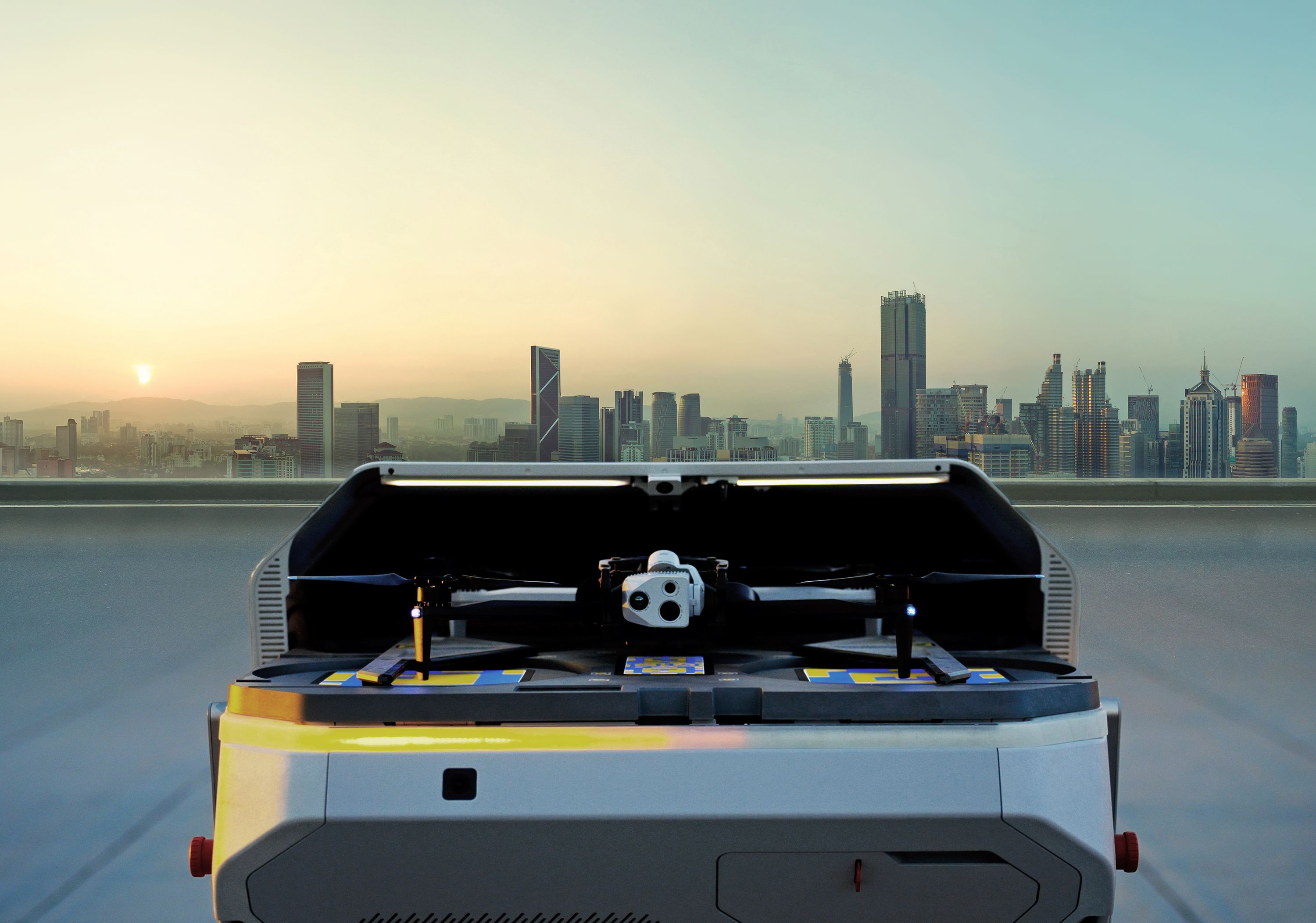
- Um, and just as Brian said, we have agencies right now that
- have beta versions of our docks. That is the, the dock that you see
- here on the screen on the bottom left, which is this awesome powered
- robot that has a weather station and has an ADSB link so it sees
- aircraft and charges and connects the do- the drone to the
- internet that can automatically open and launch that drone, right?
- That home for the drone. We have agencies that are using
- these 24/7 in real life today. Brian mentioned
- Miami. They're one of the agencies.
- Miami Beach is one of the agencies that is doing this.
- And we know that by talking about folks that are in your shoes that
- trust us today, we hope that you see we're trying to do the best
- we
- can to build the end-to-end solution so that you can launch as easily as possible.
- And, and just a little side note here.
- All the stuff that he's been talking about on this slide and the previous slides,
- and the two slides here where it talks about the ecosystem that
- Skydio has put together to provide this, this DFAR
- solution. Um, just keep in mind that
- in San Mateo, California, there's two buildings filled with
- engineers and
- people and marketing and, and sales
- and, uh, HR people that are, that are driving this, you know, making this
- engine go. But what's really cool is you can take a 10-minute drive down the
- street and there's this massive manufacturing facility.
- And man, you walk in there and you just see nothing
- but smiles on their faces,
- building drones, testing drones, evaluating drones, building docks.
- We're building docks right now. We're building...
- We have a whole new warehouse building docks right now.
- So it's just a really good feeling seeing that the ecosystem from
- top to bottom is provided here from the United States and provided, you know,
- we can do that, uh, in California right now, and it's just,
- it's just really,
- really motivating. Sorry, went on a tangent there.
- No, it, it's, it's not a tangent, Brian. I absolutely agree, right?
- When I walk in that factory... You know, I manage all of our resellers, uh, for
- the state and local space for public safety.
- I want every single person that's selling our technology and working with our end
- users in the field to walk through our factory.
- Because on the grand scheme of things, one of the coolest factories in the United
- States. It's building that e- muscle of high-end manufacturing,
- and it's bringing back this robotic manufacturing ecosystem to the United
- States. But on the grand scheme of things, it's small.
- It's a small s- where, uh, factory from a large
- scale industrial manufacturing standpoint, and that means that
- our brand is still small. The more folks that invest in us, that
- trust us, that field the technology, the more engineers
- work on it and the more Americans get jobs building it, and the more
- Americans get jobs training on it.
- That whole ecosystem to me, and, and Brian,
- I think you agree with your comment,
- is super important here.
- Yep.
- Um, right? That's absolutely critical.
- So if we want, let's, let's go to the next slide.
- This one again. Next slide, please.
- And
- all agencies are at different places.
- I think this slide kind of talks to the last 10 years of what we've
- seen, and it speaks to the future of where we're
- going.
- When we started, right? I would go out to an agency
- and I'd pull up in a rental
- car and I'd have a drone in the trunk, and I would take out that drone
- and I would
- teach a police officer who was a collision reconstructionist or a
- SWAT operator, you know, working on a, using a drone for
- overwatch to fly that drone and accomplish a specialized
- mission. And then from there, we saw so
- many folks putting drones in specialized units who started to
- realize that that drone was so useful they wanted to put
- it at the hands of more folks. And so there were agencies like Oklahoma
- City
- Police Department that led the way on a patrol-led model
- where they
- said, "Drones are really special.
- They are force multipliers for our officers.
- They allow us to save money, save time, get the right video at the right place.
- Let's put them in the trunks of cars." So they put them in the trunks of patrol
- cars, and they would have patrol cars roaming
- around the city in each
- of its four quadrants, and every shift there
- were at least four drones that were
- around that city. And that slowly started to increase over time.
- And we saw that, that, you know, agencies are at different standpoints.
- Some agencies like Miami Beach are all the way on the, the third,
- the, the fourth panel here, where they have docks on the rooftop of
- buildings, autonomously flying drones connected to
- the internet
- through 5G, responding to 911 calls that are being flown
- from somebody at a computer terminal in a real time crime center.
- And we also have agencies that are all the way at the beginning,
- just getting
- started with drones, just getting, touching their fingers in here.
- And we want you to know that regardless of where you
- are on the journey, we're here
- to help and here to advise. Um, I mean, Brian, you and I have both
- lived this over the last 10 years.
- What are... What's like the coolest takeaway
- that you've seen as we've developed
- the technology?
- This is one of my favorite slides. It tells such a...
- It's almost like the timeline, uh, of the history of drones like you
- mentioned,
- right? Uh, you know, in this, in this scenario, um, the one in
- the middle is, is my favorite story.
- I mean, the ones on the left and the ones on the right, I could,
- I got stories for
- those two, but my, my, my... As of right now,
- me sitting in this rental car
- in a parking garage, um, uh, the, that one in the middle [laughs]
- is my favorite.
- And that, why is that my favorite? Uh, so an officer,
- uh, was observing a, um, a, a park, uh, where there were
- some individuals. The individuals did what they, uh, were
- thinking they were going to do, so they needed to take these individuals
- into
- custody. Um, the drone pilot, instead of landing the drone
- or instead of calling another officer from a different place over, the,
- the, the, the, the real time crime center individual, um,
- took
- control of the drone. Officer got in his car- Made the stop,
- put the person in custody, put the person in their car, and then the
- entire time the drone was following him down the road
- and monitoring things that
- were going on, monitored the stop.
- Uh, was, was there
- so that when he put him into custody, he grabbed his controller and brought the
- drone back down, and there it was. And that was all in about seven and a half
- minutes. Um, talk about post-mu- force multiplier, right?
- Instead of having to call another officer, instead of having to take more time to
- put the drone away and land it, you just turned over control.
- Um, again, that is my favorite story. That is the middle section.
- The right sections, they're happening today, right?
- We have deployments NYPD, we have deployments Miami Beach, we have
- deployments, um, in, in, in Alaska.
- We have deployments in, uh, in Washington State.
- Redmond, Redmond PD, they're killing it up there. You know,
- there's just...
- There's so many deployments happening right now with Skydio X10s and with Skydio
- Docks that it's hard not to notice that the trend is moving that direction to
- the right side of this slide.
- Yeah, absolutely. We had a couple questions come in.
- How about I address some of these questions, and Brian, you go ahead
- and flip
- to the correct screen so that we can start our live demo.
- So,
- uh, while these qu- uh, just folks, keep putting questions in.
- We'll address them, right?
- Um, so one of the questions here is that we're talking about remote
- piloting. We're talking about all of this remote
- piloting and how
- do agencies deal with line of sight operations
- as required by Part 107. So here at Skydio,
- we have,
- um, so many,
- uh,
- amazing folks that work on our regulatory team.
- Our regulatory team is one of the best in the industry,
- and proof by this is that
- we were able to get the New York City Police Department a complete beyond visual
- line of sight waiver that allows NYPD to fly drones all
- over their jurisdiction without line of sight, without somebody in the loop,
- someone flying from a remote location.
- We do the regulatory work for you. So we'll come into your
- community, we'll let you know where you th-
- what type of waiver we think we can
- get you, and then we will go ahead and we will do the
- regulatory work. We will supply you a document.
- We will teach you what is in that document. You will review
- that document.
- You will certify that you understand that your training, like we
- are gonna ask you,
- what are your training protocols, how are you training your pilots, what
- are your
- current concept of operations? We're gonna put all of that information
- together and allow you to present this to the FAA so that they can award
- you a COA. And given that you're using...
- or a, a certificate of authorization to fly in a
- particular manner.
- That's something that here is, is we're gonna be able to help you get
- those waivers because we are experts in the industry of getting
- waivers.
- And our customers, you're the one applying for the waiver.
- Then once we, you get that waiver, we'll teach you how to fly that
- waiver and utilize by following all of the correct rules.
- Um, we have an upcoming webinar with Jakey sh-
- uh, who's on our team.
- He's on our regulatory team. It's on April 16th.
- We also have other webinars on live.uh, skydio.com.
- And of course, you can have a call with our regulatory
- team to address that and how
- to get those waivers for you. We have the best track record in the
- industry
- of getting waivers. Um-
- I, I actually highly, I actually highly recommend
- if you're a customer now or
- you're thinking about being a customer, get on the phone with them.
- It's, it's education. At the least it's you're being educated,
- right?
- Uh,
- uh, but best case scenario, you're gonna learn some really cool stuff
- about your
- airspace and how to,
- how to use, uh, drones in that airspace.
- It's, it's a, it's, they're, they're an amazing team.
- And, uh, make sure you get, check out that webinar.
- I don't know if we can drop a link in here to the people here, but definitely check
- out, um, Jakey and team when they do this webinar in, uh, in, in
- a couple days or weeks.
- Yeah. Um, so with that, I'm just gonna quickly address
- one more question and then Brian's gonna hop into a live
- demo.
- So does Skydio help with the wording of the BVLOS COA
- application? Yes, we do help with that.
- So let's, just like I said, reach out to us and we'll help you with
- that.
- Um, we had another question about Canada. Absolutely.
- I've been to Canada a couple times this year.
- Um, we've been helping agencies in Canada
- stand up DFR programs, and we have two
- fantastic, uh, partners that we do business with, uh, to serve end
- customers in Canada. So please feel free to reach out to us
- about that.
- And with that, I think, Brian, you're sharing your screen.
- You're in the DFR command platform,
- and show us what's in here. This is the, this is the software
- platform that somebody sitting in a real-time crime center or a drone
- pilot sitting on a laptop in a rental car somewhere connected to the internet
- through a hotspot is able to effectively fly a drone somewhere in the real
- world.
- Yeah, no, seriously. I am in a rental car in a parking garage
- after
- completing, uh, finishing up a demo.
- Um, I'm sitting here, I'm connected.
- I've got my, I've got my Live View device, right? I've got my internet.
- So I'm, I'm gonna go ahead and, uh, go into Skydio Cloud here, you know,
- real quick. You know, this is where you can get your reports,
- your summaries.
- You can store data, you can create pre-planned missions.
- You can do integrations with third parties.
- A lot of things you can do in here.
- That could be a whole webinar in itself if you guys want it to be.
- So what I'm gonna do is I'm gonna come in here
- and I'm gonna select one of our
- docks. Select Beehive 033. So you can see here the map
- came in,
- and just to, you know, so if nobody thinks I'm cheating here, um,
- that's our
- headquarters, and this is San Mateo, California.
- Um, you can see here, um, there's, there's, you know, San Francisco Airport.
- We have a nationwide waiver to be able to do what I'm about to do.
- We do have a, a very small area to fly in, and you'll see that here in a second
- where we have a geo-fence. Um, you also have down here on this side,
- you have all
- of my flights that, all the flights that have been done from this dock.
- I even have a camera here that tells, shows me that it's clear, clear to
- fly. Nobody's standing in front of my dock
- here.
- So what I'm gonna do now is I'm gonna select Fly Now.
- What you're gonna see here is you're gonna see the camera image here.
- Over here is my map, and you can see that there are ...
- There is a geo-fence with a no-fly zone that we have here.
- Uh, so what I'm gonna do here is I'm going to, um, quickly put
- in some simulated 911 calls so we can see
- that. One second. [clears throat]
- Once this comes up, on the left-hand side you're gonna see a
- list, a listing of
- what we call custom markers, and then I'll scroll down to show you a
- listing of simulated 911 calls. Um, [clears throat] you
- see here on this side you have simulated ... Or not simulated.
- Those are custom markers. But if I come down here, there's actually
- nine
- integrated, uh, uh, simulated 911 calls.
- And when I say simulated, I mean we have integrations with CAD
- 911 dispatch systems that can come right into here so you can
- see the calls right
- on there. So I'm gonna go ahead and launch the drone.
- Scroll in on my map here.
- [clears throat] As the drone launches, it looks down at the dock saying goodbye.
- Uh, the camera's then gonna tilt up and I can take control.
- When I can take control, I'm using my mouse pad on my keyboard to
- fly here, and you can see I'm flying around, uh,
- turning the drone.
- I'm gonna go ahead ascend to 200 feet.
- And then, hey, here. We got a call that came in, so let's go ahead
- and go to this
- call here. Um,
- looks like it's a crime in progress, so respond to incident.
- I hit that. I'm gonna get this out of the way so you
- can see what's going on.
- You can see a big blue marker on the sky there, right?
- So I can actually move the drone camera around while the drone still travels
- there. So if this was an in-progress incident, you may,
- might, might wanna
- look around to see if anybody's leaving the scene or whatnot,
- or you can just fly
- right there autonomously. Uh, once it comes there, um,
- it'll get there, and then it will stop, and you can take full control of the
- drone.
- So as we were saying earlier, you know, traditionally, um,
- you know, DFR drones have been a top-down,
- top-down type, uh, uh, performance.
- You know, they're g- they get on scene, they look down, they look for things, they
- use a thermal camera. Very, very, very positive, uh,
- results have come from these, from these programs. We're moving along,
- right?
- Technology is getting a little bit better.
- Uh, looks like we got some people on the roof
- there.
- Um, technology's getting a little bit better,
- so I'm gonna come down and I'm gonna
- look at this parking garage. I know you've seen the video a few times,
- but maybe
- you were thinking, "Oh, they probably doctored that up
- and didn't r- actually do
- that." So let's go ahead and fly in, fly into this parking garage here
- and see if
- we see anything.
- And just to set the sa- stage here while Brian's flying, right, we
- have the ability with our open APIs to have any CAD
- RMS system, um, send in
- markers to, uh ... So and we also have the ability on
- our DFR Command software here to have Axon body cameras show up
- so that you can fly to that point. You can fly to that
- location. So here ... And, and I just, I just want
- folks to know that we wanna have an open architecture that, that partners with the
- systems that you have so your 911 calls can come in directly.
- And now, I think Brian did something kinda cool.
- If you're on your computer screen at home, please go ahead and click the screen.
- And not click the screen, sorry. Take a picture with your
- cellphone of the QR code on the screen.
- And then you can watch it live on your phone.
- This ... Exactly. It's called a Ready Link.
- Okay. Brian, sorry. Go ahead.
- No, that's fine.
- We'll give folks like-
- That's fine. I'm, I'm giving a second to do that, uh,
- because this is super, this
- is super powerful. I think the first time it really clicked
- in is when
- I was [laughs] doing a, another training session with Ungod
- and he had
- some 40 or 50 people across the country, I think even some in Canada.
- And I sh- we get them the Ready Link, and you had all 40 or 50 people
- watching what I was doing in Florida on their cellphones. It was pretty wild.
- So I, I'm gonna come out of that, but you can see now the thermal camera
- is picking
- up, uh, Slim Shady in here underneath the garage.
- And okay, let's go maybe get a closer look.
- Go ahead and take the drone inside the garage here.
- [clears throat] And there he is, you know?
- I mean, obviously if, you know, depending on the risk, you would wanna,
- you would
- want to, uh, you know, make sure that you're, you know, taking the right
- precautions. But you can see that I'm inside the garage.
- Uh, I can even go and say, you know, maybe I'm, I'm flying
- and s- I spill my coffee, and I look down, and I don't see this pole.
- Oh, that's great, because Skydio technology takes me around
- it.
- They don't let me crash into it. So now [clears throat]
- I'm gonna come back out.
- Get out in, into the open here. And now that I'm done, I'm gonna go
- ahead and hit return home,
- and the drone's autonomously gonna fly back to the dock and land on the dock and
- start uploading data, start charging the battery,
- and get ready for its next
- mission. I only used,
- I only used ... What did I u- I don't know what the battery was at
- when I started
- this flight,
- but I'm at 82-
- It was at 96.
- Yeah, I'm at 82% now. It was at 96%, right?
- So I'm, uh, you know, I, it's a pretty good-
- Yeah, 92.
- Yeah, it's a pretty good, uh, pretty good flight where I
- was able to get in there,
- find Slim Shady, uh, notify the people on scene, give
- them a Ready Link, and then I still have 81% on my battery.
- So I'm ready to do another mission, right?
- Although I do have a hive of docks up here.
- So if another call came in, you're able to send out another drone,
- right?
- So having one dock in one location that can fly really far and go up
- really high and have big cameras, that's great.
- But what happens when the second call comes in?
- What happens when the third call comes in?
- How are y- how is your DFR program gonna handle that?
- And how are you gonna handle being on scene for a long time?
- You know, are you just gonna have that one drone?
- A lot of different options.
- With LTE on board the drone, you're able to do so
- many things, uh, w- with such, such little resources.
- And I will conclude my demo
- Imagine
- almost anyone can do that, right? Anyone that can send a text message can
- effectively fly a drone through a computer terminal and respond to
- 911 calls. This allows all of the folks that
- are dispatchers
- or, uh, you know... Sorry, dispatchers
- or, you know, live duty individuals, light duty individuals, you can
- cross-train them to be your drone pilots.
- And then your officers now have buddies that are showing up in the field to make
- sure that they're giving you the right information at the right time.
- We want everyone to know that we'll come out to your agency to show
- you this
- technology. We will invite you to speak with reference
- customers that
- have our docks so that you can go and see and h-
- see how they're implementing
- drones and implementing Drone First Responder into their
- workflow. Um, I think that's really important.
- We have another webinar coming up.
- As I stated earlier, the information's in the chat for you to
- learn more about how
- we're getting the regulatory service waivers across the line and allowing
- agencies to effectively fly this technology in the field.
- Um, we also want you to know that in the chat there's a March 20th
- webinar where we're gonna be... We call it a deminar because the entire
- webinar is just a live demo of the technology.
- Um, and that's also super important.
- So with that, I just want to say, once again, thank you so much to
- everyone for coming on. We have two more questions
- that came in. Because I think we have two minutes,
- I'm just gonna go ahead and
- address those now. And one of the questions is: "Do batteries
- have to be manually changed out, or does the dock have
- a system that charges the batteries?"
- The dock charges the batteries. And, uh, Brian, if you just...
- You were speaking to it momentarily there, but can you speak to battery charging
- and speak to, um,
- uh, the hive concept really quickly?
- Absolutely. Um, you know, we don't...
- We just didn't start docks
- last year or this year. You know, we had...
- We, we launched the dock at our Ascend, uh, user
- conference, um, back in September of last year.
- But we've been doing docks for a while now, right? We've had our X2 dock.
- Uh, it had its, it had its, it- its limitations. We knew that.
- We worked with it. But you know what we did?
- We did over a half a million flights with those things, and those half a
- million flights gave us data, gave us information on what
- the best possible solution could be for this type of, uh, use case,
- right? So swapping out batteries, um, maybe, but,
- you know, that's a lot of moving parts.
- That's a lot of, that's a lot of, a lot of things that could potentially,
- you know,
- not, not p- you know, work. So charging the battery, as you just saw,
- I used about 12 to 14% on a call-out where I was able to
- identify the individual, I was able to identify the risk before
- sending an
- officer, I was able to share my video feed,
- and we were back with
- 81%. That drone could have gone on another
- call.
- But the hive concept is where we, we believe is the best solution for,
- for public safety, right? So we take your call for service analysis.
- We take, we take the amount of times you have to go
- out to,
- to 6th Ave and, and Smith Street. We understand that, right?
- We get that information. We run an algorithm that our really,
- really smart founder
- put together [laughs] and he, you know...
- We understand where you need to send your drones, so we put the hives there,
- right? And maybe you're doing a hybrid approach.
- Maybe you're doing a, a hybrid approach with docks
- and a patrol LED, right?
- So what do you have in your patrol LED cars? You have batteries.
- So if you need to stay on scene on a, on a call-out that's at the end of your
- flight area, land the drone, change out the battery,
- and the remote pilot takes
- back control. There's a lot of solutions to this,
- you know, this question.
- And, but I think what we did is we did a lot of testing,
- a lot of evaluating, a
- lot of engineering, and we found this to be the best solution,
- and we hope that,
- you know, you can get out and see this, right?
- If you want to go to Miami Beach and go s- and go see it, go see it.
- You know, there's a bunch of other places too.
- Go see the technology for yourself.
- Touch it, feel it, fly it, and get to know it because it's, it's,
- it's a
- really, really good product that's, that's really making, um,
- some agencies very
- successful.
- I think that's it, right?
- Absolutely, Brian. Yeah.
- Thank you so much for everyone, uh, for listening and for joining in. Right.
- Absolutely.
- Please call us.
- Yes.
- Send us your, uh, send us the data. Send us the calls for service
- data. Let us show you how fast we can respond to
- your top priority calls. Tell us what your problems are
- and what your
- goals are from an executive policing level, and let us
- help you solve that. That's what we're here for.
- That's what we're pretty passionate about, right?
- I think I've been dreaming about drones autonomously flying across the sky
- and fighting crime for 10 years. And
- in the beginning of this, 10 years ago, 50% of flying drones was just
- getting it to turn on and connect. And today we can...
- Yeah, U- Brian's chuckling. How many hours did we spend at demos being
- like, "Oh,
- uh, we gotta recalibrate this thing"?
- Stand- standing, standing there-
- And now you-
- ... and like the hand, the shifting hands
- and [laughs] to get it to connect.
- Yeah. [laughs]
- Yeah. I've been there, done that.
- And now Brian's sitting on a hotspot in a rental car on a
- laptop autonomously commanding a drone.
- That means that a drone pilot can be at home if a call comes in in the
- middle of the night, or they can be in the real-time crime
- center
- and they can respond to those incidents.
- So thank you so much for joining us.
- Please go ahead, send us an email, join another webinar,
- ask us to come out to your agency and show you this stuff.
- Ask us to connect you to other folks that wanna tell you about what they're
- doing
- in the field. That's what we're here for. And thank you so much.
- I really appreciate all of you. Thanks for serving your communities
- and keeping
- members of my family safe.
- Take care, all.
Watch Time
1 Hr 1 Min 31 Sec