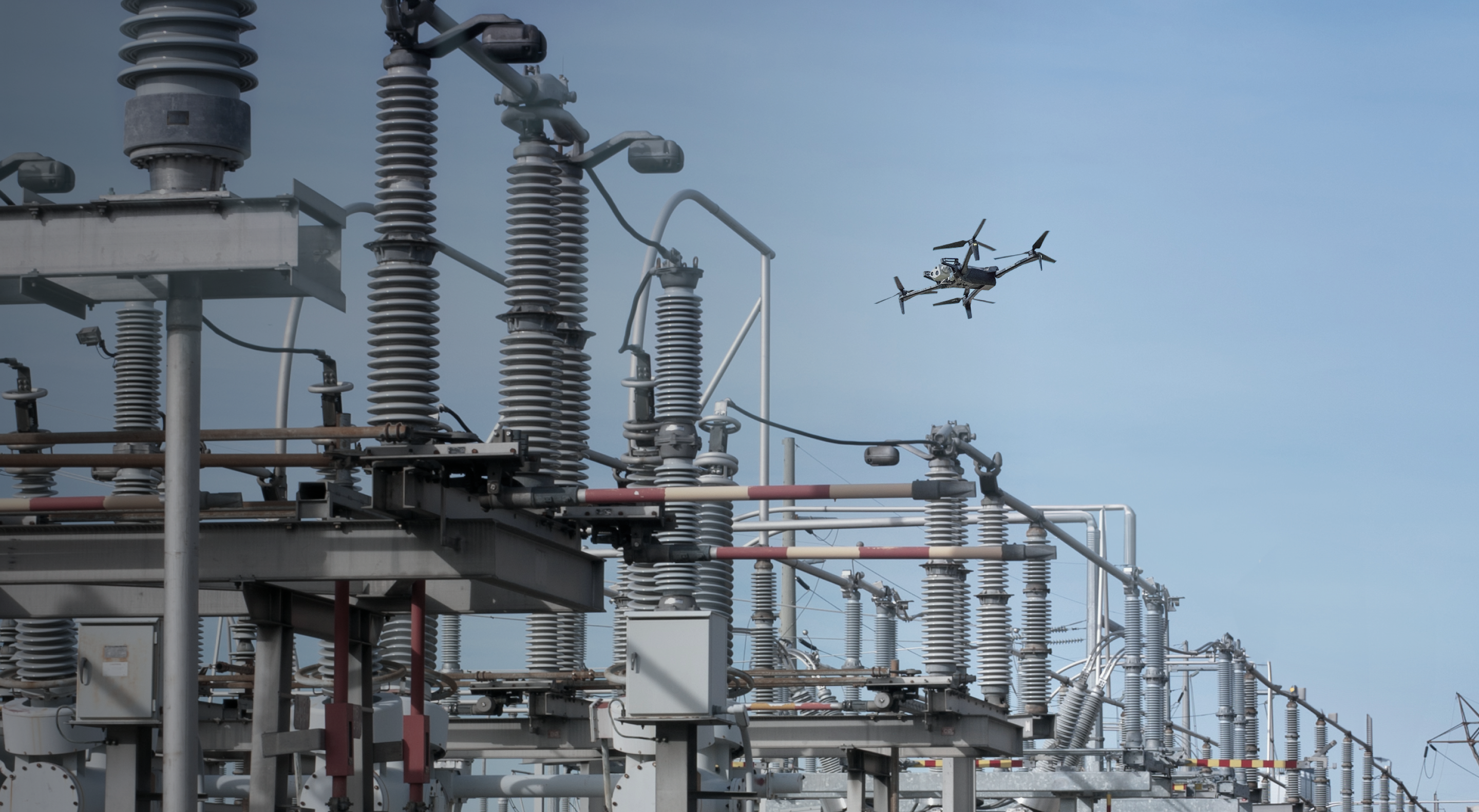

Skydio CEO discusses future of autonomous drones and U.S. security before Congress
Watch Skydio CEO Adam Bry testify before the Congress on the importance of autonomous drones and the need to protect national security and technological leadership.
- [bangs gavel] The select committee will come to order.
- During the Second World War,
- America was called the arsenal of democracy.
- While our brave soldiers fought on the front lines, millions of men and women
- labored on the assembly lines to bury the Axis
- under a storm of steel.
- Today, the Chinese Communist Party aspires to be
- common arsenal of de-
- autocracy, repressing a billion people at home
- and providing authoritarian regimes with the means to wage
- aggression abroad.
- To do so, the CCP seeks to control the key
- technologies and
- sectors that will determine future conflicts.
- We are looking in detail today at three of these: chips,
- ships, and drones.
- Chips, or semiconductors, power everything from the guidance
- system on missiles to satellites, mobile phones,
- computers, and cars. Ships transport cargo
- around the world and form the navies that can blockade global supply
- lines or enable invasions.
- This includes the risk to Taiwan,
- which would cut off the foundries that produce virtually the entire
- world's supply of advanced
- semiconductors. Unmanned aerial vehicles, UAVs,
- or drones, will play a key role in the future of
- civilian and military air power. In all three,
- America's industrial capacity has waned while China has gained
- dominance, or is in the process of beca-
- gaining dominance over each. China added more legacy
- semiconductor manufacturing capacity in twenty twenty-four than
- the rest of the world combined, and that capacity is
- expected to grow by a further thirteen percent this year alone.
- With eighteen new fabricators set to begin operations,
- [clears throat] the CCP announced a further forty-seven point five
- billion in subsidies in May. [clears throat]
- Today, the US accounts for one-tenth of one
- percent of global
- shipbuilding, while Chinese shipyards, with nearly twenty percent of their
- operating costs subsidized by Beijing, accounts for
- fifty-four percent.
- DJI, a Chinese firm, controls roughly eighty
- percent of the US commercial drone market.
- To be clear, our concerns with DJI and PRC
- control of the drone ecosystem are not about the
- competitiveness of American companies.
- Rather, congressional concern stems from the
- PRC having hundreds of thousands of
- spy balloon equivalents operating daily across our nation,
- not only jeopardizing our homeland, but giving the PRC
- a dominant position in an industry that is already playing a key
- role on the front line of modern warfare.
- Across each of these sectors, the CCP, CCP
- playbook is simple and straightforward. It's consistent.
- Using a combination of [clears throat] illegal subsidies,
- hardball tactics, IP theft, and forced labor,
- the party gains a stranglehold over the world's most important
- supply chains.
- From Huawei to E- SMIC, YMTC,
- DJI, and beyond, it's the same play every time.
- In fa- in fact, we call it the Huawei playbook.
- Pick a national champion in a strategic industry.
- Subsidize. Employ predatory pricing to offer its
- products at a massive anti-competitive price point.
- Expand globally. Drive out the competition.
- Then leverage newfound dependencies to advance
- CCP interests. Like a football team running the triple
- option, it's an effective play, and it can be hard to defend,
- but once you see the pattern, you can understand how to defeat it.
- We need to install market access barriers in strategic sectors to
- prevent malign PRC companies from taking over our domestic
- economy. We need to leverage and build upon crucial
- authorities to ensure the security of data and communications
- across our country. We need to cut off access to the US
- technology and capital that helps fuel PRC national
- champions in critical sectors, and we need to coordinate with our
- allies to encourage them to mirror these steps.
- Fortunately, there are those of us who have been watching the
- tape of similar games
- that threaten similar outcomes.
- Semiconductors were an American invention.
- The Soviets copied us. Others underpriced us.
- There were times when observers counted America out.
- But as Chris Miller, who is here with us today,
- has observed and documented in his exceptional book, Chip War,
- "No one has ever been rewarded for betting against
- America."
- We are joined today by Adam Bry, the founder and CEO of Skydio,
- an American drone manufacturer. American-made technology
- is safer, higher quality, and does not come with
- links to a totalitarian regime.
- I look forward to hearing Adam's perspective on competing with the CCP's
- economic warfare.
- We are also joined by Scott Paul from the Alliance for American
- Manufacturing. Scott has seen the CCP decimate the
- American manufacturing sector, and nowhere is this more
- costly for our nation than in our shipyards.
- The CCP is producing ships at a rate we couldn't dream of here.
- Though they're made using cheap steel and shoddy market practices, the
- People's Liberation Army Navy represents a
- grave threat to the US and our allies.
- Our national task is clear. We need to revitalize our domestic
- industries and those of our allies, so we can become an
- arsenal of democracy once again. We must ensure a
- reliable domestic supply of semiconductors outside the reach of the
- CCP, rebuilding our shipbuilding,
- and clear our skies of Chinese-made drones.
- With that, I turn the floor over to the ranking
- member.
- Thank you, Mr. Chair,
- uh, and thank you to the witnesses. Thank you to the audience for attending.
- Uh, Made in China twenty twenty five was a plan to ensure China
- took the lead in key industries, including, among others, ships,
- chips, and drones by the year twenty twenty five.
- That's next year, by the way.
- The CCP set global market share targets in each sector.
- In shipbuilding, for e- example, they set a target to control half
- the global market by next year, which they've already
- surpassed. This wasn't by accident.
- Xi Jinping has called for heightened restrictions on foreign products
- sold in China while trying to, quote,
- "tighten international dependence on China."
- How do they do this? They heavily fund the production of goods
- far
- in excess of what their internal demand requires and then export the
- surplus to other countries at prices designed to undercut the
- competition.
- This Chinese practice creates overcapacity, and it makes
- it nearly impossible for the rest of the world to compete.
- Thus, the Chinese monopolize markets.
- History shows us what happens if we do not respond forcefully.
- Consider what happened to our glass and steel industries.
- Between twenty oh four and twenty oh eight, the CCP gave
- glassmakers thirty billion dollars in subsidies,
- including discounted energy and soda ash, the
- key ingredients to making glass.
- This led to a sevenfold surge in exports by twenty oh seven.
- As a result, in seven years, in those seven years,
- America lost forty thousand jobs in the glass industry.
- And then there's steel.
- China produces almost one hundred and eight percent of its
- domestic demand for steel. That eight percent
- surplus may not sound like a lot, but it's
- equivalent to what the US produces in an
- entire year.
- And China produces steel at prices forty percent lower than what US
- steelmakers charge. It's no surprise why.
- China's largest steelmaker, known as Baowu, is owned
- by the government and, just like those glassmakers, gets cheap
- financing and subsidies for coal.
- China is now the world's largest steelmaker by
- far,
- producing more than twelve times the amount of steel that America
- produces in a single year.
- We can't let history repeat itself, but in some cases, unfortunately,
- we are. Take ships. In nineteen
- seventy-five, we were the world's number one shipbuilder.
- Now, we don't even produce one percent of the
- world's
- large oceangoing vessels. For every three hundred and
- fifty-nine large container ships China builds, we are
- building one. That is not a typo.
- We are building one
- container ship for every three hundred and fifty-nine the Chinese are
- building each year.
- Or take drones.
- As this chart shows,
- China currently controls a whopping ninety
- percent of the US drone market.
- So what do we do about it? Here's a brief analogy.
- In a few weeks, athletes from around the world will gather
- for the
- Olympics.
- Some athletes win by breaking the rules, but others win through
- investing in themselves and becoming the best at their sport.
- It's the difference between a rigged game and a fair
- competition. It turns out that outcompeting the CCP
- isn't all that different.
- Because the CCP is not currently playing fair,
- we need to do two things. One, we need to stop the CCP
- from breaking the rules, and two, we have to invest in
- ourselves to win.
- First, we stop the CCP through trade enforcement.
- For example, USTR recently launched a Section three oh
- one
- investigation into the CCP's unfair
- shipbuilding practices, including investigating the
- overcapacity issue we discussed earlier.
- But then it's on us to win the gold. We do this
- by making smart investments. For example, the CHIPS Act.
- The CHIPS Act has led to a surge in new chip factories
- being announced. And unlike the CCP, which favors its
- own Chinese state-owned enterprises, America is building
- these chip factories in partnership with others.
- Just look at TSMC's investments in Arizona
- or Samsung's investments in Texas.
- Korean and Taiwanese companies are
- creating American jobs.
- But it's time to consider what else needs to be done in other industries.
- We can win the gold, but we need to do the
- work to win the gold.
- Thank you, Mr. Chair. I look forward to hearing our witnesses,
- and I
- yield the balance of my time.
- Thank you, ranking member. And if any other member wishes to
- submit a statement for the record, without objection,
- those statements will be
- added to the record.
- Our first witness is Mr. Adam Bry. As founder and
- CEO of Skydio, an American drone manufacturer, Mr.
- Bry heads a leading consumer and commercial
- technology company of national security importance. Welcome.
- Our second witness is Dr. Chris Miller.
- Currently an associate professor of international history at Tufts
- University, Dr. Miller's research focuses on the
- intersection of technology, geopolitics, and economics.
- Welcome.
- And finally, we are joined by Mr. Scott Paul. Mr.
- Paul serves as the president of the Alliance of American Manufacturing, a
- partnership between major US manufacturers and the United
- Steelworkers Union.
- With that, I wanna welcome all three witnesses
- and thank them for being here.
- Uh, Mr. Brie, you are now recognized for your opening
- remarks.
- Thank you. [clears throat] Chairman Mulvaney,
- Ranking Member
- Krishnamoorthi, and members of the committee,
- it's an honor to be here with you
- today.
- We're having this discussion at a critical moment for the drone industry and an
- inflection point in artificial intelligence.
- And as I'm sure we'll discuss, both of these technologies
- are increasingly
- at the center of our national security and our competition with China.
- I think autonomous drones are critical for two reasons.
- One, they are becoming critical tools for many
- of our most critical
- industries. And two, they represent the competitive playing
- field for leadership in AI robots in general,
- and for leadership in the next century of aviation.
- Now, since it bears on the discussion we might
- have, I'd like to be clear upfront
- that if I'm an expert in anything, it's drones and AI, uh, not China
- and geopolitical competition.
- My passion for aviation, uh, came from my grand-grandfather,
- who served as a crew
- chief in the US Army Air Force during World War II, keeping B-17
- bombers in the air over Europe. And I grew up flying radio-controlled
- airplanes,
- which were the predecessors to drones.
- As a grad student in the computer science, uh, and artificial intelligence lab at
- MIT, I really became obsessed with trying to
- build AI software that
- could fly these systems better than the best human pilots.
- And when we founded Skydio, we started with a big bet on AI.
- We essentially build the skills of an expert pilot into the drone so that it can
- fly itself. And we did this because we felt like
- that was going to be the key to
- making these products more useful to more people in more
- places. Uh, we're now the, the largest US drone
- manufacturer and world leader in autonomous flight.
- Our products are used to inspect the energy grid.
- They're used to ensure the integrity of our bridges and our transportation
- infrastructure. They're used to deescalate the most
- dangerous situations
- in public safety with minimal use of force,
- and they're used to give our soldiers
- better situational awareness on the battlefield.
- Now, competition with China plays out in every
- sector that we serve, but I think the military use of drones
- and the
- use of drones in Ukraine is instructive.
- I actually had the chance to visit Ukraine, meet with many of their drone
- operators, uh, and they don't do anything without putting
- a drone in the air.
- They use drones to deliver strikes.
- They use drones to surveil the battlefield.
- Uh, they use drones to inspect buildings
- that have been damaged to document
- Russian war crimes.
- Um, Skydio has delivered over a thousand
- drones to Ukraine, but our
- Chinese competitors have delivered over a hundred thousand systems.
- Now, the, the Ukrainian dependence on Chinese drones
- is
- extremely fragile. These are fundamentally a hostile
- platform. They have to hack them to stop them from
- giving away their
- position to the Russian adversaries, and the Chinese are increasingly using
- export controls to restrict the flow of drones into
- Ukraine. Um, now our latest generation drone,
- the Skydio X10, which we have here
- today, uh, has some real breakthroughs in AI
- that make it much
- more resistant to Russian electronic warfare.
- Uh, and the Ukrainians have requested
- thousands of these systems for use on the
- front lines and elsewhere.
- Uh, before we move on to questions, I'd like to leave you with
- two, uh, two big ideas, two key thoughts.
- One is that as important as drones are today, the technology is
- really still in its infancy, and it's be kinda-- gonna become far more
- important over time. It's really gonna become, I think, bedrock
- infrastructure for many of our critical industries, responding to nine one one
- calls in automatically in seconds, well ahead of, of how quickly responding
- officers on the ground can get there, persistently inspecting the energy,
- energy grid in an automated fashion to keep the lights on.
- Uh, and I think it would be really insane to
- accept a future where we're
- dependent on our adversaries for technology this critical.
- But I think the second really important idea is that US companies can compete and
- win.
- I think Skydio is proof of this. Uh, the shift to AI and the
- increasing importance of software on these devices plays to our strengths,
- and we're also fortunate now to have an increasingly strong group of US
- peer companies doing everything from tactical SWAT drones to drone
- delivery. Uh, and I'm a hundred percent confident
- that as an industry, as a
- US industry, we can meet the need and the opportunity.
- And I think you all have an opportunity to help support this and ensure that the
- future of this industry is built based on US-made drones.
- And the path to do that comes through supporting end users in
- public safety and
- critical, critical infrastructure operators.
- I think also scaling our own military's use of drones to reflect the reality
- of the modern battlefield, what we're seeing in Ukraine.
- Uh, and then I think the, the most pressing opportunity
- and the most pressing need
- is to supply US-made drones where they're needed most on the battlefield in
- Ukraine. Thank you.
- Thank you very much. Uh, Dr. Miller, uh, you may proceed.
- Mr. Chairman, Mr. Ranking Member, uh, members of the committee,
- thank you for the
- opportunity to testify, uh, for you today.
- Over the past, uh, several years, the United States, as well as allies,
- have taken
- a series of steps in the sphere of advanced semiconductors to
- ensure US technological leadership and to guarantee that
- advanced technologies are not falling into the hands of
- adversaries, and in
- particular, the People's Republic of China.
- What I'd like to do today is focus our attention not on the most
- advanced chips,
- important as that issue is, but rather on the foundational
- semiconductors
- that enable almost every other segment of modern economy.
- Now, as the phrase foundational semiconductors
- suggests, modern economies
- are the technological foundation of contemporary industries.
- Almost every sector of the US economy today only
- functions because it has access to not just dozens, but often hundreds of
- thousands of foundational semiconductors per system Whether it's
- toys or tractors, whether it's ships or drones, uh, whether it's military
- systems or automobiles, we rely on more and more foundational
- chips to
- undertake absolutely critical functions.
- If you think about a modern car, for example, it could have a thousand
- semiconductors inside, and almost all of those
- are foundational chips, chips
- that don't use the most advanced manufacturing technologies, but
- nevertheless provide critical functions.
- Moving your window up and down, that's a function provided by a
- foundational
- semiconductor. Moving windshield wipers back and forth,
- that
- too is a foundational chip. Deploying the airbag in case of an
- accident, you
- need a chip for that. Managing the automatic braking system
- requires
- multiple foundational semiconductors.
- And so just in the automobile industry alone, we've got an extraordinary reliance
- on foundational chips, and autos aren't unique.
- In fact, we put more and more chips in more
- and more types of products
- almost every single year.
- Today, most of the world's advanced chips, as well as most of the world's
- foundational chips, are produced in either the United States
- or in allied or
- partner countries. When it comes to the foundational segment,
- the United States is
- a major producer of foundational chips, with very efficient and profitable
- firms producing in an economic manner.
- Our allies like Japan, European countries, Korea, Taiwan,
- Singapore, and others are major producional, uh,
- producers of foundational chips as
- well, and they've been reliable suppliers to US
- industry, uh, for some time.
- But if you look at investment trends now in the industry, focusing in
- particular on the foundational segment of the chip industry, the biggest investor
- by far is the People's Republic of China.
- And the investment is coming partly from, uh, ostensibly private sector firms,
- but largely from the Chinese government, which has poured billions and
- billions of dollars, far more than the United States has
- invested, far more than
- any other country is investing, into its chip industry,
- with a focus in part on
- advanced chips. But actually, if you trace the dollars invested, even
- more are going into foundational chipmaking facilities.
- If you project current trends forward, China is poised to see its share of the
- foundational chip market increase dramatically.
- And some of these chips will be sold into Chinese markets, but many will be sold
- into Western markets unless policy changes.
- And this, I think, presents two main risks for the United
- States, for our economic
- security, as well as for the manufacturing base.
- The first risk, which we're already seeing today, is
- that Western firms,
- including US firms, will invest less because they're fearful
- of
- their ability to produce profitably in the market if Chinese firms are investing in
- non-economic matters. And the reality is, we already see evidence that
- investors in US firms are advocating that CEOs spend
- less on capital investment in the United States because they're fearful that
- investment will not be profitable because Chinese firms are producing in
- non-economic matters. It's already happening today,
- and I think that makes the
- case for acting today to address this challenge.
- The second risk is that if we don't act, then we become more reliant on
- foundational semiconductors that are sourced from China.
- This puts our economic security and our national security at risk.
- I haven't yet mentioned the role of foundational chips in military systems,
- but
- military systems are just as dependent on foundational semiconductors as the
- rest of the economy. And moreover, we've seen China already use
- export controls as a means of developing coercive tools
- against the United States and its adversaries.
- Uh, China, uh, uh, and our allies, excuse me.
- Uh, China's already deploying export controls
- in semiconductor materials like
- gallium and germanium, trying to harm the ability of US firms
- and allied
- firms to produce the volumes that we need.
- And it's not at all difficult to imagine in the sphere of foundational
- semiconductors Chinese, uh, firms doing the same,
- restricting access to US
- manufacturers' ability to source the chips that they need.
- If we become more reliant on Chinese-made chips, this risk
- only increases. And I'll just, as a final point, highlight the supply
- chain shortages of the pandemic to illustrate the cost of losing
- access to foundational chips. During the pandemic, supply chain issues
- caused relatively small shortages of foundational chips that
- created hundreds of billions of dollars of economic damage
- because cars and tractors and hearing aids and medical devices
- couldn't be
- produced at sufficient quantities.
- This is a severe risk, I think. It's already present now in the decisions
- of
- investment, uh, of US firms' investment, uh, in the United States and in allied
- countries, and it's going to get more severe
- if we become more re- more reliant on
- foundational semiconductors produced in China.
- Thank you for the opportunity to testify, and I look forward to your questions.
- Thank you. Uh, Mr. Paul, uh, the floor is yours.
- Thank you, Chairman Molenaar, Ranking Member Krishnamoorthi,
- and members of the
- Select Committee. I appreciate the opportunity to testify at
- today's hearing.
- As I stated at the Select Committee's inaugural hearing on February
- 28th, 2023, the economic policies of the
- CCP represent a clear and present danger to the
- American worker, our innovation base, and our national security.
- To help illustrate these dangers, our June 2024
- report entitled Shockwaves reminds us of great
- American industries like gra- glass, paper, and tires that
- have been decimated because of China's massive industrial overcapacity.
- Relevant to today's hearing, we are now clearly seeing other critical
- sectors, ranging from shipbuilding to
- semiconductors and drones,
- that are at risk of a China shock 2.0, a deluge
- of low-cost import competition that could again close tens of
- thousands of US factories and lay off millions of US
- manufacturing workers. Existing policy measures are not
- enough to address the CCP's predatory market distortions,
- so we urge your attention to the report's rec- comprehensive set of policy
- recommendations to ensure American industry can
- compete and win in the twenty-first century.
- Today, I am here to focus primarily on China's
- maritime logistics and shipbuilding policies.
- Our nation has fallen frighteningly behind China as a result
- of decades of CC- CCP policies aimed at
- dominating sectors like shipbuilding with clear economic
- and military applications.
- From our earliest days as a nation, the United States has sought to develop
- and
- maintain a robust shipbuilding capability to keep our
- nation safe, to project our strength, and to grow our
- trade.
- The maritime strength of the United States helped to boost prosperity
- across the globe and support well-paying jobs here
- at home.
- But in the 21st century, the People's Republic of China's approach
- to bolstering
- its own domestic shipbuilding capabilities threatens this
- prosperity, as well as the remaining shipbuilding jobs
- in
- the United States.
- Today, China controls over half the world's
- shipbuilding and began
- construction on nearly 1,800 large ocean-going
- vessels in 2022.
- During the same year, the US began construction on just five
- such vessels.
- A briefing slide by the US Navy reveals that China's shipbuilding cap-
- capacity is 232 times greater than our
- own.
- This has significant implications for our national security.
- The US Merchant Marine currently consists of about
- 175 vessels that are 30 years old
- on average. This aging fleet, coupled with our dependence on
- foreign shipbuilders, puts our broader supply chain at
- risk.
- Investing in our domestic commercial fleet, and in manufacturing more
- broadly, would help to shore up our economic
- security
- and bolster our naval and national security
- capabilities. But to do this, we must first respond to
- China's policies.
- The largest obstacles to shipbuilding in the United States are the unfair
- trade practices of China.
- While no nation should be faulted for seeking to develop maritime
- capabilities, Beijing's ambitions go well beyond that.
- China's shipbuilding capacity has been turbocharged through a series of
- efforts aligned with five-year plans dating back more
- than two decades. Some of the support for Chinese industry
- identified in the Section 301 petition
- include policy loans from state-owned banks, equity
- infusions of debt for equity squa- sw- swaps, the provision of
- steel plate from state-owned steel producers at below-market
- prices, tax preferences, grants, and financing from
- China's state-owned export credit agencies.
- Shipbuilding was identified as a pillar industry in the Made in
- China 2025 scheme. Beijing sought
- nothing short of dominating global commerce.
- There are also valid concerns about foreign capital and
- technology flowing into Chinese dual-use shipyards.
- China sought this transfer of technology, sometimes through
- means that are unfair or u- illegal, such as intellectual
- property theft, to help bolster its naval buildup, a goal
- laid out in the 13th national five-year plan of
- 2016.
- Things are so bad today in our country that our own navy must
- rely on Chinese-made dry docks in certain circumstances.
- The practices I referenced have allowed China to capture a massive portion of
- global shipbuilding orders, with April-- with reports indicating that
- China secured 76% of such orders
- globally in April 2024 alone. This
- dominant in the market continues to have detrimental effect on
- shipbuilders in other countries, including in the United
- States.
- Any hope of rebuilding these strategically significant sectors require
- decisive action. For all these reasons, AAM
- strongly supports the ongoing USTR Section 301
- investigation into China's maritime logistics and shipbuilding
- sector.
- This effort merits your support because there are direct and indirect
- connect- connections to shipbuilding in every
- state.
- We must not allow our shipbuilding capabilities to continue to be
- victimized by the CCP's predatory domination of a
- sector critical to US economic and national security.
- Thank you.
- Thank you, and thanks again to all our witnesses.
- Uh, in the interest of getting through a
- number of questions, I'm gonna ask each of
- you to be as brief as possible in your responses.
- But wanna start with Mr. Brie. In your testimony, you write that
- the Chinese Communist Party, the Chinese government, has poured
- resources into national champions in the drone sector.
- Uh, to clarify, by this you mean state-sponsored subsidies
- that have
- artificially reduced the cost of drone production. Is that correct?
- Yes, Chairman. That's my understanding based on publicly
- available information.
- And have these state interventions led to market distortions and
- overcapacity that has affected the US and partner
- company market share in the drone industry?
- Uh, yes, Chairman. I mean, I think the, the Chinese government recognized the
- strategic importance of drones and, and pretty clearly invested to,
- to support their industry there.
- And if these distortions continue without action by the
- US, uh, will there be alternatives to PRC drones
- in the
- decades ahead?
- Well, sir, I, I'm an engineer and, and we come at this from a product
- perspective.
- I mean, our goal is to build the best products in
- the world right here in the US.
- I will say that competing head to head with Chinese companies, uh, that are
- supported directly by their government is e- extremely difficult,
- and the national
- security stakes, I think, are enormous.
- I mean, these are the ultimate data-capturing tool
- for all kinds of critical
- industries.
- So what I hear you saying is this would pose a significant national
- security
- risk. Is that correct?
- Yes, sir. I believe that's the case.
- Okay, thank you. And, uh, Mr. Miller-- Dr.
- Miller, the same questions about the chip
- industry.
- Has the PRC directed subsidies to the chip industry,
- particularly when it comes to legacy chips that have artificially
- reduced the cost of production?
- Yes, it has.
- And how have these state interventions led to market distortions and
- overcapacity affecting the US and partner company market share?
- Yes, there are widespread market distortions.
- If these distortions continue without actions by the US government, will
- there be alternatives to PRC products in the deca- decades
- ahead?
- There is a risk of becoming excessively dependent on PRC suppliers.
- And how would this, uh, affect our national security?
- Would it pose a security risk?
- This would have direct implications for US economic and national security.
- Thank you. And then finally, Mr. Paul, has the CCP
- directed heavy state subsidies to its shipbuilding industry to
- artificially reduce the cost of shipbuilding?
- Yes, Mr. Chairman, it has consistently done so for at least
- 20 years.
- And have these state interventions led to market distortions and
- overcapacity?
- They have led to massive global distortions in the shipbuilding
- sector.
- And if these distortions continue without action by the US government, will
- there be alternatives to the PRC products in the decades ahead?
- There will be diminishing alternatives, and this represents a concern not only to
- the United States, but also to many of our allies as well.
- And how does this affect our national security?
- Uh, the shipbuilding's a clear case where
- there's dual uses.
- There's crossover in terms of the supply chain, uh, in
- terms of the surge capacity, uh, and also
- in, in terms of the, the workforce and our strategy.
- The maritime sector of the United States, the commercial and the military aspects
- have, have been intertwined since the, the, since our founding.
- So yes, indeed there would be.
- Okay. What our witnesses have just attested to
- is the
- CCP's go-to strategy: building
- government-subsidized monopolies that sell into a protected
- domestic market, produce products at below market prices,
- exponentially scale their production capacity, then dump
- that overcapacity on global markets to tank prices
- and drive competitors out of the market, all in the service
- of the CCP's interests. From chips, ships, drones, and
- beyond, it's the same play every time, and that playbook has now been
- exposed and it's up to us in Congress to counter it.
- I'll now recognize the ranking member for five minutes of questions.
- Ranking Member Krishnamoorthi.
- Thank you, Mr. Chair. Um, I'm gonna start with the topic of
- ships. The number of major US shipyards has gone
- from 27 to
- eight, and today we currently don't sell any
- American ships to China.
- But China's shipbuilding industry has skyrocketed.
- In 2002, uh, as this chart shows, China
- controlled 8% of the global shipbuilding
- market.
- Today, they control 51%, more than the rest of the world
- combined. The growth came from the CCP's strategy
- to dominate global shipbuilding by excluding foreign
- ships from its market while giving its own
- state-controlled shipbuilders massive grants and
- guaranteed funding. In fact, Mr. Paul,
- its largest shipbuilder is, guess what, the China
- State Shipbuilding Corporation, and which it, it, it gets
- billions in equity infusions from the CCP, but
- regularly operates at a loss, correct?
- That is indeed correct.
- State-owned shipbuilders are also building ships for China's
- military. As you can see here, over two
- decades, China's Navy almost doubled in size
- from roughly 180 ships to r- roughly 360 ships
- today, while America's Navy has flat-lined.
- The gap between our number of ships and theirs is
- widening dramatically. This committee has
- repeatedly talked about the importance of deterrence
- for preventing conflict, but gaps like this
- between the Chinese Navy and the American Navy don't exactly deter
- Xi Jinping from starting a conflict potentially over Taiwan or
- the South China Sea. So Mr. Paul, if we don't reinvigorate our
- shipbuilding industry, this gap is very hard to narrow
- and potentially invites aggression, correct?
- Yeah, it, it certainly does. Uh, we, we have four
- operating, uh, military naval shipyards right now in ad-
- just in addition to the commercial, uh, shipyards, so our capacity
- has been extraordinarily diminished, and it presents us with a clear and
- present risk to-
- And the Chinese know that.
- The Chinese absolutely-
- And so this is inviting aggression.
- We've gotta change this for, if any other reason, national security
- purposes. Let me turn to the topic of chips.
- If ships are the backbone of global sea power, chips are the backbone of modern
- n- modern life. Chips are so important to our
- competition, and the competition is so intense that Mr.
- Miller wrote this book called Chip War.
- Now, to win this war, among other things, China wants to, A, become the
- world's dominant producer of foundational or foundational or legacy
- chips, and B, drive American chip makers out of its
- market for those same legacy chips.
- Now, I have another chart here.
- As you can see, the CCP is poised to double
- its capacity by 2030, between now and 2030, to
- produce these legacy chips. Mr. Miller, if the PRC
- succeeds, these chips will absolutely flood our
- market,
- right?
- These chips will certainly arrive in large scale in American markets.
- It's the exact same as, uh,
- the chairman alluded to playbook that we saw decimate our
- ship and steel industries.
- One tool to stop this surge of legacy chips is something called Section
- 421. It's a trade tool that allows us to impose targeted,
- quicker countermeasures against CCP market disruptions.
- But unfortunately, it expired in 2013. Now, Mr.
- Paul, I believe it's time to revive and modernize
- Section 421. What do you think?
- Uh, I couldn't agree more. It's one of our recommendations.
- It would be a smart move by the Congress.
- Well, Mr. Chair, I think we should usher this particular
- safeguard through
- Congress in, in, in this and, uh, future Congresses
- as well. Finally, I wanna shift to the, the topic of
- drones. American companies don't really sell
- drones to China.
- On the other hand, Chinese companies dominate our market.
- One Chinese company, DJI, accounts for 90% of the
- US consumer market for drones. DJI dominates
- our market because they're cheap,
- thanks to massive backing from the CCP, including equity investments
- from government-controlled funds.
- Just to be clear, the government invests in Chinese drone
- companies. Here's one we found on a popular
- website today for 300 bucks, okay? Mr.
- Brie, um, I actually brought one of your drones
- today. This is the Skydio 2 Plus. I'm sure that you
- recognize this. Um, unfortunately, this sells for over
- $1,000, uh, for consumers. Now, Mr.
- Brie,
- uh, this $1,000 is quite a bit more than the
- 300 bucks that you can buy a D- DJI drone for, right?
- That's correct, sir, yes.
- Now, today, I, I guess it's no surprise
- that Skydio pulled out of
- the US consumer market last year, but across all three sectors, Mr.
- Chair, the CCP- CCP plan is very much the
- same. They deny access to our markets, and then
- they flood our markets... I'm sorry, they deny their a- their
- market, uh, to our companies, and then they flood our
- market with their products, cheaply produced, cheaply
- made, and s- heavily subsidized by the CCP.
- We gotta take action on this. I yield back.
- Thank you, ranking member. And, uh, with that, we'll go
- to Representative Whitman.
- Well, thank you, Chairman Molinaro, and thank our witnesses for joining us
- today.
- This is, uh, incredibly important for our nation,
- especially for our future.
- Uh, Mr. Paul, let me go to you first.
- I think it's, it's very telling where we
- are today with American
- shipbuilding. Uh, we led the world at one time.
- We know historically that the nation that rules the seas through
- shipbuilding is the nation that has the economic advantage.
- I would argue that, uh, we are at a precipice of where we have to be,
- uh, on the path to reestablish our maritime
- nation status.
- We are not on that path right now. Uh, we know that the Chinese have
- about 235 times more shipbuilding capacity than we
- have. Uh, that to me is disturbing, not just on the military side, but
- on the domestic side. You know, we have a, we have a, a
- requirement here in the code that says we're gonna build 355 ships.
- You know, we've struggled to get above 295 in the
- past five years.
- We're not on path to get there. The Chinese are.
- And it used to be we could make the argument that while w- we--
- they may have more
- ships than we have, our ships are better.
- Uh, you look at a LuYang destroyer today, it's every bit as
- capable as a DDG-51, an Arleigh Burke class.
- That being said,
- the big thing is h- how do we get there?
- Uh, I think there are a lot of impediments.
- I think, uh, th- things like environmental requirements.
- I mean, if you look today what you'd have to do to
- establish a new shipyard, it
- would be incredibly difficult. I was at Newport News Shipbuilding
- yesterday talking about the issues most important to them, workforce.
- Number one for them, workforce. I wanna get your perspective.
- What do we do in the regulatory realm to be able to bring down barriers, to
- be able to build more capacity? And we need that.
- What do we do to really encourage and prioritize, uh,
- shipyard workers? Uh, and you've heard here recently where
- Hanwha,
- a South Korean company, wants to buy Philly Shipyard.
- So the question is, is what do we do in looking at foreign
- partners that are our
- friends to build capacity quickly here?
- And this is on existing footprint, so we don't have to worry necessarily
- there
- about the environmental issues.
- Mr. Whitman, thank you so much for your question, and,
- uh, I have deep appreciation
- for the work at Newport News and, uh, and HI and the workforce there.
- It actually stands out to me as one of the models for an apprenticeship program,
- and the ability to scale that up is gonna be very important as we look
- ahead
- to try to replicate this i- if we, if we truly do wanna lift up our
- capacity. I, I think this involves two steps.
- One is to identify the unfair trade practices of China and to
- respond to those. The Section 301 petition is one of
- those mechanisms. Uh, and I think that's very important so
- that there's a
- disincentive, uh, for, uh, for, for, for the
- commercial sector to utilize those heavily subsidized
- ships. It's, it's a very novel approach because it's
- not a traditional kind
- of trade case, but I think it's very important.
- I think the second aspect of that is to use some of the revenue
- that could be
- generated to lift up workforce training, uh, to provide a
- stable market, uh, for the United States,
- uh, and, and to ship some of those shipyards
- that are currently doing repairs, uh,
- into building ships again and to creating that demand.
- And there are demand mechanisms that, that are identified in that petition,
- um, that I, that I think would be important as well.
- It worries me that in, in tonnage terms, that China could soon
- surpass the United States from a naval perspective, because that's always
- been the determinant-
- Yeah
- ... in who's able to, uh, command the seas.
- So this is, this is a incredibly legitimate concern.
- Mr. Paul, thank you. Dr. Miller, I wanna go to you.
- Listen, your, your Chip, Chip War book is spot on.
- Uh, and we focused here on saying, "Let's build the manufacturing plants.
- Let's build those legacy chips. Let's do that." I think we've gotten the
- cart before the horse, 'cause what's happening today,
- as you talk about,
- is the base components in chip manufacturing,
- gallium. China controls 100% of the world's source
- of gallium,
- 96% of the world's source of germanium. You know what?
- Even if we want to do that, and China's now not only gonna overprice
- that,
- uh, but they're also gonna restrict how we
- are able to access those materials.
- We have done nothing in the realm of extraction and refinement
- of rare earth elements. We are whistling past the graveyard on this.
- There's one company in the United States that ref- extracts and refines rare
- earth, and they are struggling to compete against
- China.
- Tell us, how do we get to the very base element,
- and that is making sure that we
- are, in the United States, producing critical minerals
- and rare earth elements?
- Because without that, we can build all the semiconductor plants
- in the world, but
- with no source materials, this is a fool's folly
- Representative, I completely agree that production of gallium germanium as
- well as
- rare earths has been a extraordinary challenge,
- and the challenge has been driven
- by the exact same playbook, uh, that is China's deployed in this segment,
- has been
- deployed in materials as well. Uh, state-subsidized production,
- no environmental
- rules in China, and a large state role in the setting of
- prices and also supply of minerals that makes it impossible to profitably
- produce outside of China. This is an area where I think policy ought to
- focus
- because, as you say, it is relevant not just for minerals
- production, but also for
- the chip and electronics industries.
- Thank you. Mr. Chairman, I yield back.
- Thank you. Uh, Representative Stevens.
- Well, thank you, Mr. Chair. And, t- um, I would
- just say that
- what we are honing in on here,
- particularly with regard to shipbuilding
- manufacturing capabilities, our merchant marines and our
- naval, uh, resources, is an absolute
- outrage, and it's not acceptable.
- And I, I wanna grill you, right? I wanna ask, how did
- we get in this place?
- Why are we so reliant on foreign
- countries, particularly China, for merchant marines?
- When's the last time we built a ship here?
- I have, in the last year, been
- to Japan. I went to the Yokosuka base.
- I saw our, uh, amazing naval operation over
- there. It's an over 50-d- 50-year-old ship.
- As somebody who's very tied to manufacturing, spends a lot of time with
- manufacturers and in manufacturing plants, I love seeing
- the decades, decades, decades old equipment because it
- was built by
- incredible craftsmanship and it still
- works. And so that's what we saw in Yokosuka.
- You know, this is a, a ship that's been reconfigured,
- that's been brought
- into the digital age, but it was made a long time ago.
- And we also know that if it needs to get repaired,
- it has to go all the way
- over to the other side of the world,
- back to the United States to get repaired.
- This past weekend, or past week, I was doing meetings, uh, NATO
- meetings in Portugal, and the same thing.
- A f- nearly 50-year-old ship built in Newport
- News,
- American-made.
- So this is really incumbent on us and this
- committee to double down on the catching-up
- activities that we took with the CHIPS and Science Act
- and, you know, I, I, I played a key role in that,
- loved being a part of it,
- happy we got it done. Completely agree with my, uh,
- colleague from
- Virginia. We're not gonna be able i-i-to have a
- vibrant manufacturing sector if we don't have access to the critical
- materials and
- critical minerals. We need to replicate what
- is working through
- public-private partnership and the like for
- 21st century American industrial
- competitiveness. But the alarm bell is ringing, and it's
- really ringing in the ship industry. And I, uh, frankly, Mr.
- Chair, I'd love to just do another one on ships
- and what's going
- on with our merchant marines. Now, Mr.
- Paul,
- after I've said all this, can you just go back...
- And you had a beautiful testimony.
- Uh, we always appreciate your words here. How in...
- How did we get in this spot? And how, how weak are
- we really, particularly with merchant marines?
- Thank you for the question, uh, Ms.
- Stevens, and appreciate your support for, for manufacturing.
- Um,
- i- in a nutshell, uh, it was a two or three-step process.
- Uh, step number one, we did stop investing in our own
- shipbuilding in the
- 1980s as, as, as part of a, part of a philosophical
- chain. It's important to point out, by the way, that Adam Smith, um,
- is like, "Free trade is important, but you gotta invest in your own ships
- 'cause
- they're in s- i- they're essential and they're expensive." So, so we did
- that. Others took advantage. And this is the thing.
- China came in a- and again, through a series of five-year plans,
- identified shipbuilding as a pillar industry, poured
- hundreds of billions of dollars into it.
- And you think of all the materials that go into th- the, the ships too,
- and how
- they are subsidized. So it's subsidy on top of subsidy on top
- sub- op, on top of
- subsidy, and they would stop at nothing to do that.
- And so, uh, we need to respond to that through the Section 301 petition.
- Yeah.
- And we need to, we need to restore some shipbuilding,
- uh, investment in technology, in workforce, and in the, a-
- and in getting those shipyards from repair into building.
- Does, does the AUKUS arrangement give us any
- opportunities?
- I know that's nuclear submarines, pillar one.
- Pillar two is, you know, on innovation and technology.
- But part of it, you know, as I was looking at your testimony,
- we talk about
- y- and, and you, you said this here to us verbally,
- good pa- the well-paying
- jobs.
- Yeah.
- And, a- and obviously, you know, we're proud of that.
- We've got this going in Michigan, Detroit. You know, thank you, President Biden.
- Detroit's at its lowest levels of unemployment in 50 years.
- My district is at 2.5% unemployment. We know...
- You know, you're a part of the skills gap
- conversation and the, and the workforce
- needs. A- and yet I start to look at this
- and I'm thinking, "Well, where's the
- talent gonna come from? Where's the, where's the workforce gonna come from?"
- And
- something that AUKUS is showing us is that we might be
- able to work with allies more strategically to build
- these puppies. I don't know if there's opportunity with that.
- I'm not trying to say we don't wanna have it built here, but we
- gotta... I mean, we gotta be strategic and we gotta move.
- 2025 is around the corner. You know, we're sailing into a whole
- new period of time, and if we don't have a merchant
- marine, if we don't have naval ships, we're just ceding
- way too much ground. And the American people,
- we appreciate the audience here, but
- the American people think we're the best.
- They assume we're the best. It's pride and joy, you know, as we enter summer
- season, kicked off by Memorial Day and seeing all, you know, saluting,
- you know, our troops, recognizing the fallen and this and that.
- But we have got to get serious. So I'm over my time, Mr.
- Chair, but thank you for the phenomenal hearing.
- I yield back.
- Thank you. Uh, Representative Luet- Luetkemeyer.
- Thank you, Mr. Chairman. In the, um, one of the Washington papers today,
- The Washington Times, headline is Get China, China Out of
- America's Military Supply Chain. That's in today's paper.
- Pretty timely. As you go through here, it talks about, uh, all of the
- different components for different airplanes that are produced
- in China, including our own Air Force planes
- that are produced.
- Um,
- one of the comments in here is that Wall Street also remains complicit in
- propping
- up China produ- uh, producers because there
- are literally thousands of Chinese
- entities present in US capital markets, including a wide array of Chinese
- companies
- that continue to hide their books from American investors.
- With Wall Street's help, Beijing is using Americans f- America's financial
- markets to raise funds for its s- own state-owned companies,
- an advantage that many
- US producers don't have. It's time to delist these companies from
- US
- exchanges.
- Um, Mr. Paul, you mentioned a minute ago the amount of
- money
- that we need to be investing in, uh, ships.
- Are we financing China's shipbuilding right now with our own money
- going over there?
- I, I, I would say that is a possibility indirectly because of the
- nature
- of the supply chains involved with shipbuilding.
- If you think of all the materials and technologies that, that go into
- it, and once you, once you get down to those tiers,
- it's entirely
- possible. I, I, I mentioned in my testimony, we depend on
- Chinese-made dry docks, uh, for ship
- repair [laughs] for our, uh, for, for some of our naval
- vessels. Uh, that seems to be, to, to be a vivid example. Yeah.
- Uh, Mr. Miller, from the standpoint of chip manufacturing,
- we passed a bill, you
- know, the CHIPS Act, to try and incentivize people to come back
- and put the
- money here. Um, are we continuing to invest in China
- to be able to allow them to invest in their chip industry, uh, as opposed to our
- own?
- Representative, I think investment flows into China's chip
- industry have declined
- substantially. The new outbound investment restrictions
- will, uh, put
- further limitations on any investment into the Chinese chip industry.
- So there's ways to do this so that we can keep the money from flowing
- from
- US
- investors to the Chinese markets to be able to have them compete against our
- own companies and own products here.
- That's correct.
- We need to be looking at that, I would think. Don't you think?
- I agree.
- Um, you know, the, the article here said we should delist
- some of these companies
- from US exchanges. That's one way to s- to strangle the money from going to
- these, uh, different entities over there. How... Would you agree?
- I think that is one approach. I think there are multiple approaches
- being
- considered right now.
- Okay, what are some of the multiple approaches?
- And how do you incentivize, how do you incentivize people to stay here
- versus go to China?
- I think the restrictions coming into force on venture capital investment in China
- is another example of an approach that will reduce investment into the
- Chinese chip
- ecosystem.
- I know that, you know, Mr. Bry, you deal in, in drones,
- and I know I've got a,
- I've got a constituent who has one of the Chinese
- drones, and he uses it to s- to, to, for crop dusting.
- Uh, it's a kind of a new way of going about
- things.
- Instead of a plane, he uses a drone.
- And I think the administration has
- outlawed those, outlawed those drones from the standpoint
- of the, um,
- military since, I think, tw- 20, 2017, I believe it is.
- But they came out recently to try and outlaw that for American citizens to
- begin no longer being able to purchase those.
- And one of the things they're gonna do is probably tariff those things and then
- take... There's a bill right now that sets,
- says that they wanna tariff these kinds
- of activities and then use that to incentivize pur- buying
- American-made drones. Um,
- how effective do you think that'd be?
- Oh, I appreciate the, the question, Representative.
- I mean, I think measures like what you just
- described make a huge amount of sense.
- You know, we win as a company, I think, by leveraging innovation and free markets.
- And so placing tariffs on subsidized products coming from our geopolitical
- competitors and using the funds from that to let end users pick the best
- secure products and technology, I think, makes a huge amount of sense.
- So the point is, if we would sub- If, if you're gonna tariff drones,
- why don't we
- s- why don't we tariff chips?
- Would that be a way to incentivize the, uh, the, the industries
- and the markets to be developed here?
- Well, I think there is substantial discussion underway right
- now on this exact
- topic, whether there should be higher tariffs on
- semiconductors.
- Would it, it would appear to me if it works for drones,
- it would work for chips.
- And we need to be taking a look at that as a way to incentivize investment
- being
- here so we can do something. Very quickly, I've got about 30 seconds left, Mr. Bry.
- Artificial intelligence is a really big deal.
- I know it's really in- incorporated a lot into the, into drones.
- Would you wanna elaborate just a bit on, on that, uh, as a competitive advantage
- or disadvantage with regards to Chinese, uh, production?
- Yeah, it's, it's a great question, sir.
- I think the most important thing for people to understand is
- that as important as
- these products are now, they're becoming way more powerful
- and way more important,
- and it's a combination of two things.
- It's, one, the drones becoming AI-driven themselves
- so that they can, they
- can fly themselves, and then, two, cloud connectivity.
- So our latest generation drones have 5G modems built in.
- They connect to the cellular network, which greatly expands their reach.
- Uh, and so I think whatever the stakes are today, they're just gonna go up from a
- national and a cybersecurity standpoint.
- Uh, and so if we're gonna act, now is the time to do it.
- Okay, my time's up. Thank you, Mr. Chairman. I yield back.
- Thank you. Representative Auchincloss.
- Thank you, Chairman. Terrific hearing so far.
- [clears throat] I actually wanna, uh, carry that thread that my colleague just
- mentioned about drones. Um,
- one of the successes of the last six to 12 months for Ukraine has
- been their use of drones in the Black Sea to push back the Russian Navy.
- And, uh, I'm wondering if you could talk to us, uh,
- about
- what US industry can do with our allies, not just
- Ukraine, but Estonia, Poland,
- to, uh, double down on investments in maritime
- autonomous drones for use in establishing
- maritime supremacy and freedom of navigation in the Black
- Sea, but ultimately in
- the Indo-Pacific as well.
- Yeah, it's, it's a, it's a great question, Representative.
- I mean, I think that the, the level of innovation,
- drone innovation in Ukraine
- is astounding.
- Mm-hmm.
- Like, they, they do, they use drones for everything all the
- time.
- They have a, a burgeoning industry there.
- I think the most important thing for us to do is to recognize that,
- uh, and the products that are being used on the front lines in
- Ukraine are the
- ones that are gonna mature the fastest and be the most competitive on the global
- stage. Uh, so, you know, I think the, the opportunity is
- to, to surge in and supply US-made products,
- uh, to
- the Ukrainians to, to help them in their fight against
- Russia, and
- also, uh, force our products to be on the leading
- edge of, of technology
- and competition.
- It seems like doing that requires sort of this threading
- together of
- capital, expertise, and then the sort of the
- living laboratory to, to get feedback loops about what's working
- and what's not.
- Of those three things, what are we missing right now?
- I, I, I think we got enough money, right? But is it, is it the expertise?
- Is it the, is it the feedback loops from the
- battlefield to the, to the
- technologists?
- I mean, the question I would ask is, is the money aimed at the right thing?
- I mean, the, you know, there's a lot of money available to,
- to fund, uh,
- fund supplies for Ukraine. To date, uh, very little of that has gone
- towards drones.
- Yeah.
- And so-
- And the Pentagon's, uh, uh,
- Replicator program is not funded, right?
- Uh, it's, I mean, I think it's funded at a very low level.
- Yeah.
- Um, but yeah, the, I, you know, I think that there's,
- there's a lot of momentum
- and, and sort of talk about we need more small,
- smart, attritable systems.
- I think sending, putting the dollars towards systems going
- to Ukraine is
- the, what I see the best opportunity to, to make that real.
- I've heard that repeatedly. We're not putting the advanced market
- commitments down
- for actual swarms of drones, maritime and aerial.
- We gotta get serious about actually buying these things at scale.
- Yeah, I think I'd buy them at scale and send them to Ukraine.
- Yep.
- Uh,
- let me pivot here, uh, and talk about AI for a minute.
- Um,
- I don't think any of us know what AI's gonna look like in a decade in terms of
- its
- capabilities or its implementations, but one thing I think we can have
- increasing
- confidence about from listening to, uh,
- people on the cutting edge of the technology and the investors, is
- that it's gonna
- require an unbelievable amount of compute and an unbelievable amount of
- energy. We're talking, like, 20% of current US electricity needs
- just for compute clusters. We're talking about, um,
- trillion dollar clusters necessary.
- My friend, Mr. Connor from, from California,
- has talked a lot about making sure
- that America's tech progress is more evenly distributed across the
- country, that everyone can partake in the
- productivity gains that are coming from
- the tech sector. This seems like a very clear-cutting
- example about how we could
- do that, right? If we need unbelievable amounts of
- compute, each one
- probably powered by a nuclear reactor, frankly,
- that should probably be domiciled here in the United States.
- I don't know that we wanna have that overseas.
- What can we be doing right now to be building out these clusters here
- in the United States that are gonna require huge amounts of steel,
- that are gonna
- require huge amounts of energy, huge amounts of, of expertise? And Dr.
- Miller, maybe take the first crack at that,
- and then Mr. Paul.
- Well, thank you for the question, Representative.
- I, I think you're absolutely right that building out compute clusters
- is going to
- be key to our future technological advances and prosperity.
- On the compute side, I think chip companies know what to do.
- The energy side is the challenge. We're gonna see the first energy growth,
- uh, power consumption growth in the US for the
- first time in decades, and it'll be
- driven by bigger data centers for AI applications, and that means we
- need more power and also the transmission to bring power to the data centers
- that require it. And I think this is a-
- Do we need the transmission, or do we just need to be able to co-locate
- nuclear,
- either fission or maybe ul- ultimately fusion?
- I think the number of places where you can co-locate next to nuclear today is quite
- limited.
- Will the Advance Act help with that, do you think?
- Well, I s- I certainly hope so.
- Yeah. Mr. Paul.
- I do think, in addition to what M- Mr.
- Miller suggested, that it, it's also worth looking at the right kind
- of performance
- requirements that we have, as you suggested, so that we're
- maximizing the investment that we're making
- that will benefit other industries,
- such as the, the construction o- of them and the energy
- provision. So, and there's a number of means to do that.
- I think that there are, there, there, there's a helpful guide in some of the
- CHIPS
- Act, uh, that we can utilize and some of the other procurement
- preferences that,
- that we've identified through clean energy and other programs that have
- been scaled up over the last couple of years.
- Final question. Dr. Miller, do you think that these compute clusters,
- should we be doing these in conjunction with our European and East Asian allies,
- or do we wanna have a heavy bias towards
- US-domiciled clusters?
- I think US technology firms have always succeeded because they've had access to
- international markets. That doesn't mean every market,
- but for close allies, I
- don't see a reason why we should be worried about trading with them.
- Yield back.
- Representative Newhouse.
- Thank you, Chairman Molinar and Ranking Member Krishnamoorthi.
- Uh, thank our guests for being here today, and very important subject.
- Um, I wanna start with you, Dr. Miller.
- Thinking about the Cold War,
- um, and any lessons that we may have learned during
- that period,
- um, anything that you could recommend that,
- uh, as the US and
- European Union try to work together, uh, to address,
- uh, a rising China? You know, we have-- And I think we, it's fair to say the
- US is taking the lead on prohibiting a domestic
- integration of Chinese technologies and investments through tariffs
- and entity lists, uh, sometimes outright bans.
- But, um, some European countries are reluctant
- to take a, such a hard-nosed approach.
- Uh, there are Belt and Road initiatives in Europe, um, as
- well as the use of Log Inc. and Huawei
- technologies. Uh, certainly they pose significant security
- risks to our
- NATO allies. So just curious, h- how should, in your estimation, the
- government respond to some of our friends in Europe
- accepting their investments and using their technologies?
- Well, Representative, I think this is a very important topic,
- and you're right,
- during the Cold War there was extensive alignment of technology
- controls between
- the United States, European allies, as well as Japan.
- And today we've got some alignment, but much less than we had in the past, and
- this does create opportunities for Chinese firms to exploit
- differences in regulatory regimes.
- I think this is a problem that we need to, to put more attention to solving.
- Thank you. Um, Mr. Brie, uh, uh, it's interesting you're,
- you're here. I was just, uh, been home in the district the last, uh,
- month several
- times talking to those people that use drones in
- agriculture. I'm a farmer myself.
- It's becoming quite a, a technology that's being embraced.
- And thank you- thankfully, your company provides a serior--
- a superior
- product to some of those that are options that are probably, uh,
- the one that was
- shown here today. Um, so I'm, I'm very happy about that.
- But as you know, American companies, American consumers, when it comes down to
- picking whatever product they, they may be looking or shopping for, a lot
- of times come down, comes down to the price.
- So,
- uh, since we're relying on these things so
- extensively, and that's growing, what...
- Tell me what some of the barriers to producing more affordable drones in the
- Uni-
- in the US might be, and how we can maybe help improve those
- market conditions. And is there any role that the Department of
- Agriculture, either federally or statewide, could, could play in making
- sure that farmers and forest service planners, uh,
- everybody that utilizes these things has, uh, ac-access to more
- affordable American-made machines?
- Well, Representative Newhouse, I, I really appreciate the question and the
- sentiment behind the question. I would say the,
- the single biggest factor in
- price is scale. The larger the scale you're manufacturing
- at, the lower your
- price is gonna be. Um, you know, our cost structure
- is quite a bit higher than our
- Chinese competitors because we're operating at lower scale.
- We don't pass all of that cost along to our customers.
- Uh, we, we eat a lot of it ourselves.
- But the larger scale we get to, the lower we can lower--
- the lower we can get our
- costs, uh, the more affor-affordable our products
- become, the more
- customers they can reach. Uh, and so I think there's, there's
- just this flywheel that we have to spin up.
- And measures like, uh, we discussed earlier, where,
- uh, you know, potentially tariffs on Chinese drones
- are used to,
- to support and fund the purchases of US-made drones and let the end users pick
- the
- best product technology that, that suits them.
- I think things like that could make quite a bit of sense in
- leveraging the things
- that we're great at as a country in innovation and competition to, uh,
- to get the
- flywheel spinning faster.
- Thank you. Um, Mr. Paul,
- very,
- um, how would you say, concerning to hear some of the statistics
- that you,
- uh, have given us. Seventy-pr- six percent of global
- shipbuilding orders in April of this year alone, uh, that's a very
- tenuous position for us to be in. I would guess that most people in this
- country would tell you that that's, um, n- we, we should not be in
- that position. We should not be dependent on foreign
- manufacturers.
- So, uh, you've given us some recommendations to
- amplify the,
- uh, our response here using the Section three
- oh one
- petition, a-and we will definitely be looking at how
- we can be helpful there.
- I just wanted to pose a question that's been on my mind, um,
- recently. You know, we, we, I guess a lot of us
- are very concerned about the fact that China has long-term strategies.
- They're, they have specific outlines of goals in
- five, ten, fifteen, twenty year, even longer increments.
- Uh, they're, they're very adroit at doing that.
- We as the United States tend to think much shorter periods into, into the future.
- It's a very frustrating thing. Uh, just your reaction to that and
- what, you know, at the risk of bringing, and that's totally fine,
- uh, bringing criticisms to the US Congress,
- uh, what should we be doing differently?
- Should we change our, our strategy?
- It, it's a great question which would take five minutes to answer in
- full, but I'll
- summarize in five seconds if I can.
- [laughs]
- It takes a combination-
- That's all the time we have, actually
- ... it, it takes a combination of, um, a more aggressive trade
- policy, of more focused and strategic domestic, uh,
- uh, incentives and investment in industries
- that will build
- our future, and it also takes collaboration with
- like-minded, uh, industrial democracies as well.
- And I'll be happy to explicate that, uh, for the record.
- Yes, thank you. Again, thank you all very much for being here
- today.
- Thank you, Mr. Chairman.
- Representative Torres.
- Thank you, Mr. Chair. For far too long, the United States has been planting the
- seeds of its own decline through a series of strategic
- miscalculations and misplaced priorities.
- First came the de-industrialization of America.
- We made a miscalculation in allowing our domestic industrial capacity to
- atrophy from neglect.
- And then came the distraction of America.
- We made a miscalculation in allowing ourselves to be distracted by
- quagmires in the Middle East from the singular challenge to American
- leadership, which is the Chinese Communist Party.
- Thankfully, under the leadership of President Biden,
- aided by a bipartisan
- consensus here in Congress, we are correcting these historical errors
- to the benefit of US strategic competitiveness.
- One of the greatest achievements of the Biden administration lies in
- fundamentally changing the trajectory of the semiconductor
- arms race, or what Mr. Miller calls chip, the chip wars.
- Both the CHIP Act and the export controls on China have been
- game changers.
- According to a report by the Semiconductor Industry Association and the Boston
- Consulting Group, by twenty thirty-two,
- the United States will account for thirty percent of advanced semiconductor
- production,
- compared to only two percent for China.
- Uh, Mr. Miller, what is the percentage of advanced
- semiconductors that are
- projected to come not only from onshoring, but also from
- nearshoring and friendshoring beyond the reach of the Chinese Communist Party?
- Representative, I think we're seeing substantial
- investments both in the United
- States, but also in allied countries, in Europe, in Japan, in other
- partners that is adding to the resilience of the semiconductor supply chain.
- A- and to what extent does the
- restrictiveness of America's immigration
- system undermine the capacity to domestically produce advanced
- semiconductors?
- Representative, I think if, uh, we could have more immigrants with high
- skills in
- the semiconductor industry, we'd have a more innovative ecosystem.
- You know, the term proj- uh, protectionism is often invoked as a
- pejorative to denounce the policy shift away from so-called free
- trade.
- But in my view, there's nothing remotely free
- about trade with China. Uh, the idealized vision of free trade
- implies a level playing field in which everyone is playing by the rules.
- China has never been one to play by the rules.
- China's heavily subsidizing its own industries in order to drive American
- manufacturers out of business. That is not
- competition. That is cheating.
- And President Biden's tariffs are protecting American manufacturers,
- not from
- competition, but from cheating.
- Uh, Mr. Paul, do you believe as I do that the protectionism versus free trade
- framing ignores the reality of cheating on the part of the Chinese
- Communist Party?
- Y- yes, it's an easy headline, but it doesn't distill all of the issues
- involved. Um, and I would just point out there's a
- difference between building a
- moat or a wall around your country and simply locking your door, which
- is what
- I think the tariffs do, which is smart.
- N- no, no one wants to, to, to let something bad happen in their
- house.
- Yeah.
- I, I feel like we in the China Committee have
- no greater mission than to
- prevent a third World War between the United States and China, to
- prevent China from escalating aggression in the South
- China Sea and the Taiwan Strait.
- And a war in the Indo-Pacific, as you know, would largely be a naval war.
- And according to the Secretary of the Navy, quote, "One Chinese shipyard
- has more capacity than all of our shipyards combined."
- You know, we have a reputation as the military
- superpower,
- the naval superpower of the world.
- You know, are we truly the naval superpower of the
- world when we have no
- independent shipbuilding capacity, and when ours pales in comparison to our
- greatest rival?
- I, I would say it's, it's diminishing.
- A- and that is the concern here, is that we currently have a tonnage
- advantage,
- but it's unsustainable. We don't have a surge capacity.
- I mean, the thing that helped, uh, identify, and I, I, I'm glad the Chairman
- mentioned the ar- arsenal of democracy, was that we were able to do conversions
- very quickly, uh, to scale up, uh, uh,
- battleship-building capacity. And you, y- And the difference now
- is that we don't, we don't have that. Uh, I mean, that has disappeared.
- We do have some shipyards that have been converted to just doing
- repair
- work that we could scale back up, but we are dangerously deficient
- when it comes to, uh, t- when it comes to scaling up to meet,
- meet the kind of conflict that you're talking about for any
- sustained amount of
- time.
- Um, Mr. Miller, just one more question about, uh...
- Obviously much has been said about this, uh, China's overcapacity
- of legacy chip making.
- Um, do you think that the risk to the supply chain security
- of the United States is
- so serious that it warrants a policy response from the United States, and what
- should that policy response be?
- Yes, I think a policy response is warranted.
- I think some mix of trade measures and restrictions on use of Chinese
- semiconductors in critical systems should be examined as potential policy
- responses.
- My time has expired, so thank you.
- Representative LaHood.
- Well, thank you, Mr. Chairman. Let me thank, uh,
- the witnesses for your valuable
- testimony here today and for this conversation.
- And I'm pleased that the committee is discussing the potential impact of the
- PRC's strategy to dominate three particular, uh,
- important industries, semiconductors, shipbuilding, and drones.
- Mr. Newhouse touched on this, uh, in, in his, uh, comments, but
- if you look at China's Made in China 2025 and the
- 14th Five Year Plan, the Chinese Communist Party has made
- it clear that they intend to challenge United States' global economic
- leadership, and they are actively advancing their goals as we
- speak.
- President Xi has stated that he aims to achieve 70%
- self-sufficiency in high-tech industries by 2025,
- [clears throat] and market dominance by the 100th
- anniversary of the PRC's in, in the y- PRC,
- PRC in the year 2049. We know that the CCP is
- investing billions across strategic industrial sectors such as
- semiconductors, new and emerging technologies, and energy
- such as solar and EV batteries, all in an effort to gain
- dominant control over the global market.
- In fact, The Wall Street Journal recently reported,
- uh, that the
- PRC-based Semiconductor Manufacturing International Corporation
- is aggressively adopting homegrown semiconductor production e-
- equipment into their, into its product line, part of a broader
- campaign to eradicate American technology in the
- PRC. They dub this, quote, "Delete A,"
- unquote. Um, that article that I'm referencing was
- dated June 3rd, 2024 in The Wall Street Journal,
- titled The Goal of China's Chip Giant,
- semicolon, Cut Out the US: China's, uh, Domestic
- Chip Industry Strives for Self-Sufficiency. Mr.
- Chairman, I would ask to submit for the record this
- article from The Wall Street
- Journal.
- Okay.
- Thank you. Whether it be through subsidized
- state-owned enterprises
- that will, that do, uh, th- that do not play by the same
- rules as their competitors, the use of coercive tactics to
- manipulate the global market, or forcible transfers of technology
- and intellectual
- property, the CCP clearly is willing to do whatever it takes
- to achieve this goal. Dr. Miller, in your written testimony, you draw a
- comparison between China's increased subsidy campaign for semiconductors
- and their efforts to dominate the solar panel and EV battery markets.
- You note- Uh, that such control over a given market can
- create a
- strategic advantage that may be exploited by the PRC down the
- line.
- Consequentially, this committee has heard from a number of
- companies that rely
- heavily on Chin- Chinese-manufactured EV batteries
- and solar
- panels, making it difficult to de-risk their
- supply
- chains out of China. Can you talk a little bit about what
- steps,
- um, w-
- we need to be making to work with our allies and trading partners to prevent the
- over-reliance on Chinese legacy semiconductors and avoid
- similar flashpoints?
- Representative, today, as I mentioned in my oral remarks,
- most foundational
- semiconductors are manufactured in the West, in the United States, in Japan, in
- Europe, or in Taiwan. But that's changing as China invests
- more right now. And so the key for policy measures
- is to stop the new investment
- that's being made in China from reaching Western markets in
- large quantities. I think there are several approaches you could take to
- address
- this problem. The first is trade measures.
- The second is restrictions on the use of Chinese components in critical systems.
- Uh, and the third is to restrict the access of
- individual Chinese firms that are
- particular challenges or security risks, uh, to sell into US
- markets. And I think some mix of these, uh, policies, it would be an effective
- response to the risk that we become more reliant,
- excessively reliant on
- chips produced in China.
- And those three things you mentioned, uh, how do you grade the current
- administration on the implementation of those three?
- There have been steps taken on each of those fronts, but I think there
- is more work
- to be done.
- Um, and as a follow-up, you draw a distinction between legacy
- semiconductors and
- advanced small node semiconductors.
- When we, in Congress, talk about semiconductors, it is rare
- that the distinction
- is made. Should we be approaching policy solutions
- that would apply
- broadly to both advanced and legacy chips, or is it more effective to
- distinguish between those two types of technologies?
- Representative, I think we need to distinguish between
- these two categories.
- In advanced chips, we and our allies have a major technological
- advantage over China. When it comes to foundational
- semiconductors,
- China, in many cases, is close to the cutting edge in
- foundational chips,
- and so our ability to restrict their access to technology is less
- significant in the sphere of foundational semiconductors.
- Moreover, the use of Chinese foundational
- semiconductors is already present
- in US manufacturing supply chains, and so we need to be careful when we take
- restrictive measures not to do so too rapidly in a way that would, uh,
- enable or make it difficult for US firms to continue their existing manufacturing
- operations. So that's why I think for any measure we
- take, we should phase it in
- over time, uh, to give US manufacturers time to adjust to
- any
- potential supply chain issues.
- Thank you. I yield back, Mr. Chair.
- Representative Brown.
- Thank you, Mr. Chairman. There is broad bipartisan
- consensus against the Chinese Communist Party's unfair
- industrial policies, putting Americans, our economy, and the
- international order at risk. On this one issue,
- Republicans and Democrats strongly agree.
- A rising world order promoted by the People's Republic of China,
- North Korea, Russia, and Iran is dishonorable,
- dangerous, and deadly.
- It is worth taking a step back to get a full picture on the significant steps we
- have taken to address these challenges.
- When it comes to China's dishonest manufacturing and trading policies,
- the Biden/Harris administration has implemented monumental measures.
- Here's just a few. One, President Biden increased
- the tariff rate on electric vehicles under Section 301 from
- 25% to 100%. He did the same for
- certain steel and aluminum products, raising their rates from
- 0% to 25%.
- Two, President Biden launched the historic
- Indo-Pacific
- Economic Framework for Prosperity with 13 regional
- partners like Australia and India to enhance long-term
- economic cooperation. Three, under
- the Biden-- under Biden's leadership, we have brought
- $680 billion in private sector
- investment in advanced manufacturing and clean energy alone to the
- United States, and especially to places like my home
- state
- of Ohio. These are just three examples of hundreds
- of actions the Biden/Harris administration has taken to protect
- American workers, to strengthen our economy, and to combat
- unfair CCP practices. So Mr. Paul,
- can you speak to the success of President Biden's efforts to
- create a new century of manufacturing in the United
- States, and specifically, how are the president's programs
- like Buy America supporting a diverse workforce and workers of
- color?
- Thank you very much for the question, Representative Brown.
- Uh, I, I think it's undeniable that over the last
- two or three years, that we've seen a factory construction
- boom in the United States. Whether you measure it in raw
- terms, as a percentage of GDP, or more
- recently as a, um, as a percentage of, of business investment, we
- haven't seen factory construction like this for generations in the
- United States. So there is an impact.
- We, we have been adding manufacturing jobs,
- uh, and
- the investments have been, uh, e- all over the
- country, um, in, in many of these sectors.
- Uh, at the same time, we're seeking to reduce some
- vulnerabilities
- that we have, and I think that we're in progress on that.
- I'm glad you lifted up Buy America, because I think it's fair to say that
- there's never been more federal investment subject to Buy
- America requirements than there is today.
- Um, and that's a testament to the work
- that the Congress has done and, and the
- administration implementing it, implementing it right now.
- There's, there's always room for improvement as
- we're on this journey, but, but I
- do think that in a lot of ways, we're, we're off to a good start.
- Thank you very much. And we all know there
- is more to do to compat- combat
- unfair CCP practices and the threats posed by
- CCP, Russia, Iran, and North Korea.
- These threats are intertwined, and Putin relies on China, North Korea,
- and
- Iran to arm its illegal war against Ukraine,
- which begs the question: what are they getting in return?
- Well, for one, the CCP is selling tens of millions of
- dollars worth of drones and drone components to Russia for use in
- its illegal war. So Mr. Paul or, uh, Mr.
- Bradt, can you speak to the steps we in Congress
- need to take to address
- our adversaries' drone cooperation?
- Well, look, I, I appreciate the question.
- I think the most obvious opportunity is to look at our own military's use of
- drones, look at the scale of our own military's
- use of drones, and look at our
- form, our support for Ukraine in the form of
- drones, and I think there's a lot more
- to be done on, on every front. I think the best antidote is
- to, to support US industry. This technology's inherently dual use,
- so if you invest in, in military drones, especially at the
- smaller, lighter, less expensive class, you're also, uh, boosting
- the supply of drones for other industries.
- Uh, and I think that's the thing that we have the most direct control over.
- It's very clear that in any near peer modern conflict, our adversaries are gonna
- be flying Chinese drones, and it's critical
- that we have US technology to match
- that.
- All right. Well, thank you. Clearly, um, there are measures Congress needs
- to take to provide President Biden additional authorities to tackle
- CCP practices, which puts us at an economic
- disadvantage and pose a security threat.
- We took the first significant and historic step by passing the CHIPS
- and Science
- Act in the one hundred and seventeenth Congress, and there
- is more we can do on a
- bipartisan basis to strengthen, expand, and defend these wins.
- And my time has expired. Thank you, Mr. Chairman.
- Representative Hinson.
- Thank you, Mr. Chairman, for holding this hearing today,
- and to our ranking member
- as well. Thank you to our witnesses.
- Um, I, I wanna tackle and kinda follow up on a couple of items
- that my colleagues
- have already ta-talked about today.
- Um, but really the barriers that are hindering our ability to strengthen
- and expand
- US domestic drone manufacturing is what I'm concerned about,
- and I think that there
- is, um, a, a, a lot of regulatory environment
- improvement that we could
- probably be making. Um, we have to ensure
- that our supply chains are
- secure. That's absolutely critical for our
- national security.
- We talk a lot about the vulnerabilities that exist in the technology right now,
- um,
- coming from China. Um, we have seen, though, that that, um,
- that stringent regulatory burden for manufacturing and purchasing drones here
- in
- the US can be detrimental for our US businesses.
- First responders, we've got a lot of farmers in Iowa who use
- these drones, um,
- and they're using Chinese-made drones right now.
- We're trying to change that, obviously.
- But, uh, when foreign companies are importing these into US,
- we've talked about the
- price discrepancies there, um, obviously, um, they don't have to follow that
- same regulatory challenge that we do. Um, and I know, Mr.
- Bradt, you already talked about this a little
- bit, but, um, are there areas of US
- regulation where you think we could make some improvements to help us
- really strengthen, um, domestic drone production?
- What steps would you say need to be, um, taken to help diversify those supply
- chains, so we're, we are not reliant on chips from China for
- our, our, uh,
- manufacturing here?
- Yeah, I really appreciate the question, Representative.
- I, I point to two things, and actually touching on something we
- talked about
- earlier, immigration policy. Uh, you know, we compete for the world's
- best talent in AI and robotics. Uh, and oftentimes
- we have to jump through all kinds of crazy hoops to get PhDs and
- master's level folks, uh, many of whom have studied abroad in the US
- to, to
- receive those degrees. Um, and I think there may be a misconception.
- I mean, it's not a zero-sum game. Like, one brilliant scientist or engineer can
- create ten or a hundred or a thousand other jobs, uh,
- by bringing good
- ideas to the table. Um, so that strikes me as a, as a real
- opportunity, especially at the high end, uh, for highly skilled people with unique
- skills. There's just a huge multiplicative effect
- in every industry, especially
- leading edge, edge technology industries, by making it easier for those folks to
- come. And then the, the second area that I'd point to, uh, is our airspace
- regulation. Uh, you know, the, the airspace regulations set the rules of
- the
- road, so to speak, for, for drones.
- Uh, historically, the, the US has lagged a little bit behind
- in permitting more advanced uses of drones, being able to fly beyond visual
- line of sight, which is incredibly useful for large
- infrastructure inspection, as
- well as responding to emergencies and public safety.
- I think we're making progress there, uh, but the more that our own regulations
- reflect the next century of aviation, the more innovation we're likely to
- see in the US, and then have that innovation spread to the rest of the
- world.
- Um, how do you think the government can work
- to help o-offset some of the cost?
- 'Cause I mean, we've talked about that discrepancy.
- What, what more can we do there?
- Well, I, I think the, the idea that's been floated of, uh,
- of placing
- tariffs on, on Chinese drones or increasing tariffs on Chinese drones,
- or at least
- enforcing the tariffs that are already there, I mean, the Chinese
- are also trying
- to get around these by going in through other countries, and using those funds to
- give end users the ability to, to purchase US-made products, uh,
- of their own choosing, I think is, is one of the more,
- more natural opportunities
- that's gonna leverage our strengths.
- Yeah. I'm actually working on a bill right now
- to make sure they can't get around
- tariffs, so we're, we're definitely trying to tackle
- that side of it.
- Um, I think, uh, another place where, um, I wanna follow up on what you said, Mr.
- Paul. You talk about the three things that you think we need to work on: trade
- policy, domestic incentives, collaborations with friends.
- We know this is what China's doing, right?
- They're trying to continue to, um, manufacture,
- um, the raw materials, and, and they're, they're partnering with,
- uh, other countries, and they're using de-diplomacy to do all
- of that.
- Um, and I think that's, again, another attempt to directly marginalize
- the United
- States, um, on the global market. So, um, we talked about friend shoring,
- continuing to develop global coalitions here to strengthen our supply chains.
- Um, are there ways where you think we can
- leverage our existing relationships
- better, um, for mutual benefit? Um, what investments or partnerships do
- you think are really necessary to help us achieve this?
- This is an excellent question, and I think this comes to in play
- particularly when
- we're talking about critical miner-minerals, which
- are involved in semiconductors
- and drones-
- Mm-hmm
- ... and in a lot of different applications.
- And there's a lot that we can be doing here to provide a,
- uh,
- a, a better environment, uh, to, to get them through both, uh,
- purchases, regulation, uh, regulatory reform, and what have you, and
- also seeking to leverage our, our allies' assets there, and I think
- that has to
- be a, a big part of the strategy. I think the other part, with respect to
- shipbuilding, where this is important, is that in addition to direct
- shipbuilding,
- China's established a series of ports, uh, and, uh, logging,
- as, as I know the committee's very familiar
- A-around the world, and we need to enlist our, our allies, uh,
- in
- pushback on that because that's dangerous access to, uh,
- critical, critical commercial infrastructure, uh,
- and, and data ar-
- Absolutely
- ... around the world.
- Well, and it's not just China, it's Russia too with, uh,
- they're definitely
- eyeing... I had a chance to go to Ukraine, um, in April, and they're eyeing
- obviously the port at Odesa too. So I mean,
- there's so much strategy involved with
- controlling ports, uh, when it comes to all of these
- technologies.
- So, um, I'm out of time. I know we could talk about this for hours,
- but I
- appreciate you all being here. Thank you so much. I yield back, Mr.
- Chair.
- Representative Moulton.
- Thank you, Mr. Chairman. Uh, gentlemen, thank you very much for being here today.
- Um, you know, the title of, of our committee is all about
- competition, and we all want to improve our
- competitiveness
- with China. We wanna stop them from eating our lunch,
- stealing our
- ideas,
- taking all the good work that we do in research and development,
- and then profiting
- off of it by selling those products to the world.
- But really, what this committee should be about
- is deterrence.
- That's foundational. We can have better competitive prod, uh,
- policies, competitiveness policies, but if they don't fundamentally improve
- deterrence,
- preventing what could literally become World War
- III, then we're failing as a nation. So Mr.
- Miller, I wanna, Dr. Miller, I wanna talk to you about, uh,
- your points on
- connecting competitiveness with deterrence, about
- how economic policy has to be part of our deterrence
- picture. And while the Silicon
- Shield, of course, is really important to, uh, Taiwan's
- deterrence, and I often make the, the point to, to people in the States
- that we, we actually don't want necessarily all the
- highest end
- manufacturing of chips to come to America because otherwise that
- leaves, you know, there, there's not as much of a deterrent value,
- uh, that those
- chips, the chip manufacturing in Taiwan presents.
- But explain to us how our strategy could backfire
- if we just basically
- give China the keys to the king- kingdom with foundational chips.
- Well, Representative, today China spends as much money each year
- importing chips as
- it spends importing oil. There's no product in
- which they're more reliant on the
- outside world for, and it's the United States
- and partners and allies like
- Taiwan and Korea and Japan that are major suppliers of chips to China
- today.
- And if China were to start a conflict, it would face immense difficulties because
- it would struggle to source the chips that it needs. That's today.
- But this landscape is gonna change dramatically over the next
- couple of years as
- China invests very heavily in its manufacturing base for foundational
- semiconductors. And there's not much doubt
- that China has the
- technological capabilities to produce adva- uh, foundational chips,
- uh, once it builds these facilities.
- And so it's gonna become much more self-sufficient towards the end of the
- decade
- than it is today, especially in foundational chips.
- And I think you're right, that that does change deterrence calculations
- in and
- around the Taiwan Straits.
- So they gain economic leverage, we lose economic leverage
- and the deterrent value that comes with it
- if they can produce all these chips that
- they need themselves. What about the high-end chips?
- Is there a risk that, uh, that we, they will no longer be
- dependent on Taiwan for high, uh, high-end chips?
- Of course, up until now, they've been able to buy whatever they
- want.
- I support the Biden administration's policies.
- I think there's generally bipartisan support, uh, for, for the policies of
- making sure that certain critical semiconductors are not allowed to be sold
- to, to China. But is that just gonna create too much of an
- incentive for China to figure out how to produce these themselves, or can we
- continue to hold them back?
- Well, China needs no incentive to try to create
- self-sufficiency in its advanced
- chip making industry. It already had all this incentive
- that it needed.
- This desire was built into industrial policy programs like Made in China
- 2025. So it's not US policies that are driving Chinese self-sufficiency
- efforts, it's Chinese policies. Today, the US and allies like
- Taiwan and Korea are, uh, technological leaders in advanced chips.
- China can't compete in the production of the most cutting-edge chips today.
- And at least for the next couple of years, we have fairly high confidence that
- China will struggle to produce the most advanced chips.
- And so for now, China remains reliant on the West
- for cutting-edge chips. But for foundational chips, the picture
- is changing quite
- dramatically.
- So the ch- the picture's changing for foundational
- chips.
- Um, you've given us confidence that for the next two
- or three years we'll be safe
- with high-end chips. That doesn't give us a lot of confidence.
- Two or three years is not a lot of time.
- What sort of proactive policy should we be making, um,
- both to ensure, uh, that, that we have the capacity to
- produce chips here, but also that our allies have the capacity to
- produce
- these overseas? Because this has gotta be a team effort,
- uh,
- against China here.
- I think that's right, and we've seen over the past couple of
- years Japan, European
- countries, Korea, Singapore, and other trusted
- suppliers, uh, expanding their own manufacturing capacity
- for foundational
- chips as well as, uh, for advanced chips.
- And this is a very positive development, but companies in these countries are also
- threatened by the same non-market practices of Chinese foundational
- chip makers. And so there is, I think, room to work with allies and partners on
- this exact issue since their companies face the exact same challenges.
- Is there a policy specifically that Congress should be pursuing that w-
- we're not
- pursuing today, where we're, we're not being proactive enough?
- Well, I think the last G7 meeting, if you read the statement,
- allies endorsed, uh, allied efforts at sourcing
- chips from trustworthy companies, trustworthy providers.
- I think there's a, a consensus around, uh, this issue among
- G7 countries. And I think it's pretty clear
- which providers we trust and which
- providers we don't trust. And pushing, uh, policy action in that direction to make
- sure that not just our, but also allied manufacturing supply
- chains don't
- become too reliant on untrust- trustworthy manufacturers
- is something we could
- certainly get the Europeans and the Japanese to agree to.
- Thank you, Mr. Chairman.
- Thank you. Uh, now I'd like to call on our newest member,
- uh, for some
- questions, uh, Representative Klein.
- Thank you, Mr. Chairman. I appreciate the welcome,
- and I'm eager to get to work.
- Uh, the Chinese Communist Party is an existential threat to America and
- its allies, and make no mistake, is seeking to uproot freedom
- and democracy in
- the pursuit of power, and they're partnering with their own
- cadre of authoritarians
- to do so. Emboldened by the perceived weakness of
- this administration, the
- CCP regularly engages in underhanded trade and market manipulation
- practices, subsidizes the deadly fentanyl precursors
- pouring
- over our borders, and is actively building up its military in
- preparation for a
- possible invasion of our ally Taiwan.
- We there for- th- therefore have to be clear-eyed
- and resolute in our response to
- Chinese aggression and ensure that this Congress is taking the right
- measures to prioritize our economic and national security
- interests. Uh, Mr. Bry, uh, drone technology has
- been identified as a particular industry of interest as we
- consider our competitive posture with China, due in part to both its
- vast potential for future innovation as well as its dual use purposes with
- defense. Um, recently Autel was added to the entity
- list for their involvement in distributing controlled items to aid Russia's
- war effort, and DJI was already listed due to their use
- cases of biometric surveillance and tracking to complement China's
- Uyghur genocide operation. These ties are troubling as market
- studies indicate that Chinese-made drones account for
- roughly 60% of the American
- industrial market and have an outsized presence in the first
- responder
- market. However, you're now seeing states taking matters
- into their own hands and
- restricting the use of Chinese drones, states like Florida, Mississippi, and
- Arkansas. Uh, can you tell me what kind of other drones
- use
- cases present national security threats
- a- and vulnerabilities?
- Well, Representative Klein, I, I really appreciate the question.
- I think one of the most important things to understand is just the dual use nature
- of the technology, and you can see it in the information
- that you're citing.
- Uh, oftentimes the same drones that are being used in public safety
- are the ones
- that the Russians are using on the battlefield in Ukraine.
- Um, so there's just an inherent national
- security risk because it's such a,
- such a powerful dual use technology.
- You know, another sector I would point to, uh, which is a really important one for
- us, is energy. Um, so we sell to a number of the largest
- energy utilities in
- the US. They use our drones to inspect the energy
- grid, and we're headed towards a
- world where drones essentially become part of the energy infrastructure, where
- every power plant, every substation has an autonomous drone
- installed there that
- can fly itself, that can perform persistent inspections.
- Uh, and so, you know, if the, if the risk is, is a three or four today,
- it
- goes up to a nine or ten when these things really become network
- connected
- installed infrastructure.
- Critical infrastructure, bridges, roads as well?
- Yes. Yes, sir. I mean, we, we sell to, uh, a number of the state
- departments of transportation. They are heavy drone users.
- Um, you know, I, I think we're, we're doing quite well in that market,
- but the
- Chinese drones are, are still present.
- In what ways does the technology present privacy concerns to would-be
- users?
- So this is another really important question and something we think quite a
- bit
- about. Uh, one of the ways we think about what we're
- building is the world's best
- automated data capture platform, which is super powerful for all kinds of great
- uses, but, but definitely comes with some privacy
- concerns as well.
- Um, this is something we work with our
- customers on.
- We've ta- taken a proactive stance in best
- practices.
- For example, in public safety, we do a lot of work with our customer
- agencies there
- on community engagement, transparency, best practices, uh, to
- build trust with community and make sure that their officers
- are using drones in
- appropriate ways. Uh, but I think the privacy concerns, uh,
- speak to the,
- the greater sort of risk profile of having drones that are, are connecting back to
- Chinese servers and, and in the worst case could actually be
- taking instructions
- from those servers.
- Thank you. Uh, Dr. Miller, I appreciate you being here.
- I enjoyed your book very much. Uh, one distinct advantage that the
- US and Taiwan possesses over China is its advances in semiconductor
- technology, and
- it's been the policy of the US since twenty nineteen to carry out strict export
- controls on this sector to limit China's ability to obtain high-end
- semiconductor chips, technology manufacturing equipment,
- and know-how.
- However, while an impediment, China's largest semiconductor foundry,
- SMIC,
- still managed to raise some eyebrows with its development of a seven
- nanometer chip used in Huawei's five G phone.
- What suggestions might you have to ensure that gaps in this technology
- denial strategy aren't exploited?
- Representative, I think it's clear that the initial export controls that were
- released in twenty twenty-two did have some loopholes in them that have been
- tightened somewhat, uh, since then and I think deserve to be tightened
- further.
- It's bad to let technology go into China, but it's even worse to let
- advanced technology be sold into China in ways that we're trying to prevent.
- Uh, and I think, uh, we need to focus on this issue.
- We need to make sure that our regulations
- are aligned with those of allies that
- have comparable technologies, uh, and this ought to be an area of focus.
- Uh, would you say European allies have a role
- to play in this effort, and are they
- doing enough?
- I think both our European and our Asian allies have a role to play,
- and I think
- there's more they should do.
- Okay. Thank you. I yield back.
- Thank you. Representative Khanna.
- Thank you, Mr. Chair.
- The IBEW and the United Steelworkers, along
- with three other unions, have filed a
- petition about the unfair trade prac-
- practices of China when it comes to shipbuilding.
- This committee should support unequivocally
- their petition and demand that the USTR
- have remedies. I mean, it is unconscionable what we've allowed
- as a country. China started out with five
- percent of the global market in shipbuilding
- in nineteen ninety-nine. They're up to fifty percent.
- They're producing a thousand ships every year.
- The United States, which used to lead, is producing ten
- ships every year.
- They, this committee is for American leadership.
- We should be for ensuring that we're not losing a hundred
- to one on shipbuilding to China. The way we won World
- War II was that we had the arsenal of democracy.
- We mobilized building ships and airplanes, and now China is
- outproducing us one hundred to one.
- Now, these unions are asking for something very simple.
- They're asking for a docking fee. A docking fee of
- about a million dollars, which would be less than $50
- per container, which would mean that Americans may have to pay a few
- cents more for their jeans or their shirt so
- that we can have American-made ships again.
- But guess who's opposed to it?
- The Chamber of Commerce.
- They've been opposed to every policy on industrial policy for the last 40 years.
- They're testifying, "No, we can't pay a few cents
- more on
- the- our shirts or jeans to have shipbuilding
- in America."
- This is the philosophy that bankrupted and de-industrialized America.
- For cheap labor, for cheap prices, we kept sending our industry
- overseas to China, and we're still doing it. Mr.
- Paul, can you speak clearly about the political
- forces at play
- here? Is the Chamber opposing the unions in
- bringing
- a docking fee? Why are they doing that?
- Can we ask every member, instead of just saying, "Oh,
- I'm on the committee, I'm a
- tough on China," to actually endorse
- having docking fees on these, uh, Chinese
- ships?
- Thank you for the question. I can't tell you exactly the motivations
- behind the
- Chamber of Commerce opposition to it, but I think it's shortsighted.
- Uh, and I think that a fee like that, a- again, could be
- well-absorbed within our economy, and the- wh- when the benefits would be
- focused towards lifting up our, uh, shipbuilding capacity,
- which has reached a critical breaking point in the United States.
- Dr. Miller?
- Representative, I'm far from an expert on shipbuilding,
- so I'll defer to my
- colleague.
- Do you think, though, logically, if we're losing 1,000 to one
- to, to China, Ch- 1,000 to 10, that it makes
- logical sense that we should have some fee on Chinese
- ships?
- Representative, I, I, I'm no expert on shipbuilding.
- I don't like the idea of losing to China 1,000 to one.
- I don't think you need to be an expert on shipbuilding.
- I'm just saying the, the, the, uh, China is basically subsidizing
- these ships. Japan and Korea are subsidizing their ships.
- The United States doesn't subsidize our ships.
- We've had this argument time and again that basically we don't wanna
- pay a penny more on consumer prices.
- We wanna maximize corporate profits, and so we've allowed industry after
- industry to go to China. Finally, we're trying to fix it, and we're saying,
- "Let's have a docking fee on these Chinese ships." Does that seem a reasonable
- argument to you?
- Well, Representative, I, I agree that the shipbuilding industry
- is very important
- for US national economic security, but the specific policies, I'll defer to
- shipbuilding experts.
- Mr., uh,
- Adam Bry?
- Uh, we'll, we'll look, sir. As I mentioned in my opening statement,
- I'm a, you, you
- know, I know a lot about AI and drones. I know much less about shipbuilding.
- Um, I think it's overall important for us to
- focus on the competitiveness of our
- industries and in competitiveness of our manufacturing.
- Uh, you know, the, the Chinese have invested extremely
- heavily over the last two to
- three decades in trade policy and industrial policy to build up a
- formidable consumer electronics manufacturing base.
- You know, I oftentimes say wherever they're building
- iPhones, they're gonna be
- building a lot of other stuff as well because of the ecosystem that get,
- that get,
- that gets pulled along with it. Uh, and that's something that we see
- and face in
- the drone industry, but I also don't think it's an
- insurmountable task.
- Uh, you know, we actually see in Silicon Valley now a
- lot of manufacturing coming
- back to the US. I think that's worth supporting.
- To your specific question, you know, I, I think we're gonna have to pay for that
- somehow. Uh, and there's, you know, there's short-term costs p- for long-term
- benefit. Um, you know, I'm n- not an expert in the trade-offs there,
- but I, I think
- that we have to recognize that we are gonna have to make some investments as
- a
- country to bring back the manufacturing base.
- Appreciate that. Thank you, Mr. Chairman.
- Thank you. Representative Barr.
- Uh, thank you, Mr. Chairman. Uh, that was an interesting exchange, and, and I,
- uh,
- I appreciate my colleague from California's, uh, conversation.
- And I'm, uh, I- I'm open to, to what he's saying about a,
- a, a fee because I think China's an
- exceptional case.
- I think what the Chamber of Commerce may be concerned about, however,
- is that, uh, this kind of a policy, this kind of protectionist
- policy could evolve into, uh, something, uh,
- beyond China, and that, uh, could be used even in
- cases where we have reciprocal free trade agreements with allies and
- partners. That I think would be a mistake.
- Uh, I do not believe that we should try to counter China
- by imitating Chinese industrial policy.
- The, the advantage that we have in our country is that we're
- capitalists. We do believe in free and reciprocal trade.
- Not with China, because China's an exceptional case
- and they don't engage in free
- trade. But I think it would be a mistake to try
- to copy Chinese industrial policies,
- because that actually is the best way to misallocate
- resources. Free markets are the answer in our
- competition with China generally. Let me, uh, ask Dr.
- Miller a question about Taiwan and semiconductors in Taiwan.
- I was recently in Taiwan with a bipartisan
- delegation, and we were able to tour, uh,
- the very, uh, uh, impressive semiconductor capabilities
- there.
- We, uh, visited TSMC. Uh, I think they have
- 30% of global market share of advanced semiconductor chips, the chips that power
- artificial intelligence. Um, we had the opportunity to ask the
- chairman of TSMC about a Taiwan invasion
- scenario, and he was very direct. He said, "An
- invasion of the island would, uh, take us
- down instantaneously." Paint a picture
- for the American people, for the people watching, my constituents,
- why Taiwan matters, Dr. Miller.
- What would happen to the average American consumer,
- uh, and Americans' access to chips in the
- event of an
- invasion?
- Representative, thank you for the question.
- During the pandemic when there were relatively minor chip shortages, we
- saw a experiment in real time as to just how costly
- that would be. I mentioned in my testimony,
- the auto industry alone faced hundreds
- of billions of dollars in cars that couldn't be sold because they
- couldn't
- source chips. And it wasn't just autos, it was tractors, it was hearing aids,
- it was across the, uh, manufacturing sector of the economy.
- And that was at a time when there were minor disruptions.
- As you said, Taiwan is the world's most important producer of
- chips, especially
- when it comes to the most advanced chips.
- And so for phones, computers, telecoms infrastructure, certainly any
- artificial intelligence application, we would face enormous delays, uh,
- huge inflation, uh, as a result of any disruption to the chip
- production in Taiwan.
- Well, I think that's, uh, uh, why we, we need deterrence with Taiwan.
- Um, and we also need to, uh, have supply chain resiliency
- and build out our,
- our, our, uh, uh, uh, diversification of access to chips
- beyond China. Um, M- M- Mr. Paul, let me ask you about Subic
- Bay and shipbuilding. Um, when I was in Subic Bay, we spoke to Cerberus
- about their decision to buy the shipyard.
- Uh, and the State Department touted the
- success of an American company purchasing
- this critical infrastructure, but we also saw how much the shipyard
- and port
- is underutilized, and Cerberus expressed concern
- that they were not making
- returns on investment. How can the United States government
- actively encourage or help US companies invest in the
- capabilities at Subic, and can Subic
- be a part of the, part of the answer to our shipbuilding
- capabilities and part of the deterrence strategy, uh, in the Western
- Pacific?
- Y- Mr. Barr, I'm glad you raised up that question because I do believe
- that there
- are possibilities, that this isn't a, this is not a hopeless case.
- A- and, and I'm g- I'm g- I'm glad you mentioned that.
- The idea behind just going back to the fee is that it would provide
- a revenue source to have some investment in new
- technology, in port upgrades, and in workforce training that
- we're gonna need to scale up. W- i- i- is that we're, we're at such a
- breaking point now. We have a very fragile supply chain
- in shipbuilding. We've lost 20,500
- suppliers in the shipbuilding sector over the last two decades.
- And so we need it to be agile, and that is going to
- take some investment. Uh, a- again, uh, g- uh,
- yes, I do believe that we should operate as a free market
- whenever possible.
- Even Adam Smith suggested shipbuilding as a-
- Yeah
- ... unique case, and that you need to find revenue sources to
- support your demand
- And to say, Mr. Paul, I, I appreciate your testimony.
- I appreciate, uh, the, the comments, uh, from my friend from California, Mr.
- Khanna, and I'm open to that. But I wanna make sure it's limited to
- China.
- I think w- it would be a mistake to broaden that.
- And it, a source of revenue to revitalize our
- shipbuilding capacity, great, I'm for
- it, but let's not let that evolve into an
- overly broad industrial policy, uh, that limits,
- uh, of, uh, free trade with allies and partners. That's my point.
- Now, t- tell me about Subic, uh, uh, and Cerberus.
- And, and we need to get back into, into Subic Bay and does
- that present some shipbuilding opportunities with the Philippines?
- Y- it, it may. Uh, let me respond for the record since I se-
- seem to have time, but
- I'd be happy to explicate more of that, uh, in, in, in a written response.
- Thanks so much. I yield.
- Thank you, and, uh, I wanna thank all of our witnesses today.
- Um, questions for the record are due one week from today.
- And without objection, the committee hearing is adjourned.
- [gavel bangs]
Watch Time
1 Hr 47 Min 32 Sec