

How Cross-Functional Data Powers Modern Utilities (Live from DTECH)
Recorded Live at DTECH
Aging infrastructure. Tightening reliability targets. Mountains of inspection data scattered across departments, systems, and regions. The data exists. The problem is getting it to the people who need it, when they need it.
In this panel, leaders from Southern California Edison, Exelon/BGE, and Nova Scotia Power join Skydio's Senior Director of Energy Strategy to discuss what it actually takes to connect data across functions, turn it into operational decisions, and what gets in the way.
The conversation covers:
- Why siloed inspection, vegetation, and reliability data leads to reactive maintenance and missed risk
- How drone programs fail to scale when strategy and governance lag behind technology
- What cross-functional alignment looks like in practice — and who needs to be in the room
- How standardized capture and audit-ready records build the trust needed to act on new data sources
Featuring perspectives from asset management, grid strategy, and UAS operations, this session is built for utility leaders who are past the pilot phase and ready to operationalize.
Panelists
- Craig Stenberg — Sr. Project Manager, Remote Sensing & Unmanned Aerial Systems, Southern California Edison
- Anirudh "AP" Paduru — Director, Customer Strategy, Planning & Governance, BGE/Exelon
- Mike MacMillan — Manager, Asset Performance, Nova Scotia Power
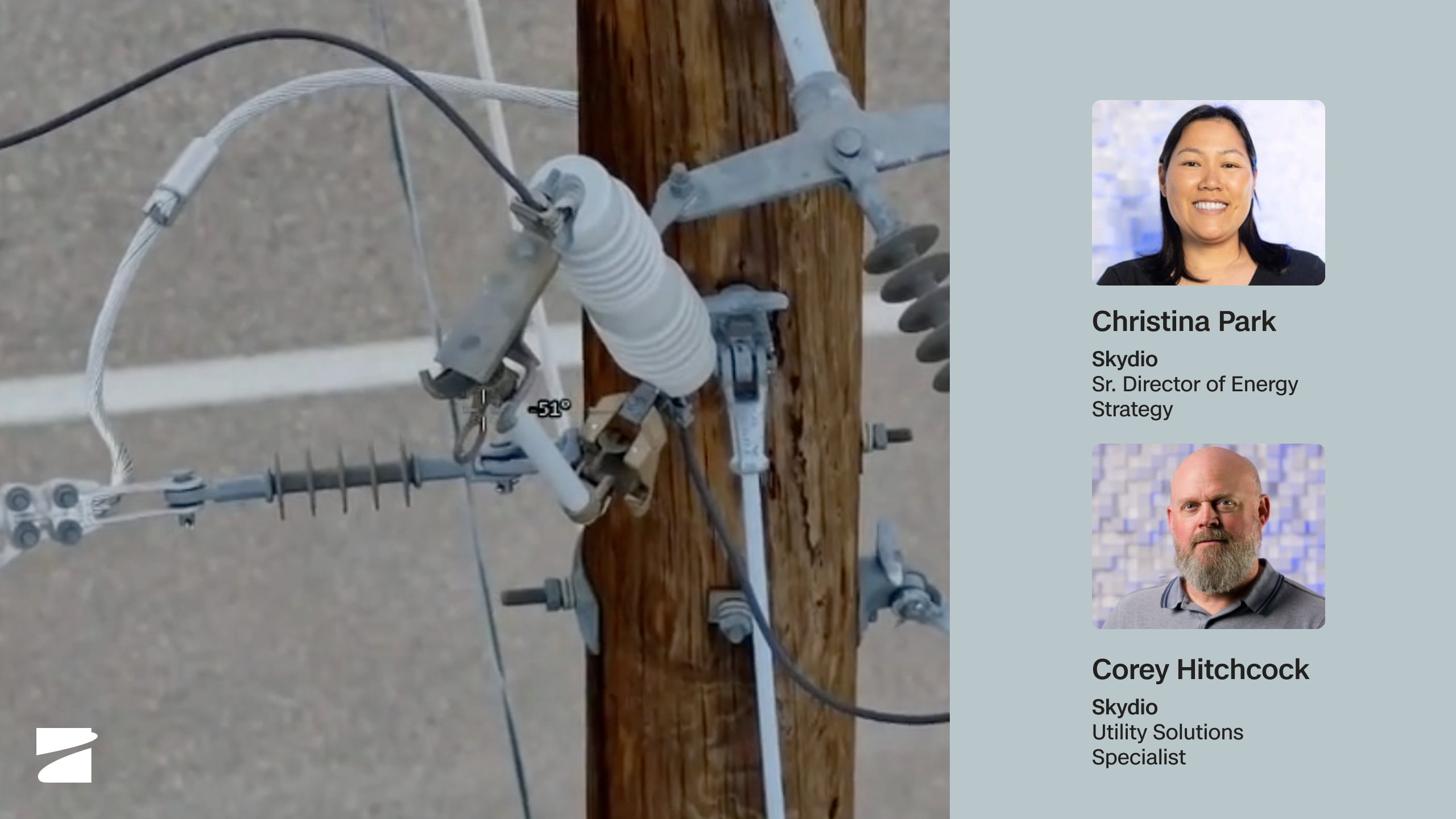
- Moderator: Christina Park — Senior Director, Energy Strategy, Skydio
- All right. Hi everyone. My name is Christina Park.
- I'm the Senior Director of Energy Strategy at Skydio.
- Skydio is the leading, uh, autonomous drone manufacturer.
- Um, we are actually based in San Mateo, California, and we're very excited to be
- here with UIGA as well as DTech. Um, so a little
- bit of background for me, I've been at Skydio for three years.
- Uh, I was hired actually when Skydio decided to verticalize and
- focus on very specific industries, one of them being utilities.
- Um, and they were chosen based on the critical
- industries that society relies on.
- So, uh, using autonomous drones and remote operations to be able to
- improve your
- reliability and resilience, that's the mission of our company.
- But I was actually hired in because I was once upon a time a customer.
- So I spent fifteen years of my career working at the New York Power Authority.
- I was in engineering and asset management, um, and happened to come across
- Skydio as we were investigating their offerings, uh, in terms
- of how to operationalize technology in asset management.
- So, uh, very excited to lead this discussion
- today, and I will hand it over to
- AP.
- Great. Thank you. Good morning, everyone. My name is AP. I'm from, uh, Exelon.
- I'm the Director of Customer Strategy.
- Been with the company for, uh, a little over sixteen years.
- Uh, been in various operational, uh, departments, planning,
- uh, launched a drone program, was the head of innovation
- and investment strategy,
- and now in the customer side. Uh, really excited to be here, especially,
- you know,
- because of the different departments I've been in, this topic really
- resonates well with, you know, what I've faced over the, you know, uh,
- more than a
- decade and, and how we are still trying to overcome, uh,
- with all-- uh,
- despite all the good efforts that we have put in place.
- So really excited to be here.
- Uh, morning, everybody. I'm Mike McMillan.
- I'm the Manager of Asset Performance at Nova Scotia Power.
- We're up in Canada, on the other side of the, the continent,
- the East
- Coast. Um, and part of my role, I'm within our enterprise
- asset management team. Um, so we're responsible for,
- you know, setting asset strategy and, uh, as, as my boss likes
- to say, keeping the business, uh, connected.
- Um, so important, uh, really important topic today,
- talking about silos and how we
- can share the data that we do have and, and make better decisions.
- Thank you.
- Morning, everyone. My name is Craig Stenberg.
- I'm with, uh, Southern California Edison.
- Um, uh, I founded the Remote Sensing and Unmanned Aircraft,
- uh, departments there c-company within our
- aircraft operations,
- and been with the company for about fifteen years now.
- And, uh, what we were able to do over that time is bring our
- remote sensing into the twenty-first century.
- So, um, happy to be here and answer any of your
- questions.
- Great. Thanks, gentlemen. So as our keynote speaker stated
- earlier, um, I was really excited to see,
- uh, or to hear some of the stories that he was telling because I think early
- detection and prevention, really in today's day and age, uh,
- to catch incidents
- before they happen is really critical.
- And I think no matter what department you sit in, uh, it's, uh, to,
- to quote him, "Outages are bad, speed is critical." Um, and so
- I think this is something that's gonna be really exciting as we dive in.
- So for all three of you, uh, and anyone can jump in on this question.
- Um, so utilities generate enormous volumes of
- data.
- So you have spatial, operational, asset data, uh, but much of that value
- remains siloed. Um, so from your perspective,
- what's at stake if these
- silos persist, and what becomes possible if data
- is shared across
- functions?
- I can start there. I, I think the, the biggest risk if, if the data isn't
- shared is you make bad decisions. And bad decisions could mean you're
- investing in the wrong assets, could mean, in the case of emergency management,
- you're restoring, uh, not the wrong customers,
- but maybe customers you're
- missing that critical infrastructure.
- Um, if you, if you can't get that data sharing right,
- if you can't break down
- those silos, uh, you're gonna be wasting a lot of time
- and a lot of
- customers', uh, rates and, you know, potentially, uh,
- putting, you know, increasing your reputational risk.
- So, so that's kind of the ones, the ones that I would see.
- Yeah, I resonate with the same answer and, and especially like, uh,
- the ultimate thing is it impacts the customers.
- It doesn't matter what happens, right?
- You know, whether it's an asset issue or a wildfire, you know, uh,
- or any kind of
- an outage, ultimately, it just impacts the end user, which
- is the customer.
- But there are s-- uh, these data silos also, what, what
- it happens is that it will ultimately create a trust
- issue with, uh, the different programs that
- are being launched or new programs
- because you, you see the data coming in, but it's very siloed.
- Others don't understand where that exists or how to leverage that data.
- So as you try to create new programs, like let's say your company doesn't have a
- drone program today or any other, uh, remote, uh, like a geospatial program,
- and if you're trying to grow it, the past experiences, experiences will
- haunt your ability to actually scale these programs, right?
- So the data silos are, are, are a big problem.
- But again, even if you solve the data silos,
- the next big challenge would be is
- how do you leverage all that massive data into insights as well?
- But to get to the insights, you need to be able to make sure
- that these datas are
- communicating or in one location, and then you can move on to the next
- thing.
- And I think, uh, one of the challenges we've had at Edison
- with this
- is that, um, when you're not sharing the data,
- your other
- departments go out and capture the same data-
- Yep
- ... and at a usually great cost.
- Uh, we have six helicopters that serve fifty
- thousand square miles of territory.
- So,
- uh, when we get a request to go and capture some data,
- and then just three weeks
- later we get another request to capture the same data, we don't really have a lot
- of resources to spread around to do that.
- So,
- um, so data silos has been an, an issue.
- It's an issue that we're now beginning to, uh, address and
- fix, but I think it's gonna be a little bit of
- time.
- And as I understand it, hiring helicopters
- are kind of expensive So if you had to
- send it twice for the same inspections.
- Yes, they are. Uh, I would say on average, we probably pay
- about four thousand dollars per hour to operate a helicopter, so.
- So definitely not worth doing twice when you can do it once.
- Um, I'm really excited to be up here with
- these three because, uh, they
- represent three very, very different functions and very,
- very different departments
- who often have to work together. Um, but historically,
- I think it's just been very
- hard. Even in my experience, I started my own career in generation, and
- after thirteen years moved into asset management, where I was like, "Oh, there's
- this whole thing called transmission that I didn't pay attention to-
- [laughs]
- -for over a decade, uh, and kinda had to learn.
- So, uh, I have a few questions for each of you in
- the functional, uh,
- for your functional perspective. So the first question is for Mike.
- If we talk about asset performance, from an asset performance standpoint, what
- data has the biggest impact on reliability and risk today?
- Um, yeah, uh, great question. So I, I think the biggest one for us is
- anything that we consider a leading indicator.
- So not necessarily-- I, I mean, I love analyzing outage
- data as much as the next person. [laughs]
- [laughs]
- But, you know, you're already behind the eight ball once
- you're looking at that
- data. And historically, that's primarily been where we've made
- decisions, and then you, you end up chasing problems, um,
- after they've, they've occurred, and you can't really be proactive.
- So from an asset performance and asset risk, making better
- risk-based decisions, uh, it's all about leading indicators.
- So things like in our inspection records, things like, uh, condition
- assessments for vegetation, all of those that we can really leverage
- that
- data. Um, you can be more proactive.
- You can prove to your customers, you can prove to internal stakeholders,
- your
- regulator, that, okay, this decision that we're making is
- based on that good data. It's before we have a problem,
- hopefully. Um, and we can, we can kinda prove that we're making
- the best decisions in the interest of those, in those customers.
- Great. And you are kind of the end recipient of
- getting data,
- right? I think we're in a place where I think
- everyone has accepted that more
- data is a good thing. We don't have enough of it.
- Um, but once it's collected, the next question is for AP in strategy
- planning and
- governance. So how do strategy planning
- and governance shape how new data
- sources like UAS, um, uh, drone data, are adopted and scaled?
- I love that question. [laughs] So
- yes, I mean, strategy, like if you,
- if you think about long term, right, and when you, when you think about the new
- data sources, the strategy should come from what
- is the business need?
- Like, yes, we have a fancy tool or a very effective tool, and if
- you don't know what you're gonna use for actually or why you're gonna use that, it
- just becomes an expensive operation, right?
- And so you need to be able to, uh, latch it with what
- is the business outcome I'm expecting.
- What is the business problem that I have today
- that I'm unable to solve?
- Or maybe sometimes it's all about what do I don't know today,
- right? Sometimes we don't know stuff, and it happens, and then we are spending
- hours and hours investigating after the fact, okay, why did this happen?
- We thought we had this, right? Sometimes it's lack of information.
- So defining that business need is very critical,
- and that's where the strategy
- comes from. And once you have that established, it also helps you in
- standardizing, okay, what do I need to capture?
- Then comes the planning side of things, where you say that, okay, now that I
- understand I need something from this particular source, how often do I need it?
- How differently do I need to, uh, need it?
- And how does it, uh, change from what I'm already
- gathering today? Or how is it different than what I don't know
- today?
- And lastly, what happens is, comes down to once you decide on all
- these things, is the governance piece, which is the most critical, I would say,
- is
- because now you need to have a data owner.
- And how does this data sync with other systems?
- And as it's syncing, how is it changing your decision-making
- capability as well?
- So all of these things, I mean, you can-- s-it's--
- it-- on paper it seems easy that you can define everything ahead of
- time,
- and sometimes we have to, to support these, uh, programs,
- launch these new programs
- and scale them. But as you go with it, you need to be agile
- and also tweaking that
- to say that, okay, this is the initial assumption we started with,
- and as we get
- this data, actually it's way more reliable than what
- we expected.
- Or, or maybe we need to change some things to
- capture more enhanced data.
- Because if you don't have such a plan, your drone operations or your drone
- photography just becomes a very expensive photograph that you're taking of the same
- asset that you could have just gotten from the ground.
- So you need to be able to differentiate between what do we have today and how
- is it
- gonna change that outcome. So, and going through that
- experience myself for three years, uh, launching the first drone program in all
- of
- Exelon, right? Technology, one thing I learned is that technology
- will enable adoption, but if you don't have the right strategy
- or planning or
- governance, you cannot scale the program.
- And that's where we focused a lot in the initial stages.
- Like even six months to eight months, we were only doing very
- minimal missions. We were establishing the standard operating
- procedures, the
- emergency procedures, and things like that.
- And everyone was like, "Hey, we funded you so much.
- I haven't seen anything flying around that much.
- What's happening?" And we're like, "You gotta wait for it."
- And once we started
- that, it completely changed the perspective.
- And we have about thirty, forty-plus pilots, million
- or a couple of million
- dollar-plus savings, and we are doing drone operations like every day.
- We pretty much replaced ninety percent of our helicopter inspections as well with
- drones. So it just comes from how do you build
- that strategy and how do you
- plan and scale it.
- Uh, that's really good 'cause I feel like, uh, technology, any sort of
- innovation kind of starts as a science project, right?
- I think, uh, utilities are in a space now where we're kind of
- past the R&D
- phase. And admittedly, the technology also needed the past five,
- ten years to come along. Uh, realistically, the drones that
- were available ten
- years ago are not the same as the drones that are available today.
- Um, and so I really like what you said because
- I think the, uh, goal
- of scaling and operationalizing once you get past just, uh, doing a
- POC just becomes so much more complex.
- Absolutely. And if I may add one more point, the,
- the key is, is start small.
- Like, you know, when, when we looked at the drone programs
- that the other companies
- were doing, or even within Exelon, like the other operating companies
- were doing,
- and I used to be in Baltimore Gas and Electric, by the way,
- when we launched the
- drone program, so we have other operating companies
- within Exelon.
- Everybody started with the most ambitious and a difficult use case, which is the
- storm, uh, management. They wanna use drones for storms.
- And when we went back, and as we were strategizing, we said that, "Why did
- they fail?" Like, I mean, they've been doing this for two years,
- or why couldn't
- they really scale the program? And it became that, hey,
- you need a lot of people to
- do that. And storms happen only
- twice or maybe once a year. Still that, but it happens that, so you don't get to
- test your program, you don't get to build that trust.
- So what we did is different.
- We started with the most easiest programs.
- We build the trust and then once we build the trust,
- we started recruiting more
- people into it. And within a couple of years,
- what happened is we had an, pretty
- much an army of drone pilots, so when the storm happened,
- they could go on the
- entire system and scan the system way more faster than you could have ever
- imagined, so.
- Yeah, and this is something that we're seeing across the industry,
- I think that
- reactive, uh, maintenance decisions using drones
- is what is in the news, right? And our goal is to stay out of the news.
- [laughs]
- [laughs]
- So when you think of storms and fires, those are the two main things that nobody
- wants to be in the news for. Uh, but how often do they happen as opposed to
- everyday corrosion, everyday bolts falling out, vibrations,
- um,
- just stress corrosion, cracking, fatigue, woodpecker holes, all of those things.
- And those are the things that if you could catch those early indicators,
- it would
- make a much bigger difference in your proactive maintenance strategies, which
- ultimately,
- you never-- If you're doing it right, you never get in the news, right?
- [laughs] Um, but I think it's hard to see that when the
- sensational, uh, big storms happen and you, and you have those
- responses.
- No news is good news.
- Yeah. [laughs] So Craig, this next one's for you.
- So, um, from a UAS perspective, what has it taken to elevate
- a drone program from a tactical tool to an enterprise data source?
- Oh, well,
- um, uh, kind of to, uh,
- I didn't know how to pronounce your names first.
- N-
- AP.
- N-- AP, okay. To, uh, AP's point, you know, starting small,
- um, in, in the early days when, uh, somebody came to us and
- said, uh, "Should we start a drone program?"
- That was somebody, I think it was our
- CEO at the time, when she said, "Start a drone program." Um,
- that was, uh, you know, we, we started with one drone and, and
- one guy flying it. That was me.
- [laughs]
- And, you know, which is really how do you--
- learning what we don't know.
- You had to know what you don't know, right, at, at this point.
- Um, and eventually, you know, we had our first, you know,
- dozen pilots or
- so, and we realized pretty quickly that
- if we're really going to scale this at all, we're, we can't do this as a
- centralized operation.
- Mm-hmm.
- Um, and so that represented another, uh, problem that
- really it's not technology or,
- um, I guess the, uh, the scalability and, of the aircraft itself.
- It's really more about,
- uh, the operator. So we're an aircraft operation.
- We-- Like I said, we, we have helicopters, and every time we bring in a helicopter
- pilot that we're gonna hire in, that this person has at least three
- thousand, four thousand hours of flight time,
- years of experience, uh,
- a tremendous amount of knowledge in aviation.
- Uh, and what we're looking to do now is take somebody with the same kind of
- skill
- set on the lineman side or the, you know, the utility side
- and introduce an entirely new, uh, concept on how to
- operate and basically we're gonna try to make professional pilots out of people
- who've never flown anything before.
- So,
- uh, that was probably the biggest challenge
- that we had as far as, uh,
- scaling. But, um, and ag- and
- also the, uh, we, we mentioned the, the drones today are much different than
- they were ten years ago when we started all of this.
- So,
- um,
- it's, uh, you know,
- th-thank you. I, I can say obstacle avoidance has been a
- huge help.
- Um, [laughs] but, um, it's not a flight plan, just so you know.
- Um, [laughs] but,
- uh, that was,
- uh, being able to bring in equipment that w-would be
- much more reliable and also had a, it's an ability to
- avoid the objects that you're trying to look at was al- was,
- uh,
- another big piece of this. So,
- um, what we did then is by crowdsourcing the
- aviation, uh, we've actually gone from a few dozen,
- about a
- dozen pilots initially, to about a hundred and twenty today.
- So we've gone about ten X increase.
- We actually have reduced our size, believe it or not.
- We, uh, we're-- About a year and a half ago, we were about two hundred
- pilots in the company, almost two fifty.
- And when we transitioned to our current
- platform, uh, we were,
- um,
- significantly higher cost platform.
- And as we're bringing in the equipment of the, the old pieces that were now
- six, seven years old, some of these were brand new in the box.
- And we discovered there were a lot of people joining the program
- because they
- wanted to be a drone pilot, but they actually have no use for the
- drone.
- [laughs]
- So,
- um, so that's, uh, that-- Now we've gone through kind of
- that rollercoaster. We've now kind of, I think we've right-sized to what,
- um, you know, our... We're a large utility, so our right
- size might not be your right size. But,
- uh, we've right-sized that program.
- And, um, the other piece is that we have different
- organizations in the, in the company that have different mission sets.
- So by having a centralized governance on how to fly the
- aircraft, which is very basic, we now allow other
- organizations to, as long as you're staying within those
- rules, you write your own
- rules on what you need to do.
- Yes.
- And that is the other piece that really had helped synergize the
- operation. So,
- uh, which synergizes data too, and hopefully that'll kind of set up cue
- the
- next, uh, phase of this.
- Yeah. And I think what I'm really impressed
- with, with Southern California Edison
- and how you guys have set up your program is that you actually give a
- drone to each pi-- Like, your pilots are-- You didn't incur a lot of
- headcount hiring hundreds of extra pilots.
- You made pilots out of the people who need to see the assets anyway.
- Uh, or at least that's what I'm hearing.
- Um, and I think the work that we've done together,
- just seeing how somebody in
- generation has very different inspections than somebody-The MTMD has very
- different, uh, inspections that they use the same drone for,
- but you've, in the
- aerial program, really trained them up, uh, to be able to use the drones
- as a tool. Um, so I f- I found that really exciting about your program.
- Well, thank you. Uh, that was, you know, that, that did take some doing to
- get there. We had to literally had to build the
- training program for it.
- But the other half of that, that, uh, you're, you're very modest about
- was, uh, being able to partner with a technology,
- a, a
- technology partner who will respond to the needs of the company and,
- um, develop the-- basically develop the next, uh,
- work methods on how we're going to do this, which is a huge technological
- advancement in order to do that. Um, it's im-- it is
- important if you're a vendor working with a utility,
- uh, it's important to be flexible and, uh, be able to move in the
- direction the utilities may need to move because, um, and
- maybe as we're flying throughout the-- as we move forward with, uh,
- this conversation and additional conversations here,
- is the more data that you bring in, uh, the more
- insight you get from that data because it, it synergizes with other pieces of
- data. And, uh, that was part of what helped
- develop our program is we're doing this and think, "Hey,
- what if we had a drone
- that can do this?" And having a partner who's willing to
- build that out
- has, has been pretty major for us.
- Thanks, Craig. Uh, partnership is really what we're all about, and it's,
- uh,
- been great because I think like AP said before, your solution is only as good
- as understanding the problem-
- Yeah
- ... you're trying to solve. And I think that's what we're all trying
- to do.
- Um, so my next question is for everyone.
- Uh, so what barriers most commonly prevent
- data sharing across teams,
- and what has actually worked to overcome them?
- You wanna-
- Um, I think for me, the biggest barrier has been like
- knowing that data exists, uh, [laughs] that, that people
- could use. And we've seen lots of examples, um,
- you know, and
- Craig mentioned this too, is so, you know, we collected this data, and then
- somebody else collects the same data, and maybe a third person collects that
- data. Um, so, so having the ability, um, to
- kinda sit at the middle or to understand, okay, this is what other folks are
- doing from a remote sensing point of view or just, you know, traditional
- inspections, um, what data do we have out there,
- knowing even who to, who
- to talk to. So one thing that has really worked for us,
- um, is kind of building cross-functional teams
- that are meeting on a regular
- basis. So, um, you know, in distribution, we've got so
- many stakeholders, uh, from folks in the field that
- are doing construction and
- maintenance to, you know, regional engineering to asset
- management to so on and so on. Um, but even just to get
- some of those people in the same room to say, "Here's what I'm working on.
- Here's the problems that I'm having.
- Oh, I might have that data for, for you.
- Oh, we collected this loading data or this, uh, imagery,
- um, that might be a good fit." Um, just sparking those conversations
- have been really important for us to understand what's already out
- there, what we can leverage right, right off the hop.
- Craig, wanna-
- Sure. So, um,
- as far as, uh, data sharing goes, um, I think what we've found in,
- uh, from my experience anyway, everybody b- wants to be the
- one that pushed the button, but, um,
- but you know, no, th-then they don't want anybody else to be
- able to push it.
- And so as a result,
- that's what I think prevents people from wanting to share their data.
- But, um, at the same time,
- the, all the questions people are asking, uh, require
- all this data that is there. I think that's what's driving all the,
- you know, "Well, if you won't give it to me,
- I'll go get it myself," you know?
- Um, so,
- uh, we're finally starting to break away from
- that at Edison, but it's actually
- taken quite a bit of doing and, uh, it's...
- In a, an odd way, uh, the data that you're collecting,
- it, uh, it almost mirrors socialism in a way.
- If everybody were to collect the data and put it in one s-repository
- for everybody to use, I'm not a socialist, by the way, but it's just a model
- still. It's there. If everybody puts it in
- that same repository for use, then
- everybody can use it the way they need it.
- Um, and, uh, and you know, instead, I know why the-there's been
- so much, uh,
- r-resistance to that, but,
- uh, we're just now getting to the point where
- our information
- government within the company is starting to say,
- "I guess we're gonna have to be
- the ones to own it," so.
- I think if I double-click to give this question to AP.
- So how do you build trust and share data and decis-- uh, when
- decisions have real operational and regulatory impact?
- Looks like you read my mind and just asked the question.
- [laughs]
- No. Yeah. I was gonna touch that, and exa-- I mean,
- I agree with both your points
- there. So, um, that's one, one challenge we've seen
- is like, you know, sometimes data,
- uh, makes people scared. You know?
- They are suddenly seeing so much data that they,
- they're not privy to in the past,
- and they don't know how to react to that data. Like, I'll give you an example.
- We, we, we have a very robust typical
- pole inspection program, and as we were doing a parallel inspection to,
- to a point
- with the drones, when we captured those images and,
- and sat down with
- the typical inspector and, and went through those images, our
- work orders shot up by four hundred percent.
- And that doesn't mean that the inspectors who were doing it
- were doing it wrong in
- the past. It's just that you didn't have
- that kind of a lens at the-- until at
- that, uh, that point. And suddenly when that came up, our work orders shot
- up and some of the critical, like e-even within the work orders,
- we have like a
- priority tens, twenties or thirties, like, you know, different priorities.
- And when you have a highest priority, you need to fix it within a week,
- basically.
- It's a reportable thing to the regulators.
- Now, suddenly we had to pause the entire
- program saying that we are not equipped
- for this. So if you know something, you gotta go fix it.
- And then the question is, what is the right thing to do?
- Because now we are realizing that we may not have been getting all the
- data that
- we want, and suddenly there is this device, but it is not, uh,
- inducted into the
- full end-to-end preventive maintenance program either.
- So we had to really take a step back and, and rethink our strategy completely.
- And then
- after that, what happened is the transparency piece.
- Are we able to get the same data consistently?
- Who's actually capturing this data from the drones?
- And, and, and how often is it gonna happen, right?
- So we have to define the transparency to say that this is how exactly we capture
- this data. This is the time period we're gonna
- capture this data.
- So it, it creates an auditable trail.
- So in case you find a very critical issue, you have to take down a service or
- something happens, unfortunately, you can go back and say that, "Yes,
- we have
- identified at this point of time by this qualified person, and here's where it's
- stored," and, and we can actually work with the
- regulators on those aspects.
- Even if you have to take down a line on a temporary basis because you just re- uh,
- recognize the highest priority issue happening on a pole
- that might just take down
- a transformer or something like that.
- And then comes, again, the governance piece. Where
- is the data going from there?
- It's like you've, you've captured it, you saw the data, but where
- is it gonna go,
- and how people are gonna leverage that thing.
- So that's another big silo that we had to break down as well,
- which was very
- time-consuming, but it was worthwhile to go through that effort.
- Uh,
- in Exelon, we have launched a data, uh, platform or
- big, big data or data lake, whatever terminology you wanna call that,
- in twenty
- sixteen. So that changed the game for us
- when it comes to data.
- But one thing what we realized is that we are capturing millions of data
- points in a given day, but now how do we extract the insights?
- The silos are broken, but the question was,
- did it really break the silos,
- or is it just that everything is being dumped into a storeroom now,
- and you have to
- go through a storeroom to really find out what that data means, right?
- So and then now we're adding this drone data, which is overlapping with your
- existing data. So what-- how do-- Which data holds the
- truth? So, uh, it became a, a,
- a planning to trust the data. So we had to first
- create how we're capturing it, and then what is the
- transparency of the data? Like, which means, again, as I said,
- who's capturing it?
- What, what is a different, uh, process to capture that?
- And once it happened, we had to do a lot of field validation to
- say that,
- "I saw this split on the cross pole, which means it's gonna come down.
- It's a priority twenty for us." And then a week later,
- the fleet crews would
- go in and say that, "Yep, the image was right. It's very accurate.
- It makes sense to us." And we have to go through multiple
- iterations of that to
- build that trust. And as it built, we were able to secure the
- data and put the right governance, and then everybody star-started using
- that data as a source of truth, and it started ending up in our system of
- records.
- So it's, it's a journey. You won't get there day one,
- but you gotta plan for it.
- And you gotta figure out what is that gap, what is the data process that
- you have within your own companies, and then realize, okay, are we--
- do we have a
- data lake like what we have, or is it si-siloed?
- If so, who's your biggest stakeholder, and what to do with that?
- If I could follow on that, um, who are the key stakeholders
- that you found that you
- had to bring to the table, right? When you had all this information
- and suddenly
- there, there are decisions to be made.
- Um,
- once we have the data, getting to the data, flying the drone
- is the easiest part, I
- would say.
- [laughs]
- But once you land the drone, the difficulty begins actually.
- [laughs] So it was mainly the executives because suddenly they, they did not
- plan for this. They did not plan to have this
- information.
- As I said, suddenly the work order shot up,
- and you don't have that, that much
- workforce available to get this done.
- And even if you can go contract the work source, you don't have the budget because
- you didn't plan. You're planning to see maybe a thousand
- problems in a given year,
- and you plan for twelve hundred, and within the first quarter of the year,
- I
- already showed you three thousand problems, and you,
- you're not planned for it,
- right? So convincing them, how do we standardize this?
- And also working with our, uh,
- uh, teams that interact with the regulators to
- say that, "Okay, this is a
- new form of doing, uh, inspections," then how do we really
- change our protocols around it, our preventive maintenance protocols
- around it,
- and, and things like that. And then ultimately showing why is it
- worth the investment now that you have identified so many problems.
- We were looking at retrospectively and saying that, "Okay, these
- are definitions
- even true." I mean, if every pole is going to have ten
- problems, then is it really a problem?
- Because they did not come down in the past twenty years.
- They're, they're up and running. So what does it really mean then?
- So we have to go back and define how do we take these data
- points
- and actually draw a more specific derived
- insight to make that judgment call on whether we need to go do
- something about this or not. So those were the biggest, you know, folks
- I would say we had to convince. And then at the same time, it was also
- the field operators because our--
- when we s-launch the program, one philosophy we started with is that
- we are not going to give drones to anybody just like that in the company.
- We are only going to give it to the folks who are actually doing that function.
- Like, you know, if it was a lineman who
- was supposed to get on a bucket truck and
- look at an equipment, only they're gonna get a drone as a part
- of the enhancement.
- Like, you know, or, or maybe a transmission operator.
- So an engineer wouldn't get a drone because a typically engineer will not be
- going
- into the field to inspect something on their own, right?
- So we created that, that pipeline of things, and we had to
- ensure the field workers were trusting the technology in their hand
- to ma- to ensure that we can get the information what they
- need.
- So it's, it's, it's, again, it's, it's a stage of growth.
- That's why it took us a couple of years to get to that point.
- But mainly convincing the field folks that this is the right data source,
- and once
- you have that, now convincing the leadership on how to
- act on it.
- Awesome. Uh, I have a question for Craig.
- So how do you maintain consistency and accessibility, um, as
- UAS programs scale?
- Well, um, I kinda answered that a little bit earlier, but I'll go,
- uh, I'll
- expound on it. So our central, um,
- I guess, uh, operation for the drones within aircraft
- operations would
- be, um, w-well, we're using what we call a model manager
- concept. So,
- um- If we're the sheriffs in town, we'll put a few deputies around the
- company, and they become kind of the chief pilots
- of their organization.
- And,
- um, and, and it's that model manager thing.
- If you go right across the bay here to North Island, that's where I kind of, uh,
- developed my operational knowledge as I, I was in a
- helicopter squadron over there.
- Um, if you remember a,
- a game back in the nineties, a computer game called Wing Commander-
- Mm-hmm.
- Um, that's a real thing. There actually is something called a wing commander, and
- if you're on the base over there, there's a helicopter wing.
- That's just one little building that actually has no helicopters attached
- to it.
- Um, but it-- all the people in there are managing the programs everybody
- else is flying, all the different squadrons.
- So the, uh, the wing commander would be the commanding
- officer of
- all the, uh, squadron commanders. Okay?
- So we just took that cookie cutter
- object and put it right into Edison, and that's how we're operating that
- program. So
- what that's done for us is, uh, by giving the
- basic skills of flying the aircraft to the people that are flying them,
- and then developing the, the higher technologies and developing the
- standards that they're going to have to meet in order to do these more advanced
- operations,
- we've empowered everyone else to, uh, find the
- best ways to use that new tool. And that
- instead of trying to be, um, you know, dictatorial, you know, "This is how you're
- gonna use it, this is how you're gonna use it," it's,
- it's really not about what
- you're allowed to do, it's more about what you're not allowed to
- do.
- "Do whatever you need to do, just don't do these things."
- [laughing]
- [laughing]
- And that's really unlocked the, uh,
- the creativity within the company.
- And, uh, we're-- we knew going into this that
- if we do that,
- we're-- people are gonna think of ways to use
- these things we've never thought
- about. We just have to plan the rules in such a
- way that they
- don't come up with new ways to screw it up we never thought about.
- [laughing]
- [laughing] Guardrails are definitely important.
- Um, so I think, uh, we're getting to our last ten
- minutes. Todd, I am watching the time. Don't worry.
- Um, so for you three gentlemen, how do you measure success for
- cross-functional data initiatives?
- I think AP touched on, uh, the need for executive support and
- alignment, um, to really bring some of these things to
- scale and to
- align across departments. But really, um, what,
- what metrics do you use to measure success?
- Um, I think one of the things we can look at
- if we, uh, go
- back to the early days of our program was, um,
- one way of looking at a successful week was a week where nobody smashed one of
- their aircraft.
- [laughing]
- Okay? That was, uh... Which was very few and far
- between. And we get to this end of it where,
- you know, we've-- a lot more
- development has happened. We've, we've really improved our internal
- training.
- The, uh, equipment has improved significantly.
- And, uh, now it's, uh, really, it's more like, um,
- "Hey, did we get through a year without anything
- happening?" Which is, um, you
- know. So--
- And that's the operational, uh, way of measuring it.
- Uh, the other, I think, uh, probably more significant is,
- um,
- you know, a lot of our use cases are centered around wildfire prevention.
- And it's like, well,
- um, you kind of have to go back historically
- and say, you know, back at this time,
- all these fires were going on, and you fast-forward to today and,
- um,
- uh, Craig Fugate kind of mentioned some of
- this, is, uh, it, it's also the early
- detection piece. But on the prevention side,
- uh, both of-- we've seen both of those. It's not just been the drones either.
- We've, we've done other infrastructure
- improvements to, uh, help
- prevent wildfire. So now it's gotten to the point where we
- have very few
- wildfires, and they do occur. And, um,
- it's a more difficult way of measuring because you're-- it's
- where you're measuring what ha- what did you not lose, you know?
- That's not really, uh, the same kind of, uh, metric, but it is one way of
- saying that,
- um, because we have-- we're, we're diverting so f- much fewer
- resources to recovery due to our prevention.
- That has been, uh, I think, uh, one way of measuring that.
- Any more?
- No.
- I think, I think for, for us, like, a lot of the great,
- great points there. Folks aren't smashing what you built.
- [laughing]
- [laughing]
- That's, that's usually a good, a good sign.
- Um, one thing that we've, we've seen a success and maybe a,
- a difficult me-
- metric to measure, but you know, we're building tools to analyze
- risks. For example, in the transmission system,
- we're bringing together, you know,
- our inspection results, our vegetation results, our lagging
- indicators like performance, uh, reliability.
- And when we start to hear that people are-- teams that, you
- know, they don't report to me, but we work closely with them, are saying,
- "Yeah,
- we, uh, we used the risk dashboard, and we identified these risks,
- and we built a
- project, and the project's in the capital plan."
- Like, I'm,
- I'm crying from joy-
- [laughing]
- -to hear that. That's-- That means we were successful. We built the trust.
- We built the right data pipelines.
- We brought the information together in a way that can be consumed by those
- teams. And when operations and capital and folks who
- maybe are only seeing, you know, they might have the temptation to
- just focus on, "Well, I saw this pole was broken, and I'm gonna go fix it,"
- but I
- don't have the, the view of the full scope.
- Um, when they're starting to use those tools,
- that's a huge win for
- us because it means we're making better decisions.
- We're not being as reactive. And when we go to
- talk to our customers and other stakeholders,
- we can stand behind those
- decisions and say, "Yeah, this is why this is priority number one
- for us." Um, we can go to our regulator and say,
- "This is,
- uh, ca- [audio improvement] plan we stand behind.
- You can be confident if you approve our expenditures.
- So, so that's a huge, uh, that's a huge win, win for us.
- And I'll, I'll, I'll give you another example.
- Like, we have operations teams and folks, you know,
- uh, not disparaging anybody working in
- operations or working with field folks, but
- that is a hard nut to crack, um, to get them to
- use maybe a, a different way of working or,
- or something new that they've
- seen. And when we talk to them, and it takes time to build [chuckles]
- that trust, we've talked about that, but giving them tools that really
- resonate with them. And, and again, when you get a call from somebody
- that says,
- "Hey, I'm looking at this risk score, I'm looking at these inspection results,"
- can we dive deeper into that and, and we can talk about
- why this is red, this is your number one priority.
- Well, you-you've saved a whole lot of time
- and heartache.
- Uh, you've saved crews from making unnecessary
- trips.
- You potentially avoided outages.
- So, so that's another huge way that we're, we're looking at measuring
- success.
- Very nice. We should talk about that.
- Yeah. [laughs]
- Talking to the field folks. Uh, we--
- I mean, uh, the program is a little bit more mature,
- so I'll start from, like, how
- we started off, you know. So we created a rubric to,
- just to convince the
- executive leadership to say that, [clears throat] excuse me,
- how is it, uh,
- mainly it comes down to the savings.
- That's the language that everybody understands very easily,
- right?
- So we talked about how much, uh, cheaper it is going to be using
- drones compared to the typical, uh, traditional, uh, inspections.
- And then we said, "What about the worker safety?" Like,
- you know, how will it
- improve the safety of the lineman or the field personnel doing this thing?
- And then we talk about o-operational efficiency. Can you do this more often?
- [clears throat] Excuse me. Sorry about that.
- Uh, operational efficiency, can you do this more often?
- Like, you know, and next comes the data quality.
- Like, you know, is it a better resolution data?
- Will it help you make better, [coughs] uh, better
- analysis or, or better outcomes? And then,
- [clears throat] once you meet that, each individual use
- case will have its own detailed benefits, cost benefit as well.
- So I'll give an example. We had an issue about, um, where we
- had a lot of, uh, water crossings. The lines were do-doing the water
- crossings, and
- we had to install these tags on the line so that the
- boaters or the sailboats won't hit those lines.
- When we did with the traditional methodology, that
- was costing us almost like one
- point five million dollars. It takes five years to do
- that because we have to put a
- bucket truck on a barge, and the barge has to go into the center of
- the, uh,
- crossing, and they have to go up with the water
- shaking and the wind
- and everything. And we said, "Why can't we do this with the drones?"
- So safety was paramount. So safety conditions went from one
- safety to five safety because there's nobody on the water.
- Somebody's on the bridge or on the side by the bay,
- and they just fly the drone.
- And from a savings perspective, instead of spending one point five million
- and accounting for losing two or three drones into the water because of
- any
- con-- some condition that we cannot control, all of
- that together, we spent
- hundred and thirty-three thousand dollars. That's it.
- So we saved ninety-five percent of the cost right there.
- So we did that analysis for every single thing.
- Another big example is that we have these, uh, uh,
- uh, natural gas pla-- uh, towers, uh, or silos actually,
- uh, in the downtown Baltimore area, which has to be inspected every other day.
- Somebody has to climb up all the way, which takes them three to four
- hours, and once they're up there, if there's a high wind event,
- they gotta sit
- there. They cannot come down. And it's a, it's a huge physical
- fatigue, it's a safety risk, and it's almost one dedicated person just
- doing
- this. And we were able to do the same thing with
- the drone in ten minutes.
- And instead of every other day, we can do it three times a day now.
- And what we also did, thanks to the drones,
- we actually automated the whole damn
- thing. Now we don't-- nobody has to even go out into the field.
- They just push a button from the control room, the drone comes out of the box, it
- does everything and comes back, and the data is being processed by AI in
- the back
- end. So, so what, what happened is, like, or
- what we did is each... You need to esta-- reestablish the
- baseline, saying that these are the criterias
- that we're gonna meet before even we
- launch into a use case or go do this thing.
- And once we do that, each individual use case is different.
- And another aspect what happened is people who were rolling out with,
- you know, the
- mid-sized bucket trucks, they don't do bucket trucks anymore.
- They just use a pickup truck, actually, with a drone or a couple of drones,
- different drones, depending on what their function, uh,
- dictates.
- They just fly the drones. So instead of purchasing a mid-sized
- bucket
- truck, which is
- a few tens of thousands of dollars, we're buying a simpler pickup truck with a
- drone, and we're able to do that. And with our
- sustainability goals, what we did is that we gave all these, uh, field folks,
- uh, EVs, EV trucks, Rivians, and we said that this is a
- completely, uh, zero carbon inspection.
- So we changed the narrative to say that this is a very environmental friendly
- inspection as well, and we can do it as many times as we want
- because drone is
- powered by batteries, EVs are powered by batteries,
- and you change the narration,
- and again, the PR concept with that too.
- That's awesome. And I know we're, uh, running out of time, so I wanna wrap it
- up, but really wanna thank you, gentlemen.
- I think, uh, the future is really, really exciting, and I think what's more
- exciting is the future is here now.
- So I think AP touched on, uh, not only the value of flying drones,
- but the idea of
- flying drones remotely. Um, and this is something that Skydio is really, really
- passionate about. Um, so if you have time in the next few days,
- we're over at booth
- five four five oh one. You can fly a drone yourself remotely,
- um, in different parts of the country.
- Um, and we also have this Paraverse arcade
- simulator, uh, that's
- specific to utilities, so you can conduct some utility
- inspections and see, uh, how
- good you are as a pilot. But overall, we would love to talk to you.
- We're very excited about the future for utilities and just being able to automate
- and make everything safer, more reliable, and more resilient. Thank you.
Watch Time
42 Mins 32 Secs
Related Webinars
Dock for X10: Remote Inspection & Patrol, From an Office Chair
Watch webinar
You've never been inspected like this before
Watch webinar
How drones keep substations operational, compliant, and secure | Skydio Ascend ’24
Watch webinar