

Episode 4: FAA Part 91 BVLOS Waiver Deep Dive - What You Can (and Can’t) Do
The FAA’s new Part 91 BVLOS waiver process opened the door to faster approvals—but what exactly does the waiver allow, and where are the limits? In this session, regulatory expert Jakee Stoltz will walk you through the real-world permissions, constraints, and operational details of the new Certificate of Waiver (COW). From altitudes and airspace to visual observer requirements and beyond, you’ll get a clear understanding of how to maximize your operations while staying fully compliant.
- Hey, everyone. Welcome back to another webinar, uh,
- regulatory updates for public safety.
- I'm Jake Destalte on Skyio regulatory team.
- Um, thanks for taking the next hour out of
- your day to, uh, hear me talk a little
- bit more about Part 91, Beyond Visual Line of Sight operations.
- So, uh, two months ago, the last webinar I did, uh, I
- talked about the, the new process that the FAA put in place for these
- waivers, and basically, like how to get one and just kind of, uh,
- information about the, the process itself.
- Uh, but since that last webinar, we've had a bunch of new agencies getting
- this
- approval. And so,
- uh, the webinar today for the next hour or so is going to be about the
- waiver itself or the COW. So if you're one of the agencies
- that, uh, received one since then, uh, we're gonna kinda dive in.
- And if you don't have one yet, uh, this may still be just useful for you to
- kind of
- get a preview of, uh, what you could get.
- So
- we'll jump into it here. So before I talk about the waiver itself,
- uh, I just wanna
- give some updates on basically like the last two months, you
- know, how have things been going, what trends are we seeing and so on.
- So
- the first thing is just, uh, congratulations to all the Skyio customers
- that have received this Beyond Visual Line of Sight waiver.
- Uh, so we're over fifty now, kind of covering about half the states in
- the
- US here. Um, so it's just awesome to see kind of the
- scale,
- uh, that and the impact that these waivers
- are having across the US.
- And then the last webinar I did, I showed a chart here that
- just kinda showed the trend of the waivers, and basically
- like how did we even get to this point.
- So,
- uh, again, it kinda all started back about nine,
- ten months ago
- now with, uh, NYPD getting approval.
- That approval took a year plus, uh, just kind of this big effort.
- But, uh, the good news was, uh, in the last webinar,
- the process had come down all the way to about a average of thirty days, which
- is just really incredibly fast, uh, for the FAA.
- So they deserve a lot of credit for really streamlining that process and,
- um, helping public safety agencies get these
- approvals.
- But, uh, since then, it's really kind of gone
- just one more step, uh, beyond that.
- So,
- uh, just in the last two months, the average time has been six
- days from submission to approval.
- Um, and we've seen approvals get turned around
- in one day, so sometimes they even
- come faster than this, but this is just the, the average.
- So you can plan, uh, about a week or less to, to get this
- approval when you do submit it.
- And it is worth noting that that, that timeline just really applies to like
- the two
- hundred foot types of approvals. The four hundred foot approvals
- are still taking a
- little bit longer, so, uh, just keep that in mind.
- [clears throat] And then,
- uh, broadly speaking, so I mentioned, you know, the map was just kind of Skyio
- customers that we've been supporting with this waiver.
- But broadly speaking, uh, about three hundred agencies now have
- received this approval, and again, just like in the last two months.
- So,
- um, these are mostly all, you know, two hundred foot approvals.
- But, uh, again, I just wanna give, you know, huge kudos to the FAA
- for, you know, they really streamlined the process.
- They kinda took it into a whole another gear in the last two months.
- Um, and so we're grateful for their, their work on this and,
- and just keeping the
- momentum going.
- Okay. So if you, uh, haven't, you know, worked through this process
- yet or, or gotten your waiver, um, I would definitely recommend, uh,
- you do that. So,
- um, the time is now. You know, these things are, uh,
- getting approved really
- quickly, so I'd, I'd just recommend not waiting.
- Um, and to help you do that, uh, we do have a guide available,
- so you can head to this website here.
- I'll just kinda leave it on the screen for, for a couple seconds.
- And, uh, the, the website covers basically a kind of
- start to finish guide
- on how to get, uh, the waivers. And you can even
- email us to get some, uh, forms and templates
- and just examples and things like that to make it even easier for you.
- So,
- uh, again, head over to that website and, uh, get your waiver today.
- Right? So
- feel like a salesman, but really it's, it's just, uh, super easy to
- do and, um, it can really enable your program to do
- advanced operations.
- Okay, so just some updates, but now we'll actually get into kind of
- the
- waiver itself and just talk about some of the provisions, what you can do,
- what you can't do, like things to think about, gotchas,
- and so on.
- And so there's three just kind of quick notes I wanna, uh,
- convey before I jump into provisions and what you can do.
- So just a reminder, uh, that this is a Part 91
- operation and a Part 91 approval, so it's not Part one oh seven.
- There's a lot of similarities to Part one oh seven,
- uh, but this is kind of a separate thing
- altogether.
- Uh, so keep that in mind as we go through.
- Uh, I'm gonna focus the review ahead on the
- two hundred foot
- approvals because that, again, is the majority of approvals that's
- happening out
- there.
- Um, if you're-- if you have a four hundred foot approval
- or you're interested in
- getting a four hundred foot approval, this is still gonna be useful for you.
- There's a lot of provisions that are basically identical between the two
- types of approvals. Uh, the 400-foot rules just have some extra
- provisions regarding the detect and avoid technology.
- Um, so it's still gonna be valuable for
- everybody, but the kind
- of the text I'm gonna focus on is the 200-foot approvals.
- And then,
- uh, you're gonna see in some of the slides,
- you're gonna see like little pink
- numbers next to some of the text.
- And so these pink numbers are basically the provision in the waiver
- itself. And so if you have a waiver, uh, you could pull it up and
- kind of put it side by side of the webinar and, and follow along, and you can sort
- of cross-reference like what I'm saying compared to the text that the FAA
- uses in the waiver. Uh, 'cause I'm actually not gonna, um,
- you know, I, I copied some of the text out of the
- waiver, but this is not like a
- line-by-line reading of the waiver itself, so it might be useful just to
- cross-reference.
- And then, um, if you don't have the waiver yet, uh,
- we're gonna share a
- link to, uh, just like a sample waiver.
- So the waivers have largely stabilized at this point.
- They're not changing like on a week-by-week basis like they used to.
- Uh, so you can download this example.
- I kind of wiped it of, of agency information.
- Um, and so if you don't have one yet, you could, you could grab that sample and
- follow along as well and just kind of get a preview of,
- of what you'd be able to
- get.
- All right.
- So the first kind of two things that I wanna talk about is just like,
- what does this, uh, waiver actually allow you to do?
- Like what kinds of operations?
- And so I'm actually first gonna start off with visual line of sight.
- So this waiver does include the ability to do visual line of sight
- operations. That's provision 10, if you're following
- along.
- And it's, it's a pretty short and sweet provision,
- but basically it says you can do
- visual line of sight operations up to 400 feet AGL, and that's an
- uncontrolled airspace
- or up to the UAS facility map altitude and controlled airspace.
- So it kind of largely just mimics Part 107, uh, and the visual line
- of sight operations you'd do under Part 107.
- But again, it's a Part 91, uh, operation instead.
- And, uh, I do wanna kind of briefly just hit on
- like
- what visual line of sight even is, 'cause there's some misunderstanding ab-
- out
- there about what visual line of sight kind of means.
- And so visual line of sight is an operation where all the,
- the flight crew members
- can see the drone throughout the flight.
- So this includes your pilot in command, the visual observer, if you're
- using one, and the person manipulating the controls,
- again, if you're
- using one. So
- it's a little bit, uh, of a kind of obvious scenario in
- the picture here, but, um, a visual line of sight operation would
- kind of look
- like this if you were using all three roles.
- So you'd, you'd have everybody kind of standing
- together within earshot of each
- other. Everybody has a view of the sky and the drone,
- uh, and you're kind of working as a, a flight crew.
- So that's visual line of sight.
- Something that's missing from this waiver now is actually the ability to
- do beyond visual line of sight with a visual observer.
- Uh, so this was a, a fairly recent change.
- Uh, the FAA decided to remove this kind of
- option from the waivers,
- and they're also, uh, I believe at this point, the intent is for
- no further kind of beyond visual line of sight with VO COAs to be
- issued. So this would be like the old first
- responder beyond visual line of sight,
- if, if you're familiar with that term.
- Uh, this concept has basically been retired
- for public safety at this point.
- So,
- um, so if you're planning on doing an
- operation where you wanted to
- have like the person or the, the PIC or the person
- manipulating the controls indoors, but then a visual observer outdoor
- scanning
- airspace, that's no longer included with this
- waiver, and
- it's not a visual line of sight operation either.
- That would be considered beyond visual line of sight.
- So just something to keep in mind. If you have the waiver, it's probably
- still active, so it's not like the FAA kind of went out
- and proactively just like
- canceled everything.
- Um, but just know that you probably won't be able to get
- that renewed,
- or if you were just planning on getting that type of approval, that's, it's really
- not, um, an option anymore.
- Okay. And then the waiver, of course, allows some kind of beyond visual line of
- sight operation, and this is without a visual observer.
- So, and this, of course, is kind of the main reason
- that most people are getting
- these waivers. So
- we'll dive into it here. And this is provision 11,
- if you're following along.
- So there's kind of those little pink numbers on the left side.
- Um, so the first thing to know about the
- beyond visual line of sight, uh, approval
- is that,
- uh, without a VO, you can fly up to 200 feet AGL.
- And then there is a small kind of carve-out as well to fly above 200 feet
- AGL, as long as you're within 50 foot of an
- obstruction or an object or some kind of, some kind of thing
- that would be, um, dangerous to crewed aircraft if they
- were to hit it.
- Um, and in the graphic, this is kind of this, uh, little, you know,
- green area
- that you see above this, uh, structure.
- So again, you know, maybe a scenario, I'll just kind of try and give one.
- There's probably many scenarios here.
- But let's say you had a roof alarm, uh, on
- top of a 25-story building. So it's maybe a 250, 300-foot
- tall building, and you need to get to the top of
- that building to check
- that roof alarm. So this waiver does allow you to kind of
- go up.
- You have to stay pretty close to the building,
- but it does allow you to go above
- 200 feet in that scenario. And then once you leave that, uh,
- that roof line, you'd come back down to 200 feet.
- Uh, so hopefully that's clear.
- And then just like visual line of sight operations, uh, the maximum altitude
- is limited to the UAS facility map altitude and controlled
- airspace. Um, so if you have a 200-foot grid or
- 100-foot grid or 50 foot, zero, whatever that grid number is,
- that becomes your maximum altitude, kind of regardless of the other
- capabilities.
- Okay, so that's the first thing. And,
- and I'll, I'll kind of
- take a, a tangent here on Skydio specific.
- So with an X10, if you're operating an X10,
- this waiver actually
- allows you to operate that X10 beyond visual line of sight in
- multiple different ways. So,
- uh, if you're flying from a controller doing
- more of, like, a tactical operation,
- you can fly beyond visual line of sight, and this would actually cover, like, the
- tactical beyond visual line of sight concept.
- Um, I didn't specifically call it out before,
- but, like, tactical beyond visual
- line of sight is not really a, a specific waiver you
- can get anymore either because this one kind of covers that
- scenario,
- uh, just inherently. So if you could launch an X10 with a
- controller,
- and as long as you keep that drone below 200 feet
- and use the ADS-B built in, you
- can fly it behind buildings, you can fly it a little bit, uh, further
- distance and so on.
- And then you could also, uh, launch an X10 from the street,
- so to speak,
- but then commandeer it and fly it remotely from a r-
- remote location.
- So it's kind of like a dockless remote operation, um, that's
- allowed. Um, and then finally, of course, like the dock-based, uh,
- operation is, is included as well.
- So you can just launch an X10 out of a dock and fly it remotely without
- anybody, uh, standing outside.
- Okay, so now kind of moving on, uh, from those two concepts, uh,
- really the rest of these topics I talk about kind of apply to
- both of those, both your visual line of sight
- and your beyond visual line of sight
- operations.
- So one, one thing that the FAA did in these recent waivers
- is
- they actually made ADS-B a requirement for all operations
- and even visual line of sight, which is a little bit different than you,
- than you
- might be used to.
- Um, but the FAA is just kind of seeing the
- value of having that airspace
- awareness in a method that's different than, than visual
- sight because, um, we all know visual sight is maybe
- not kind of the best, uh, way to see and avoid aircraft.
- So ADS-B is really a great safety layer on top of that,
- even in visual line of sight scenarios, uh, to know what's around you.
- So
- the, the waiver kind of speaks to two technical
- requirements for your
- ADS-B solution.
- The first one is that the receiver must be capable of, uh,
- receiving both types of ADS-B out frequencies, nine seven eight and
- 1090 megahertz.
- So, uh, just check the technical specs of the
- ADS-B
- solution, you know, you're looking at, and it'll-- it should tell you,
- uh, if it picks up one or both of those, uh, frequencies and the requirements
- that it, that it picks up both.
- And then the other technical requirement is that it must be a local sensor
- or an FAA-approved UTM third-party data service provider,
- uh, which does have a, have a, have a special meeting.
- But I've, I've kind of chosen to give a few examples
- here of, uh, solu-
- different solutions out there. So,
- uh, Skydio, we've, we've basically got, got you covered.
- If you're flying, uh, the Skydio X10, uh, and/or
- the X10 Dock, um, the X10 itself has a
- receiver built in, so that's a local sensor
- that receives both
- frequencies. The X10 Dock has a ground receiver and the
- external radio kit, also a local sensor that picks up both
- frequencies.
- If you're using something like a D-Ron Beyond, uh, system, their
- system has built-in, uh, ADS-B receivers, uh, included,
- so that also would cover you.
- Uh, and then examples of, uh, options that are not necessarily
- compliant with this requirement is things like FlightAware, uh,
- FlightRadar24, and even something like ForeFlight, uh,
- which
- I really love ForeFlight. I, I've used it, uh, flying crewed aircraft in
- the past. It's a great app, but, uh, it doesn't meet the requirements
- for ADS-B. And some of the, some of the reasons, like these
- bottom three are not necessarily approved are, um, they're,
- they're kind of based more on like crowdsourced, uh, receivers.
- Um, so you don't necessarily have guaranteed
- coverage at the low
- altitudes that we really care about
- a- around the drone. There may be latency things.
- You don't necessarily know, like, is the
- aircraft shown on FlightRadar24 exactly where it is in real life?
- Is there a delay? Um, it doesn't really tell you.
- And also there's just no integration between, like, the
- ground control station and these pieces of software.
- So they're also, like, a little bit hard to use to kind of know
- exactly how
- close an aircraft is to your, to your drone.
- So,
- which leads me to the next part. So the waiver doesn't talk really
- about how to use the ADS-B. So let's assume you have a system that
- meets those two requirements. Um, there's more to it than that.
- It's like, how do you actually use it now to avoid
- aircraft
- and, and keep a safe distance? So,
- um, so I would encourage you to think about,
- like the system that I'm choosing,
- you know, if it's not a, a Skydio X10, is the data easy to
- understand? Uh, especially by a pilot that might be
- focused on the video and the mission, um, and maybe not
- necessarily have workload or time to kind of watch airspace maps
- carefully. You know, is it-- is the altitude in meters or
- feet? Does it show kind of exactly how far away
- those aircraft are from
- your drone and so on?
- Uh, does the system include alerts?
- So, uh, if it doesn't include alerts, you might have to spend more
- time kind of watching that map carefully.
- But, um, maybe it has some alerts that warn you when
- aircraft do get close, um, and you should pay attention to that.
- Skydio has this built in.
- Um, and then do those alerts give you enough
- time to react?
- So it's one thing to kind of get an alert, but do you have enough time to
- assess the situation, uh, maneuver the aircraft out of the way
- if you need
- to, and so on. So actually think about just how you're
- gonna use that
- ADS-B data. You wanna make sure you have it
- and it meets the
- requirements. Of the waiver and then kind of think about how a pilot's
- actually gonna use it.
- Okay. And speaking of things that are required for all operations, uh,
- anti-collision lighting is another one of those things.
- So I just have one slide on this quick call-out.
- But, uh, anti-collision lights long been a
- requirement for night
- operations.
- Uh, but for day operations under this waiver,
- the anti-collision
- lighting is also a requirement. So basically just turn your drone's strobe
- lights on at all times at this time.
- Okay. So now let's get into, uh, a little
- bit more on airspace. Um, and I previously mentioned
- that, you know, these UAS facility maps
- are kind of the maximum
- altitude for operations, both visual line of sight
- and beyond the line of
- sight. Um, so just getting into that a little bit more here.
- So
- if you're gonna fly below the facility map altitudes,
- this waiver is basically your, your built-in airspace
- authorization. And if you actually look carefully, the,
- the title of these approvals is Certificate of Waiver and
- Authorization. Uh, so it's kind of both together.
- And then on the second page, there's kind of a bolded statement about,
- uh, this waiver serves as an authorization to
- fly in controlled airspace.
- So
- bottom line is that if you're gonna fly in controlled airspace
- below the facility
- map grids, uh, you're approved, and there's basically
- nothing kind of extra needed. So you
- don't need to get LAANC, uh, because you apply to Part Ninety-One
- anyways. That's kind of a one oh seven dot four one
- thing.
- Uh, you don't need to do radio communication
- or, or communicate, like, with the
- tower in any way. Uh, you don't need any kind of extra airspace
- clearance, uh, to fly in there. So you're basically allowed to
- just fly below the facility map grids in controlled airspace, and
- this waiver allows that.
- So if you wanna fly above the facility map altitudes, and I know this is
- a, a pretty, uh, hot topic for many agencies because
- you, you know, you might be impacted by like areas of
- zero grid, which
- effectively are kind of no-fly zones at this point because you can't fly
- above zero.
- Um, so if this is you, if you have, uh,
- airspace and grids that, that kind of are blocking operations in certain parts
- of
- your jurisdiction, uh, you have two options, and the waiver
- covers this. So the first option is to use the
- SGI process, the Special Government Interest process.
- And so these are approvals that you can get on kind of a
- case-by-case basis for emergency scenarios or like
- exigent circumstances, things like that.
- Um, so these are, these are not necessarily--
- you can't use them for like routine
- operations, or you can't necessarily get them like
- proactively, like you're
- planning for an operation.
- Um, it has to be kind of real time for
- emergencies.
- Uh, and I've put a link here, uh, to the FAA's website about this, so you
- can go, uh, go there and kind of read a little bit more.
- The FAA's website also has the form, uh, on that website that
- you would use to, uh, request these, these types of approvals.
- So that's one option. Um, it has some, some drawbacks, but
- it can be used to get access to, uh, airspace that you wouldn't
- otherwise be able to fly in in emergency scenarios.
- So the second process is, uh, provision number
- twelve. There's basically a provision that says if you wanna fly above the UAS
- facility maps or above four hundred or kinda in any airspace that
- you're not otherwise allowed in,
- uh, you can request an airspace authorization
- through CAPS.
- Um, so the purpose of this is to enable like more
- routine operations in certain parts of your jurisdiction that might
- be covered by this.
- Uh, unfortunately, there's-- FAA is still developing the
- process to actually approve these things.
- So, uh, I don't have a lot of information to share
- at this point.
- We will definitely share as soon as we know.
- Uh, we've been supporting some agencies who
- have submitted requests, and
- we've kind of worked with airports,
- but we just don't have, uh, kind of approvals
- and a process necessary to
- share on this. So,
- um, more to come, but I would say just kind of what's
- important for you to know
- today is that, um, we do expect there to be a path forward
- to getting into-- routinely getting into some of these, uh,
- areas of airspace that are otherwise kind of blocked by these
- facility map grids.
- Okay. So that's, that's like controlled airspace,
- basically, and, and kind of your,
- your limitations within that. But there's also
- heliports and other, uh, uncontrolled airports
- that, uh, don't have facility map altitudes,
- and so therefore, you might be
- asking like, "How do I fly near the heliport in town?"
- You know,
- "Can I fly near the heliport in town, or are there restrictions around that?"
- Um, so I'm gonna kind of lead this off with an
- example, uh, from
- some recent operations. So, um, I was in Elgin,
- Illinois, uh, supporting kind of a dock trial there.
- Um, awesome agency to work with, by the way.
- So Elgin, if you're on, um, it was great to,
- to be with you guys for a week there.
- So,
- um, you know, just, just looking at their airspace situation
- on a
- website like FAA UAS Visualize It, it's all
- uncontrolled airspace, all Class G.
- Uh, there's really no airports, um, in their jurisdiction.
- There are some kinda nearby, but there's really no impacts.
- So,
- uh, from an airspace perspective, there's like no restrictions.
- You know, they can fly up to four hundred feet
- visual line of sight.
- They can fly up to two hundred feet down visual line of sight. It's no problem.
- But, uh, if you look closer and use some different
- tools like Exceptionals or the FAA's airport database, uh, you can
- actually see that there are a couple hospitals with heliports, uh,
- in, in and kind of nearby their jurisdiction.
- Um, now the, the Elgin PD, they knew about these,
- so they've been doing drone
- operations, uh, in the past, and, and to their credit, they knew these were
- there. They, they asked about them.
- We talked about them in the, uh, site survey.
- Um, but you should, as an agency, as you're kind of prepping a program or,
- or scaling it up, you should be aware of these heliports,
- um, because they don't always show up on like
- the UAS Visualize It,
- uh, page.
- Uh, so if, if you have this situation basically like
- kind of what, what
- should you do? So the waiver has three catch-alls, I
- would say. The, the waiver doesn't explicitly tell you
- what you can and can't do
- around these, but they-- there are three catch-alls that you should be,
- uh, aware
- of. So
- the first one, and this is provision twenty-one and twenty-two,
- again, if you're
- following along. So the first one is that, uh, regardless of
- the operation and where you are, the PIC must have situational
- awareness of air traffic and not pose a collision hazard.
- So that's kind of a catch-all.
- Next, the PIC must ensure there's always a safe
- operating distance
- between their drone and other aviation activities.
- And then finally, the drone must not be operated in a manner
- that
- interferes with operations at any airport, heliport or seaplane
- base.
- Um, so
- if I, you know, again, kind of going back to this example,
- like what, what the PD
- did here, um, and this is-- these are just kind of suggestions.
- I don't, I don't think there's necessarily a
- one-size-fits-all here.
- But what they chose to do is actually just put a geofence around
- these two,
- uh, heliports. And so that way... And, and this is a relatively
- small geofence. You know, we're, we don't-- not talking necessarily one,
- two, three miles like some of the,
- the standoff distances that we've seen in the past.
- But, uh, they decided to put a geofence, uh, just to kind of
- keep, keep this, um,
- you know, keep the, the operator mindful of where these areas
- are, prevent kinda
- inadvertent flight, uh, directly over the heliport.
- Um, but other scenarios or just suggestions,
- like you could do outreach
- to these hospitals just to try and learn a little bit more, like, uh,
- how often do you have, you know, medevacs coming in and out?
- What kind of flight paths do they have?
- Um, and you could share some information about
- what you're doing with them.
- Uh, you should include these locations in your
- pre-flight review, so
- just kind of being always mindful of where these are.
- And, uh, even if you don't geofence them, at least you're mindful,
- "Okay, there's a heliport there, so I should be kind of extra cautious,"
- really keeping an eye maybe on the, uh, ADS-B data, 'cause a lot of medevacs do
- have ADS-B out.
- Um, or like I said, you can, you can use geofencing.
- That's an option in our system and many others to, uh, just prevent kinda
- inadvertent flight over these areas.
- So,
- um,
- yeah, and if you've got other ideas or, or you've, um, kinda worked,
- worked things out with your, uh, local heliports, uh, you know, would love
- to hear about it. So you can share some examples or, or, um,
- stories in the chat or, or just reach out to us otherwise.
- So again, I don't think there's necessarily a
- one-size-fits-all here, but it is
- your responsibility, your agency and your pilot's responsibility to
- give way to, uh, helicopters and such flying in and out of these
- places.
- Okay. Um, a few just final quick notes about
- airspace. So this is just kinda like the parking lot
- category of a few other things
- to be mindful of.
- Um, so number one is that you do still need an
- additional spe-special authorization to fly in prohibited areas,
- restricted areas, uh, TFRs as well would, would be included
- in that. So like one, uh, common thing is the national
- UAS security restricted areas, kind of those red hatched areas you
- might see on, uh, UAS Visualize It.
- Um, so you'd need some kind of extra
- ap-approval or authorization to fly in
- those. This waiver doesn't cover that.
- And then, uh, it's worth noting when you're doing beyond visual line of
- sight
- without a VO, your flight altitude is still limited to two hundred
- feet AGL or the fifty foot from structures,
- even if you're in a grid that's higher.
- So let's say you're like in a three hundred foot grid in your controlled
- airspace,
- um, you're still limited to two hundred feet
- AGL if you're flying without a VO.
- Um, and then, you know, it would, it would drop down from that.
- So if you're like in a hundred foot grid, then you're limited to a hundred, fifty
- foot grid and so on. So just keep that in mind.
- Just 'cause the grid is above two hundred does,
- doesn't necessarily mean you can
- fly above two hundred.
- Um, and I think this actually-- I think this hits one of the questions.
- There was a, a question that came in about just how do these
- waivers and
- authorizations, uh,
- kind of work in relation to DoD military installations, uh,
- and sensitive areas. So, uh, I think this probably answers that
- question, is that you'd still need some kind of
- additional authorization
- to, uh, fly in those types of areas.
- Okay, so now we're just kinda moving on to
- another, uh, topic here,
- and that's operations over human beings.
- And so might be just kind of wondering like, "Can I do it?
- Do I need a parachute?" You know, what are the requirements and so on.
- So we'll kinda hit on this for a minute.
- So the, the waiver does allow flight over people,
- uh,
- but you have to think about the flight purpose, and depending on your flight
- purpose kind of dictates your requirements.
- So this is one of the key differences between a Part 91 waiver, this
- waiver, and like Part 107. Part 107 is just kind of
- explicit. There's a, a way-- a regulation that specifically says you
- can't
- fly over people, and you can't fly over moving vehicles
- unless you have an ops over people compliant drone, basically.
- Um, and there's waivers and stuff, so that's just kind of a general
- statement.
- But part ninety-one doesn't have that kind of same,
- uh,
- explicit restriction. Like, there's no part ninety-one regulation
- that says you
- can't fly over people because aircraft fly over people all day.
- Um, so this is again, just one of the kind of key differences.
- So,
- um, the, the two kind of scenarios here.
- So if your flight is for the purpose of safeguarding human
- life, and that's, uh, the key words that the FAA uses to
- say
- you can fly over people.
- Okay, I think I'm back. A little internet blip there.
- [chuckles] Um,
- but yeah, the second part of the ops over--
- that twenty C, and this
- is provision twenty. The second part of that is
- that yours should
- minimize it to the extent possible.
- Okay, sorry
- for
- the technical issues there. I think I'm back, uh,
- just blip in internet there.
- So, uh, let me, let me get back to the safeguarding human
- life. So when you are safeguarding human life or your--
- the purpose of your
- flight is for safeguard- safeguarding human life,
- and you do fly over
- somebody,
- uh, the FAA, the, the requirement in, in the provision is that you minimize
- it to the extent possible.
- Okay.
- My, uh, my friends in the background are, are saying I'm good.
- Um,
- we will keep going. Sorry about that.
- Um, all right, so I think I made that point.
- Um,
- but yeah. So let me give kind of a scenario of like,
- where this
- would kind of come into play. So,
- uh, let's say you're-- you get a-- you're doing DFR operations, you get a
- call for service, and you wanna get the drone as fast as
- possible to
- that location. So you might launch the drone
- and just point A
- to B as fast as possible. But let's say you
- incidentally, and just for a brief moment, fly over somebody on a sidewalk
- on your way to the call. Uh, so that is kind of effectively
- allowed under this provision. And then when you get to the call,
- uh, your, your pilots can make kind of small
- tactical decisions
- about where to place the drone, kind of relative to what's on the ground
- to
- minimize this. So the pilot can position the drone over
- the
- roofline of a building instead of, you know, a busy street or
- sidewalk right next to it. Um, and so just kind of
- thinking about, you know, minimizing it and just, uh,
- doing it as little as
- possible is just kind of good practice to minimize this risk,
- uh, flying over people. Uh, but you are allowed to do it.
- So then, uh, in any other case, um, if your-- if the flight
- purpose is not for safeguarding human life, then it's kind of one of two
- things. You either must have a drone that is ops over people
- compliant, and the FAA references back to part one oh
- seven,
- uh, subpart D. So this is like the category one, two, three,
- four for
- ops over people.
- Um, you can check if the drone you're
- operating is, is
- meets one of these categories. You can check on the FAA's website
- that I've put in
- small blue there on the right side.
- Um, and then the other option is if, if your drone's not on that
- list, you can still equip a parachute recovery
- system that
- is compliant with the ASTM standard and a mechanism to stop the
- propellers.
- Uh, so for the X10, we're gonna have a, a parachute available very soon.
- Uh, it's being designed to meet the, the category requirements.
- Uh, the parachute will also be ASTM compliant,
- so the, the X10 parachute
- attachment will cover you in, in these scenarios.
- Um, or you can operate, uh, in a minimal way
- over people without it when you're doing operations that are
- safeguarding human life.
- Okay. So hopefully that kind of explains sort of your,
- your two options
- that, that you'd be thinking about.
- And I'm gonna kinda take a, a s- a sidetrack here for a
- second. Like, airworthiness is related to, to ops over people
- because, uh, ultimately the risk is like if your drone isn't
- airworthy and you have an issue, the drone could, uh, injure
- somebody or, or some-- injure property, damage property on the ground and so on.
- So to really just to minimize the risk altogether,
- um, you should think about, uh, the airworthiness of your drones.
- And so under part ninety-one,
- uh, your agency is responsible for
- self-certifying airworthiness.
- And so just kind of thinking about, like, how do, how do I go about accomplishing
- that? Like, what kinds, what kinds of things should I be thinking
- about?
- Um Uh, the waiver doesn't speak to any of this
- really, so there's
- no provision in the waiver that says you have to have airworthy
- drones,
- or you have to do maintenance or inspections or anything like that.
- Like th-this is just kind of best practice, um,
- and, and good things to do to make sure
- that you're, uh, safe.
- So, uh, what I would recommend, and, and there's-- this
- is a pretty minimal list,
- but, uh, what I would recommend is, uh, have an airworthiness statement.
- Um, so this...
- When you, when you worked through CAPS to get COAs
- before, there was actually a
- step that required you to upload an, an airworthiness statement.
- Since CAPS isn't part of this process anymore,
- that you don't necessarily get that
- prompt, but I would still recommend your agency
- have an airworthiness statement
- kind of on file for the drones you're operating.
- Uh, we have examples of those if, if you need one to, um, kinda
- know what to put together for that.
- Um, and then on a maintenance front, you know, definitely
- recommend following the OEM recommended procedures as, again, kind of
- baseline. So things like scheduled maintenance,
- you know, following like the
- intervals for things like props and batteries and other consumables,
- uh, doing your unscheduled maintenance.
- And then after maintenance, uh, one of the best practices out there
- is to do what's
- called a functional check flight.
- So basically this is a short, kind of low risk flight,
- let's say five minutes or less, where you're kind of just
- exercising the drone and making sure it's all functional after
- you've done some
- maintenance. So let's say you've changed all the props
- on your drone, you wanna
- make sure that you did it correctly, the drone still, uh, flies safely
- and, and, and properly. Uh, you can just do a short flight, maybe
- just stay over the roof line or in a, a dedicated like area,
- and just kinda exercise that drone really quick to make sure it's
- good.
- So,
- um, and then just having a record of these
- things.
- Uh, this doesn't have to be too complicated,
- but just recording, you know, when
- maintenance is done, what was done, in kind of simple terms.
- You know, I replaced all four props on June tenth.
- Um, and then like a name and, and, uh, signature of who did it.
- And then finally, uh, before flight, you should also do
- pre-flight inspections. Um, and this is kind of a place
- where Part 91 regulations do come in.
- There's a, a regulation ninety-one dot one oh three
- pre-flight action,
- which basically says the pilot in command has to become familiar with all available
- information before a flight. It's kind of one of those catch-alls, but,
- uh,
- doing your pre-flight inspection, uh, helps that pilot in command,
- uh, do that. So,
- um, the PSE, you wanna make sure they're verifying
- everything is ready for
- flight. Again, it, it should include the OEM kind of minimum
- recommendations, but you'll likely wanna expand on
- that a little bit.
- Um, and I'll give you example. So what, what we recommend at Skydio is actually
- kind of a two-step or, or two-phased pre-flight
- inspection. Uh, we recommend a kind of
- thorough full pre-flight that you do at the start of your shift.
- Uh, this might take a little bit longer, but you're kinda going through everything.
- It's a full weather briefing, an airspace check,
- a full check of the drone, the maintenance logs, you know,
- is everything
- ready to go? There's maybe notifications
- or like internal
- processes that you're running as part of that.
- Um, but... And it might take a little bit of time,
- but you do it once at the start
- of your shift to kind of get, um, settled in and, and become
- available or become, uh, familiar with all the available
- information.
- But then after that, for every kinda subsequent flight the rest
- of your shift,
- you're doing more of an abbreviated checklist where you're just kind of
- quickly
- checking the things that might change throughout the day.
- So, you know, the winds change throughout the day, the
- thunderstorms come and go. Um, you're checking that the battery
- is charged every flight. So you're, you're just checking more of kind of those
- quick things so that you can minimize the time between that call for
- service and, and getting the drone in the air.
- So that's just a, a strategy we recommend, but, um,
- as an agency, you should be thinking about this
- and kind of putting procedures
- and, um, processes, processes in place, uh, to
- ensure your fleet is airworthy.
- Okay. And the next kind of big topic is qualifications and
- training. So this is another place where the waiver
- is pretty quiet. Um, it doesn't say a whole lot,
- or it kinda makes some just general statements.
- Uh, so I've pulled those out here. There's, there's a provision one
- that basically
- says the responsible person,
- uh, has to make sure that the, uh, flight crew is trained and has
- the necessary knowledge to safely operate, that they're informed of the
- waiver, and that they're informed and familiar with Part 91 regulations.
- So,
- um, it doesn't go into much detail, uh, and it
- doesn't-- there's no provision otherwise
- that kinda says like, "Training must have
- this or that."
- Um, so I, I wanna kind of just pause here and,
- and give again some like
- recommendations on, uh, what your agency should be thinking about.
- So,
- um, and this is another kind of key difference
- between Part one oh
- seven and Part 91.
- Uh, this really is kind of your agency's like
- self-certification of
- flight crews now strategy. So the previous part was
- self-certification of the drone and the airworthiness, now we're talking
- self-certification of the flight crews.
- Um, so firstly, it's, it's a bit of a misunderstanding,
- but the remote pilot certificate is actually not an FAA
- requirement for Part 91 public aircraft operations.
- It's definitely considered a best practice, and, and we would continue
- recommending that, uh, because if you, if you have all of your
- pilots get their remote pilot certificate, that gives you flexibility to
- do both Part one oh seven operations to be fully qualified
- there and Part 91 operations under this waiver.
- So it is a best practice, but it's actually not an FAA requirement,
- and it, it doesn't-
- Um, it doesn't cover any of the skills and maybe only part of the
- knowledge that your pilot's. So I'd say it's kind of a minimum
- qualification, but just simply getting your remote pilot
- certificate and saying
- like, "That's our self-certification strategy,"
- I, I think is
- kind of insufficient and maybe missing the mark a little bit.
- So
- here's just kind of a, an analogy I put together, um, that,
- that might help to kind of get agencies thinking about this.
- And so,
- uh, the analogy is, uh, you have like a bucket.
- Let's say th-this is kind of represents your pilot, and you need to fill that
- bucket with knowledge and skills, uh, so that they become
- safe, proficient operators. So kind of the goal is to fill
- that bucket up,
- uh, with, you know, different lessons and, and knowledge and skills and so on.
- And, and once you hit the top of that bucket, you've got a, a safe,
- proficient
- operator.
- And so there is a small part of that that
- is an FAA requirement. Like under Part one oh seven,
- the remote pilot
- certificate is an FAA requirement.
- So that,
- that, uh, test and basically passing that will kind of fill that bucket up
- with a certain amount of knowledge on airspace and weather and,
- uh, things like that. But it doesn't--
- again, it kind of doesn't cover like skills
- or other knowledge that the pilot might
- need. Under Part 91, there's actually no requirement, so, you
- know, you can use that remote pilot certificate to fill
- that bucket up a little
- bit, but again, it's not gonna be totally full.
- So then, uh, and a lot of agencies do this really well.
- Like, the next thing that we'd recommend
- is to have an in-house kind of agency
- training,
- and this nearly always includes the OEM, the vendor's
- training as part of that. Um, so you might,
- uh, a-and this varies, but you might have, uh,
- some agencies just doing a couple days where they're kind of working through some
- flights, adding in additional knowledge and so on,
- um,
- where some agencies do like a full week or two even, which is awesome.
- Um, but you wanna have some kind of in-house
- agency training to put
- more knowledge and skills in that bucket.
- And then finally, yeah, let's imagine like the bucket has a tiny
- little pinhole
- leak in it, right? So just over time, these skills might kind of
- degrade or, uh, you forget things or,
- uh, you know, the industry changes, uh, quite fast.
- So there may just be new knowledge that wasn't part of that initial training.
- So you wanna have also some kind of recurrent training,
- um, and some strategy around that.
- So I'll, I'll just kinda give an example, um, one, one level,
- uh, more detailed than that. So here's what kind of a, a training
- strategy might look like. So your agency might initially require all
- pilots to get their remote pilot certificate.
- Uh, again, this is considered a best practice,
- not necessarily an FAA requirement,
- though. Some agencies will actually use the remote
- pilot certificate as
- kind of a, a, a barrier to entry, so to speak.
- So if they're posting like a job, posting internally for drone
- pilots, this remote pilot certificate can kind of
- be a way to,
- uh, parse out like who's really serious about
- this or who, who
- isn't. Um, so it's another way to use that.
- Uh, then the, then the agency would do some kind of
- in-house training
- on the knowledge topics that are kind of missing from that remote pilot
- certificate, so things like the Part 91 regulations,
- uh, the,
- the agency's waiver. So remember that the waiver requirement is
- that everybody's
- familiar with the waiver, so you'd cover that.
- You'd maybe go in-depth on the agency's airspace.
- So the remote pilot certificate kind of broadly talks about airspace,
- but you might
- wanna deep dive on your specific airspace and things to look out for.
- And then the, uh, agency's policy.
- So [clears throat] again, the remote pilot certificate doesn't talk
- about
- policy and SOP at your agency, so you may wanna, uh,
- include that as part of the training.
- Uh, then it's pretty common to transition to a
- kind of more skills-based
- training. So that might include, uh, like our Skydio X10
- and X10 Doc training, where you're gonna, uh, meet with our trainers and
- basically learn all of the features and buttons and kind of functionality of
- the
- system.
- Um, but even then you might wanna add a little
- bit to that.
- So you might wanna start introducing some scenario-based training and, and kind of
- put these, these skills to the test in a
- simulated but kind of real type of scenario.
- And that really, uh, helps to build some of
- that aeronautical decision-making and
- kind of applied skills.
- Um, so that might be kind of what the agency's
- training looks like initially, and
- then they'll do some kind of like monthly or quarterly, uh,
- training after that, just to kind of keep those skills fresh,
- bring everybody
- together, talk about new things, new features, et cetera.
- Um,
- so yeah, if, if you're, uh, on this webinar and, and you're like, uh,
- command staff in your organization or leadership, um,
- I would certainly encourage
- you to-- I know,
- uh, dedicating time to training is hard.
- You know, everybody's kind of understaffed and, uh,
- and just
- working hard to kind of get the basic functions done.
- But if you can find ways to just give your drone program a little bit
- of time to, to do this training and do that, that recurrent training,
- that'd
- be, uh, I think, uh, time well spent.
- Um, or if you're, uh, if you're not command staff on this
- webinar, but you're going, "Man, I, I wish I could convince my command staff
- to
- give me more time for training,"
- uh, you're certainly welcome to point them to
- this webinar or, um, you know,
- I'm happy to kind of make the, make the pitch again.
- But I think this is really important,
- uh, for the overall success of your drone
- program.
- Okay. Last topic, and then, uh, I'm gonna get to some
- questions and, uh, hopefully my, my internet's holding out here.
- So the last thing is just kind of on record keeping and reporting.
- So there are some requirements, uh, for record keeping in the
- waiver. Um Uh, things like tracking the evidence of your
- training,
- a current list of pilots, current list of drones, and your flight
- times. So,
- uh, this information does not need to be kind
- of proactively provided to the
- FAA on any kind of, you know, monthly, quarterly basis or whatever.
- You should just be tracking it, and then if,
- if the FAA requests the information
- from you, you'd produce it at that point.
- Uh, it's also worth noting that the, the CAPS reporting is not a
- requirement anymore, so you don't have to log into CAPS
- and do any kind of monthly
- reporting. It's just, uh, just these things
- that you're tracking and, and
- producing upon request.
- And then reporting, and this is more kinda accident incident reporting.
- Uh, but there is a provision reminding
- agencies that the NTSB,
- uh,
- requirements still apply. It's worth noting that the NTSB
- requirements apply to any drone operation you do, whether it's Part one oh seven,
- Part ninety-one, BVLOS, visual line of sight, uh, it
- doesn't really matter. These requirements apply to any drone
- operation, so you
- should become familiar with them.
- Uh, there's a website here in blue.
- Uh, the NTSB put together a really good, uh,
- kinda like a four-page memo on what their requirements are and some
- examples and so on. Uh, so I, I would definitely bookmark
- this, uh, memo and just review it and kinda become familiar with, with the
- requirements there.
- And then, uh, the FAA has two additional re- uh,
- reporting things that they wanna know.
- So the first one, and this is the very last provision in the waiver.
- The first one is they wanna know any time the drone gets within five hundred
- feet of a crewed aircraft. So basically like an encounter between
- your drone and,
- and an aircraft.
- Uh, they want that reported basically, like, as it happens.
- So if this event happens to you, you would just, uh, send the FAA a
- note via email.
- And the second one is they wanna know, uh, any time there's a loss of
- control event. And again, if this were to happen to you, uh, just send the
- FAA with an email and a brief description.
- Okay. So left about ten minutes for
- questions. I'm just gonna take a peek here
- and see, um...
- Okay. So fir- first question, and there's some good ones here.
- So the first question is, uh, you know, what if you don't use a VO, just a,
- a pilot? So I think this is probably
- a question in reference to the visual line of sight.
- Um, just let me see if I can find it here.
- So yeah, you, you can do visual line of sight operations
- with just, like, the
- single pilot and command flight crew.
- I kind of gave, uh, the exaggerated example here of, like,
- a full,
- full crew of all positions, but you can definitely do visual line of
- sight with
- just a pilot in command who can see the drone and see the airspace
- around it. Um, that's definitely allowed.
- All right. Um,
- there is a question about the executive orders, but I'm ac- actually gonna pass on
- that one. So,
- um, we're still reading those, um, and, and we'll definitely
- kind of put out some information, uh, with Skydio's perspective on that.
- But, um, but yeah, still pretty fresh.
- Everybody's still kind of digesting those. I'm gonna pass on that one for now.
- Um, question is: "Is it possible to get the waiver in
- advance
- of getting an aircraft?" Uh, so the answer is yes.
- You don't
- need to have, like, a, an aircraft specifically picked out
- necessarily before getting the waiver.
- Um, these waivers are actually kind of
- aircraft agnostic now. When you submit the application,
- you don't even
- necessarily need to list, like, a specific make, model or serial number
- or anything
- like that. You do need to make sure that the, the drone you
- use meets the requirements. So, you know, things like has the
- ADS-B solution,
- uh, has anti-collision lights, has standard remote ID, et cetera.
- Uh, standard remote ID is a requirement in here.
- I didn't, didn't kinda cover it, but it's one of the provisions.
- So you need to make sure your drone, uh, meets those requirements.
- Uh, but you can certainly get the waiver in
- advance of kind of picking one,
- uh, because you don't necessarily have to list
- a specific make and model.
- And that's covered too, um, if you go to our guide and, uh, you look
- through that and you, you request the resources from us, um,
- some, some of the resources that we provide is, like,
- how to fill out the
- seventy-seven eleven to kind of be aircraft agnostic.
- Um,
- there's a question here about, like, does the fire service need a Part one oh
- seven with the waiver? So, um,
- I'm gonna kind of interpret this question as, as like the qualifications
- thing. Um, and if I get this wrong, just let me know.
- But,
- um,
- kinda back to,
- to this, this slide here. So when you're flying under Part ninety-one
- and
- under this waiver, uh, just to kind of recap it, the
- remote pilot certificate, or some people call it like the Part one
- oh seven
- certificate, but it's really a remote pilot certificate
- is the name.
- Um, it's not an FAA requirement, but it's definitely considered a best
- practice. So, you know, we would still recommend
- that all your pilots,
- uh, get that certificate, and that way you're covered.
- You can fly under Part one oh seven, you can fly under Part ninety-one.
- Uh, but do remember that the, the remote pilot certificate
- is kind of just the
- beginning of your training, and you should do...
- You, you should do more on top of that to cover the, the
- other knowledge topics, Part ninety-one and so on, and then the
- skills as well.
- Uh,
- okay. And then, uh, question here about kind of, um...
- Again, I'm, I'm sort of having to interpret the
- question a little bit, so if I get
- it wrong, just let me know. But it, it's kind of a question of like-
- How do we move
- forward, um, and expand operations under these
- waivers and not get like locked into a specific,
- uh, aircraft or a specific vendor and so on?
- So,
- um, uh, and I think this ties back to the, the, the question I
- answered to
- about getting the waiver in advance of the aircraft.
- So again, the waiver does not necessarily need to be
- locked
- specifically to kinda any one drone maker model or any vendor.
- Um, you can write the waiver in such a way
- that it covers kind of your
- future, uh, or your current fleet and your future possibilities.
- But again, just like the, the drone that you ultimately operate under the
- waiver
- has to meet, uh, the requirements of it.
- So,
- um, so hopefully that, that answers that one.
- Um, another question here is, uh, you know, kind of
- along the lines of my, my department has, uh, various beyond visual line of sight
- waivers already.
- Um, so is this new waiver kind of like a,
- a, a new thing or, or should... is the old one, you know, good enough
- and so on?
- Um, so as kind of a broad statement,
- um, if you have some of the older types of
- waivers, like
- tactical beyond visual line of sight, first responder beyond visual line of
- sight,
- um,
- I, I would recommend getting this new waiver.
- And once you do, and again, like you can download the sample here,
- so you can basically kind of see what the waiver you're, you're, um, likely
- gonna get will look like. Um, you can likely let those
- previous COAs, uh, expire,
- uh, 'cause you might find that the new waiver kinda covers, uh,
- the types of
- operations that those waivers allowed or, or maybe even gives you more
- capability, which is always good.
- Um, so you can potentially just let like your
- old waivers expire.
- Um, there was also-- This is probably a, a small group of
- people out there, but there's also a group of agencies
- that got
- kinda the first versions of these beyond visual line of sight waivers.
- Um, they still looked like a COA and, um,
- you know, they did allow this beyond visual line of
- sight without a VO, but it, it
- kinda looked more like the old style of COA instead of this new waiver.
- Um, and, and I would say there's, I don't know, probably
- fifty or less agencies out there with this old one.
- But if you're one of those agencies and you're on the webinar and, uh,
- and maybe
- the, the, the person that asked the question has one of those,
- um,
- y-you can just get this new waiver.
- So you can go back through the process,
- um, it's really straightforward, and basically get yourself the new kind of
- version of it. And then again, you can just kind of let that old, uh,
- waiver expire.
- Um, and it's gonna be pretty similar, so there's not a, a bunch of
- differences. Like functionally, you can still do the same kinds of beyond
- visual
- line of sight operations, but the new waiver has some advantages of
- like
- less record keeping and there's no caps requirement and so on.
- So there, there are some advantages to just getting
- the newest version, uh, if
- you're in that situation. So,
- um,
- all right.
- What additional-- A question here, but just what additional requirements
- are there
- to get a four hundred foot beyond visual line of sight waiver?
- So that's a, that's a really good question.
- So,
- um, I, I kind of briefly covered this in my April
- webinar,
- so, uh, you can also go back and, and just, uh, re-watch that.
- But kind of the, the quick summary and recap of it is if you wanna do a
- four hundred foot approval, you need to deploy, uh,
- some kind of non-cooperative detect and avoid system.
- So the two hundred foot approvals, you can do that with just ADS-B,
- but then the
- four hundred foot you have to have ADS-B and a non-cooperative
- detect and avoid system. So this would be something like, uh, a
- DedroneBeyond system with the radar panels or there's,
- uh, Case G systems out there and, and other kinds of radars and so
- on. But it has to be a system that's capable
- of detecting aircraft
- without ADS-B.
- Um, so that's kind of a basic, uh, requirement.
- You know, there are options out there.
- We're
- partnering closely with Dedrone to basically have a direct integration
- between
- their system and ours, uh, which will be coming soon.
- So like you'd see, uh, the
- non-cooperative targets from the DedroneBeyond system, uh, directly
- in Skydio's GCS, uh, which will be awesome.
- We're actually gonna do some, uh, content about that, uh, as well,
- so kinda stay tuned for that. But,
- but yeah, basic requirement. Um, and then the request
- itself, there's like two additional forms, uh, that you need to
- fill out. You need to provide the FAA a bunch of
- information about that, that
- system, uh, for them to review it. So hopefully that
- answers that question.
- Uh, okay. I have a minute or two left here.
- Um, question is, uh, if,
- if I, if I'm, if I'm an agency and I get this Part ninety-one beyond
- visual line of
- sight approval, do I need like the traditional COA?
- Or the way I kind of interpret that is like, do I need that, uh,
- blanket COA or the jurisdictional COA?
- That was kind of the names from,
- uh, previously. Um, so I, I would say again,
- it's, it's kind of a generic statement, uh, to a group, but I would say you
- don't need that anymore
- because this new Part ninety-one beyond visual line of sight waiver covers visual
- line of sight operations, and you can write it in a way
- that actually
- covers, uh, nationwide, like all uncontrolled
- airspace and then all controlled airspace below the grids.
- Um, so yeah, if, if I were an agency today,
- I would just get this Part
- ninety-one, uh, beyond visual line of sight waiver as like
- the first thing,
- and that's gonna cover visual line of sight, beyond visual line of sight, and,
- and probably cover your needs for, for quite a while
- until the next, uh, best thing comes out at least.
- So-
- Okay. Uh,
- one final-- this maybe is a good slide to leave up.
- There's a question here about ADS-B, so let me just go back to
- that.
- Um, the ADS-B standards, kind of what's allowed
- and what's not allowed.
- So yeah, this is provision thirty-four and thirty-five.
- So if you, if you downloaded that sample waiver or if you have the,
- the waiver
- already, um, provision thirty-four and thirty-five are those
- requirements. And then here's just some examples again
- of, uh,
- systems that meet the requirements and then some examples of systems
- that don't.
- Okay. Um,
- and I'll, I'll do... There's one final one here.
- Um, how does this waiver interact with the new
- public safety shielded
- operations waiver? So,
- um, I, I think what, what the, uh, person asking this question is
- referring to is like the part one oh seven,
- uh,
- uh, it's had some different names like, uh, obstructed waiver,
- shielded waiver, et cetera, but there is basically a part one oh seven waiver
- option out there.
- Um, and so kind of the quick, quick difference is this part
- ninety-one waiver,
- uh, was really kind of designed for DFR, and it, it actually
- allows like that r-full remote operation where the pilot's
- kinda inside, you know, at a real-time crime center, remote
- operation center, et cetera, and then flying a drone remotely to calls
- to get
- there before, uh, first responders. So this waiver allows that.
- The part one oh seven waiver, um, and again, I'm, I'm assuming
- they're talking about kind of this common shielded obstructed waiver, but
- that one was meant more as like a tactical beyond visual line of sight, uh,
- kind of part one oh seven option. So it actually requires the pilot to be
- still on site and the drone to be flown within a mile of the pilot.
- Um, there's a requirement for, uh, the parachute and kind
- of observer comp-comp-ops over people compliant drones if it's over a
- certain weight. Um, so you're certainly welcome
- to pursue that. That could be like an additional
- capability.
- But I'd say the biggest difference is the part ninety-one allows remote
- operations, is kind of fully designed for DFR,
- whereas the
- part one oh seven was more designed for kinda tactical use
- cases.
- Um, and, and the second... The, the question wasn't specific to this,
- but I'll say
- it anyways. There are part one oh seven options for DFR as
- well.
- So you can get a part one oh seven waiver to do remote operations that
- are effectively like the equivalent to this part ninety-one op, uh,
- waiver. So if you'd rather kinda do your
- operations under part one oh
- seven, that's an option for you. Uh, but just know that if you
- do,
- uh, there's ef-effectively a hard requirement
- for the, um,
- the parachute and the observer people compliant drone.
- So you don't get this flexibility here to fly over people without it.
- It's, it's basically a hard requirement under
- part one oh seven.
- Okay. Um, a few minutes over, but thanks, uh, for those of you that stuck
- with it. Thanks for, uh, attending and, um, yeah, hopefully
- this information was all valuable for you.
- Um, we're gonna have another webinar probably
- in, in August
- at some point. So,
- um, we've got some ideas for content around
- that.
- But if you wanna hear me kind of ramble on about some,
- uh, regulatory topic, uh, shoot me a note as well.
- Um, so yeah, thanks for joining, and we'll see you on the next one then.
- Stay safe.
Watch Time
1 Hr 4 Min 24 Sec
Related Webinars

Episode 9: Choosing Your Path: Part 107 vs Part 91 for DFR
Watch webinar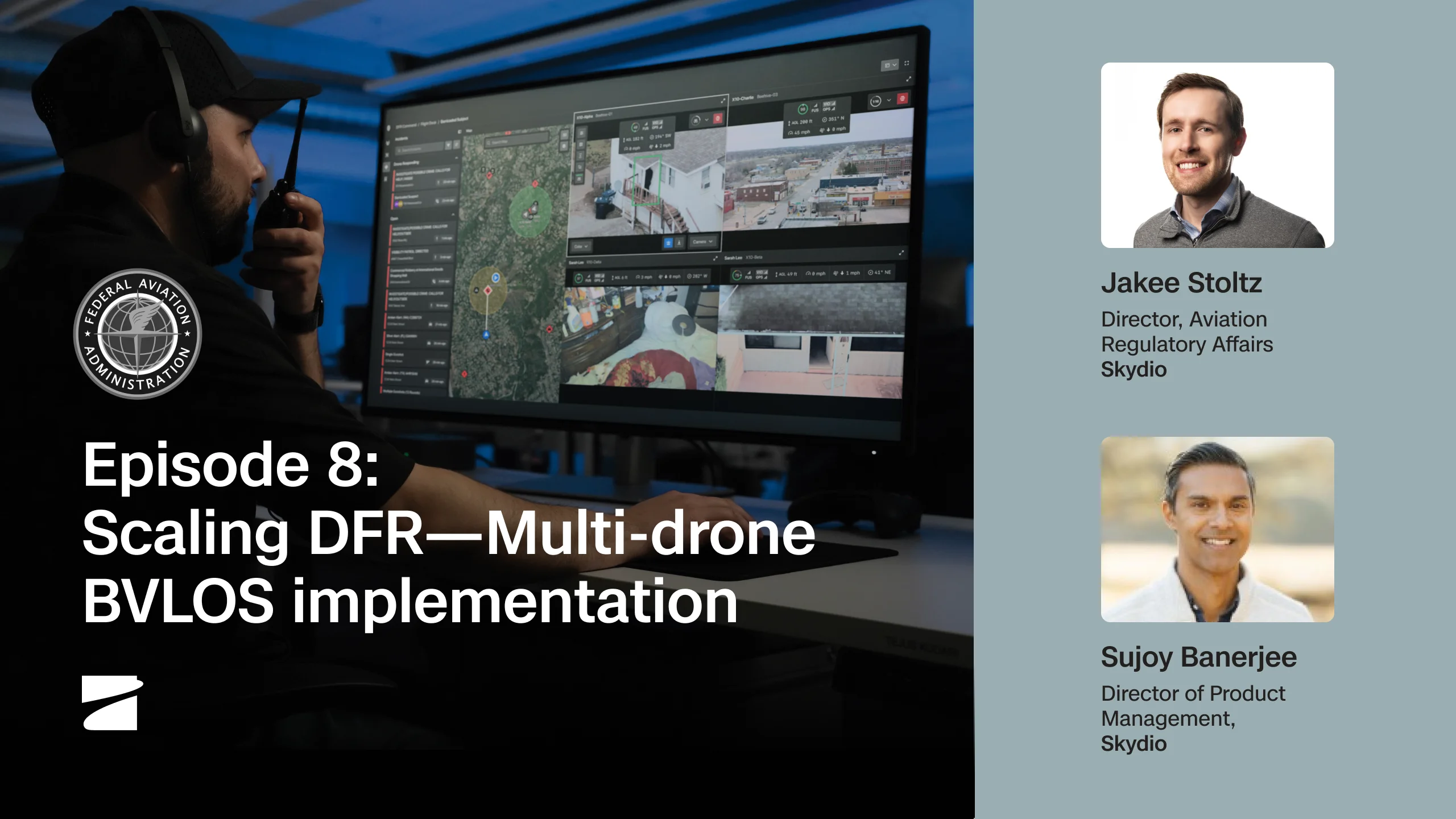
Episode 8: Scaling DFR - Multi-drone BVLOS implementation
Watch webinar
Episode 6: Unlocking zero grid & multi-drone BVLOS
Watch webinar