

Strategies to avoid utility downtime and cut inspection time by 50%
Watch this discussion with Levi Young, GIS/UAS Analyst at Arkansas Valley Electric Cooperative, to see AVECC’s aerial inspection workflows with Skydio drones that have cut inspection time by over 50% while unlocking new capabilities and mitigating employee risk.
Learn more about how to improve utility reliability and resilience using drones.
- Hey, everybody. Welcome to Skydio's webinar,
- co-hosted with the Arkansas Valley Electric Co-op.
- Today we're gonna be talking about strategies to avoid downtime and cut
- inspection time by about 50%.
- Uh, my name's Ongan Singh, and I will be your main host for the
- webinar today.
- I am a, I'm the channel sales manager here at
- Skydio, so my job is to manage the
- partners, um, that sell our product into the field.
- Um, you may have, you know, seen me on a webinar before.
- I've been doing these for, for a while now,
- at different companies around the UAS
- industry. Uh, my background's in photogrammetry
- and remote sensing, and I've kind
- of made my way through, through to, to being a, you know, partner manager, um,
- here now at Skydio. I've been at Skydio about nine months.
- Um,
- today am I... I'm, I'm gonna be the main host,
- but I'm not gonna talk that much
- because we're really gonna focus on our co-host and our guest speaker today.
- So Corey Hitchcock, he joins us now. He's, uh, he's new to Skydio.
- He, uh, he left the utilities industry where he
- helped grow one of the biggest
- drone programs at Southern Company, uh, for utility-focused inspection,
- um, to now be here a solutions specialist for
- the utilities industry at
- Skydio. Um, and I'll let you know Corey introduce
- himself moment, uh, for a bit.
- So Corey, go ahead and, and tell the world why you're here at
- Skydio and what
- you're excited about.
- Hey, I'm Corey Hitchcock. I am excited to be here at Skydio.
- Uh, I am the utility solutions specialist, as Ongan mentioned.
- Uh, I, uh, am kind of the, um, serve as
- a bridge between the utility community and, and
- industry and, and Skydio proper. So excited to be here.
- Uh, excited to hear what Levi's got to share.
- Yeah, absolutely. No, we're really excited
- that Corey joined the team.
- You know, I've had the pleasure of working with
- Corey in the field when he was at
- Southern Company. Um, and, uh, it's pretty exciting when, when we can get
- experts from the industry to come join a company like Skydio and really help push
- it forward. And so Levi Young, you're a GIS analyst and, um, you know,
- helping run, run the UAS program at Arkansas Valley
- Electric Co-op.
- You've been doing it for a couple years.
- You're helping implement some really cool technology and kind of pushing the
- boundaries. You know, I think in the last two
- or three years we've seen significant
- growth in the, in the indust- industrial side of drones,
- but a lot of it has been
- pushing use cases that we've kind of built over the last 10
- years and pushing
- those for, for growth. But I think what we're gonna talk about
- here today is
- something a bit novel. Uh, it's new and it's something where you're really
- pushing the boundaries of what's possible, um, and allowing your, your company to
- innovate. So if you go ahead, tell us a bit about yourself.
- Tell us a bit about Arkansas Valley Electric Co-op, and then let's hit this
- off.
- Yeah. Um, hi, I'm Levi Young. I've been working here at
- Arkansas Valley Electric for almost five years now, and,
- um,
- been a certified pilot for at least four years.
- I think I got it about six months after I, uh, I started here.
- As Arkansas Valley Electric, we're a not-for-profit that was, uh,
- founded in
- 1937, and our UAS program was founded in 2017.
- But as a cooperative, our goal is always reducing outage time,
- uh, whether it be for asset fault or a storm.
- Um, making safety
- our number one priority, and then reducing costs because everyone
- wants to
- reduce costs.
- Personally, my goals are always to innovate
- and to push the boundary
- on what we can do, and especially in the drone world.
- So that's, that's why we started looking for these
- different ways to
- up what we were already doing in our company.
- Um-
- Oh.
- All right, Levi. So let's talk about some of the critical
- inspections you guys do
- with your drones. What, uh, what are you using drones for, uh,
- or what have you
- been using drones for in the, uh, at your co-op?
- Yeah. Um, so we
- have been doing distribution, uh, inspections for a while.
- We started out with transmission line inspections, and tho- those go, go over
- great. Same thing with distribution. Um, device inspections are a big one.
- Uh, making sure asset health is always at its peak so we don't have as
- many
- outages. But when we do have an outage, whether it be storm related
- or asset health
- related, a lot of times we're called on to go out
- in front of the lineman.
- Let's find the damage, find where things are going wrong,
- report back, and that way
- they have exactly what they need and know exactly where to go before they
- ever get
- there. The last thing and kind of what we're gonna talk about
- more so today is
- substation measurement and substation inspections.
- Mapping out the substation and
- being able to,
- uh, update spec sheets or,
- or, uh, just get sizes on things or even
- asset health again, because
- a healthy substation is gonna keep everything running better.
- So this, this proactive outage inspection
- that you're doing, is that
- more like to, to help you guys manage your momentary
- outage situation? So like the, the, the, the better
- understanding you have of what your system's doing, the better, uh, you guys
- can manage the, uh, the momentary situation? Nuisance outages.
- Yeah, and I think that's, that's a big thing
- that a lot of people don't realize,
- uh, in not only the drone world, but just in electrical world or
- all utilities in general. If you're keeping up with asset health
- ahead of
- time, the proactiveness of it, it's going to make it better in the long
- term.
- You're gonna have less of those outages.
- So the more frequently we can keep up with
- inspections, the less time that we're gonna have people out of power
- or in other
- utilities, just out of whatever they may, they may serve their members.
- Cool.
- So, um, so tell us how you used to do it
- when you first started using drones
- before, before you used the, the Skydio, uh, s- 3D scan method
- we're gonna talk about later. So what, what were you guys doing when you went to
- inspect a, a substation or, or transmission or distribution line?
- Yeah. So whenever we were wanting to map a substation,
- typically, like I said,
- we were looking for, uh, spec sheet updates or something like
- that because maybe
- the spec sheet was damaged or, or it was illegible, or it hadn't been
- put into digital yet, and we're, we're trying to update things before we
- move over
- to digital. Things like that. We're wanting to get a,
- a size comparison of the
- whole substation. So as you can see on the pictures here-
- We would put a stick or a piece of PVC pipe with some markings
- on
- it for measurements, and we would know the size of that, that,
- uh, object
- and put it up on a long stick next to the, uh, the power
- grid, whatever it may have been at the time,
- with this, in this case, an insulator.
- And this one was offline, so no power here,
- so it wasn't a big deal that it was
- right there next to it touching it.
- But we're able to
- take pictures of the entire substation.
- We took, uh, thousands of pictures, and it took about a
- day to take all of these pictures just flying. It took several people.
- I mean, there was a few of us pilots, and then there was a few linemen, a
- sub tech, maybe an engineer as well.
- And we had to do all of this gathering of information,
- and then after that, we still had to have somebody come back to
- the office, take
- all of those photos into a PDF viewer or a, a photo
- viewer, and take that measurement that we know of that, that, uh, stick
- or that
- piece of pipe and were able to
- tell our, our sizing of insulators or bolt patterns or whatever it may have
- been
- that we were wanting to get. Uh, but they had to do it for every single
- picture, and if they ever needed to go back,
- they had to go find that picture
- through thousands of pictures.
- Right. And so, so this, so you using, um,
- the traditional method that you just described was a manual
- capture of, of the whole asset, right?
- You're, you're manually operating the drone,
- manually flying it and doing the
- capture.
- Yeah. W- we manually pilot it, and then somebody had to hold the stick
- the whole
- [laughs] -- during it as well. So that-
- Right. Yeah
- ... like, it's pretty tiring. I don't know for those people
- that have used those,
- those are not the lightest of objects, especially whenever they're 40 foot in the
- air above you. [laughs]
- Okay. Cool.
- Um...
- All right. So, so now tell us how you were able to do it using that Skydio
- 3D scan. Like, how, how did that make your, um,
- capture faster? How did that, um, you know,
- uh, improve your workflow?
- Yeah. So it really changed the entire game for
- specifically the substation purpose, and that's kinda what we were looking for
- anyway because we went from having to have several people there,
- whether it be pilots and linemen and stuff like that,
- now I can go by myself and
- fly an entire substation without anybody there.
- We tend to keep a sub tech or an engineer there just in case.
- Uh, it's always best to be safe on these t-
- types of things.
- But one or two pilots may be necessary for an
- inspection like this, but that's about it.
- And I can go out there, I can put the drone down
- or send it up into the air and say, "Okay, here is
- this object, here's this object, and here- here's this object," and then it goes
- and scans every single one of those on its own.
- And I don't have to touch the controller after I say go.
- I just have to maybe change a battery or two throughout the process.
- It's not really... It, it's a process that's so easy
- almost anyone could do it in a substation immediately.
- That's cool. Angad, you wanna-- you had some questions about, uh, EMI and
- the, uh, obstacle avoidance with the Skydio,
- or you, you had some
- comments there.
- Yeah, absolutely. I mean, so this is one of those moments where, you know,
- dealing
- with this in the field and, you know, Levi, having met you in the field and, you
- know, kinda helping that journey of getting your team Skydio
- drones, what
- we've seen is a, a lot of folks are inherently worried about flying
- in electric environments, right? In, in, in areas where...
- I mean, you're flying this, this drone in, in this, in this GIF here is flying in a
- live
- environment where that substation's not turned off, right?
- And I think that th- this is a great time to have a little bit of a
- discussion with
- Corey and, and Levi about how that is and flying
- traditional drones into flying Skydio, right?
- For those who don't know out there, Skydio drones are fundamentally different.
- They have six cameras on them that see the whole world around it, and
- every moment it's building a real live 3D model of everything that it
- sees. And the AI on board [loud engine revs]
- allows it to fly.
- Obstacle-- it's obstacle avoidance based off vision,
- based off
- navigation, right? And so we're in that energized environment,
- and we're flying these drones, and h- how is the drone not getting
- confused, right? I mean, we sometimes say Skydio drones
- are immune to
- EMI. Uh, Corey, you know, i- i- in that, in that energized
- environment, you've been, you've been flying these drones.
- Levi, you've been flying these drones.
- What's your experience with traditional drones in the industry and then moving to
- the Skydio platform in this specific use case?
- So for us personally, um, [lip smack] over the years...
- And sorry, there's a mower going around outside.
- [laughs] Couldn't have come at a worse time.
- But, [loud engine revs] uh, it's, um,
- we-- In the older drones, if you even went around a transmission
- line, you would
- start to lose signal, uh, just from any electromagnetic interference
- no matter what. But yes, in this, in this video, this is a live
- substation. I was able to, to... Uh, I wasn't even able to.
- I pushed the button, and the drone was able to fly on its own,
- and we never lost
- connection. We kept pict- We were able to view pictures of it,
- view the model it
- was making at the time or, or at least the, the bulk of the model,
- so it
- knew-- we knew it, it was gathering plenty of data on what it
- needed to see.
- [loud engine revs] And it never, it never even thought about
- hitting a line. I mean, it, it dipped and dived.
- It went between bus lines, highly energized, no, no
- problem at all.
- Yeah, no, I, I think that's something that,
- that's pretty, you know, a
- technological advantage with this type of solution is that that camera is seeing
- all the world around it and allowing it to fly in that
- energized environment, and the drone's not getting confused,
- and the drone's not
- crashing, and that's something that's pretty
- special, right?
- And that's why we're talking about a novel use case here with flying in these
- energized environments. So I think this is really cool and, you know, let's,
- let's pop up, uh, let's talk about how you're--
- what you're actually doing with
- that 3D model and what it looks like.
- Yeah. So once we took the, the scan in about two
- and a half hours for the whole
- thing, we were able to push it over to GenX Labs,
- which is a software that
- we use, and it takes about 16, 24 hours for the process
- of this substation. It is a smaller one.
- But most poles and things like that don't take near as long to process.
- Um- And of course, a bigger substation's gonna take longer.
- It's just more data.
- But we can always refer back to GNX for these.
- So we can just go into this model and double-click onto a picture.
- So it's super simple that way.
- Um, we're able just in flight time to take
- this from a day
- of flying to just to two and a half hours, and it gives us so
- many different uses rather than just the, the
- measurements.
- Um, we're able to inspect asset health, make sure we're maintaining our,
- our substations or our poles, whatever it may be that we're inspecting.
- We're able to do all that through this as well,
- and we can use GNX to tell,
- uh, changes over time
- during this type of thing as well.
- Okay. Super cool. So basically, just to clarify for some of the audience
- out there,
- you're, you're getting out there, right?
- You're taking your drone out of your box, you're putting the battery in, you're
- looking at that asset, at that substation, and you're going into 3D
- scan mode, and the drone's taking off.
- And then you're basically flying around the substation.
- The drone on board is understanding the volume or the object
- that you're about to go fly, and then you're pressing go.
- And now this drone's zooming around that, you know, energized substation,
- taking hundreds and hundreds of photos autonomously,
- avoiding all the power lines. And there was a question in the chat here,
- what is
- the thinnest object that Skydio can avoid?
- And you can think about it, about a half an inch.
- So as long as, you know, a power line or an object or a thin branch
- is thicker than
- half an inch, you're, you're good to go, and you can, you can av- the drone will
- avoid that because it's seeing everything around it.
- So while it's seeing everything around it and avoiding stuff, it's
- simultaneously taking photos from anywhere from three
- feet away to 10 feet away from the object.
- So it's taking these super high resolution photos of the entirety
- of that substation, and then the drone's landing.
- You're taking that SD card out, you're putting it into GNX Labs
- or whatever
- photogrammetry platform you choose. I mean, here we're talking about GNX Labs.
- We're about to show that digital twin, and then you're going ahead and you're
- pressing process, and then you're getting this beautiful
- point cloud.
- And, you know, I'll, I'll... My background's in photogrammetry and,
- and doing this
- type of work, and when I look at this point cloud
- that we're about to go through,
- I've been pretty amazed by it, right?
- And that's because traditionally capturing point clouds of,
- and, you know, creating digital twins of objects that
- are super thin, um,
- and long like power lines, that's been hard because the traditional
- methods of image capture are flying 100 feet or
- away from that object, that volume, that thing that you're interested in
- mapping. And here with Skydio's 3D scan, 'cause the autonomy is allowing you
- to get so close, and on doing it by itself, you're taking
- photos from, like I said, anywhere between three to 10 feet away.
- And so you're getting a higher resolution photo closer up to the
- object that you wanna map, which is this energized substation, and that's
- allowing us to get this beautiful 3D model.
- So I'm gonna turn it back to Corey and Levi, and let's, let's hop into the 3D
- model and let's examine it, and let's talk about what we're really
- using it for and
- the value to the, to the engineers and to the electrical.
- Yeah, for sure. And one thing I wanted to add to that,
- we fly around our copper
- lines as well that are even thinner, and it's not had a problem seeing those in
- good lighting as well. So let's hop over to that model.
- Um, so can you guys see the model now? Everything's good?
- We got it. Yep.
- All righty.
- And we had a couple points we looked at here and some things we were able to kind
- of get out of this. Uh, we'll hop over here first.
- Looking at-
- And just so, so everybody understands, uh, we used 3D scan or out-
- or Levi used 3D scan here to, uh, scan the substation
- pretty, uh, fully autonomously. So the, basically you create the boundaries
- of the volume that you wanna scan, and you hit go, and the drone, uh-
- Yeah
- ... does the scan, and this model was what was able to be created with it.
- And, uh, we've got about, uh, three, uh, a, a few
- things that we wanna show you. Uh, and, and Levi,
- let's start with those insulators
- that we saw.
- Yeah. Yeah, for sure. And right up in here, um, one,
- one thing that was
- really
- amazing was we're able to get the geometry out of these insulators.
- Typically in photogrammetry, you, you get a cylinder,
- so it was ... It's incredible that we could see the,
- the spots between these and
- the differences. You see a couple holes here and there,
- but that could be maybe we
- didn't,
- uh,
- didn't get a good picture of one angle or, or maybe a shadow hit it wrong,
- something like that. But for the most part,
- beautiful on all of this, and
- we can double-click in here,
- just if we're looking at inspections, um, just to make sure of the
- health, no tracking on our insulators and things like that.
- Yeah, and that spot that you clicked on the 3D model
- is then referenced
- over to the 2D photo that was-
- Yeah
- ... used to create that model. So you're able to get, um, the full
- resolution image and be able to-
- Yes
- ... kind of, uh, you know, inspect those insulator pins and
- really get in there and, uh-
- Yeah
- ... and view your asset.
- Yeah. And it's, uh, we can annotate the image just as well
- as we can annotate our model here. So we can, we can s- mark
- spots that are damaged or anything like that as well,
- and we can slide through to
- different pictures and different angles on this as well.
- So it, it's really helping for inspection
- purposes and
- whatnot.
- Yeah, that's pretty cool. So take us over to what we found on those,
- uh, those
- lightning arresters there-
- Yeah
- ... on the-
- So over here we were able to find that on these
- arresters,
- and you can see it's come up down here in the corner on this angle of the picture,
- that we're missing a squirrel guard there.
- So we got to looking at all of these,
- and we noticed... Oh, gave me a bad angle that time.
- Let me see here.
- Might have misclicked.
- There we go.
- And you can see that on all of these, it's either damaged
- or it's been
- missing altogether. Uh, so we're able to go out and have
- that fixed
- and make sure everything's safe and for us and the squirrels,
- [laughs] of course, or other wildlife
- And then, uh, and then finally in this model, um, we've
- got a, a measurement of-
- Yes
- ... a high side switch that you did. Um, can you kind of talk us through that?
- Yeah. And this is, this is one of the main things that we
- were looking at
- whenever we were doing it, uh, because we wanted to be able to measure
- for, like I
- said, the spec sheets and things like that,
- or for future builds to say, "Okay,
- this substation was built this way, and we wanna go from this point
- and build into
- a new one, but we know we need the same sizes,"
- or things like that.
- And we're able to do things like bolt spacing here.
- You can see I was able to take this polyline and measure.
- We know f- .452 from that bolt to that bolt.
- Uh, three foot from the inside here to the
- inside here,
- roughly three foot. Uh, roughly four point...
- or .45 is again about
- .1 or almost a foot between
- these two on this side here you can see.
- And then again, so we can assume out of this
- that all of these are the same
- bolt spacing of a .45, which is about five and a half inches,
- and there's three
- foot in between these two and about a foot in between those two.
- And that way we can, we can kinda know
- which ones we're looking for
- whenever we're going to order new things.
- Uh, as you look here on the length,
- you can see the length of the entire thing. It's about five and a half feet.
- Um,
- it is
- that, that 462 is gonna be about five foot five
- and a half inches, and
- we know that. And then we can come back
- and see the actual width.
- And one thing that, uh, we had talked about, Corey,
- we know that's a six-inch
- across beam, and it's showing that it's exactly half a foot because you
- can see here that's all shadow over there.
- Uh, so we know from there to there is exactly six inches
- going across it.
- Which is, which is pretty cool, which gives you confidence in your other
- measurements that you made on your 3D model.
- If you take a known measurement-
- Yes
- ... um, you know, from the model knowing that that,
- that's a six-inch piece of
- steel and, um, and be able to, uh, infer or
- confirm that the other measurements are good.
- And that's another thing you can do.
- Like we did that, that piece of wood before or
- that piece of PVC pipe, you can do
- the same thing. I mean, measuring concrete on the ground,
- if you know the size of
- the concrete or size of a two-by-four or something like that,
- you can measure off
- of that so you can have a guaranteed measurement and know exactly what your,
- what your area of leniency is.
- That's, that's super cool. You know, uh, by the way, hey, for all the attendees out
- there, keep your questions coming. We see them.
- We'll address them as we get towards the end of this webinar, so we really
- appreciate you being active and engaged and asking questions.
- And I know we had a couple questions just come through about accuracy, right?
- You know, the... What's really interesting
- when I'm hearing this discussion between
- Corey and Levi here is they're saying, "Hey, we know that beam is, is about half
- a... you know, six inches across." And so when we show in the measurement
- that
- because we know what it really is in the real world,
- we're able to use that as a
- reference in the 3D model in this digital twin to show that
- it's accurate, right? This isn't, you know, survey grade work
- that we're doing with
- drones where we're going out there with, you know, high precision GPSes
- to really ground truth the measurements in the entirety of this model.
- It's different because this is a substation.
- These are known parts and known locations, and there's traditional
- lengths, right, Levi? This is... We had this discussion earlier where you
- were
- saying that you know most of the measurements already because they're
- pretty
- standard through that substation-like environment.
- So by going in and measuring a known reference, you know that,
- hey, that's pretty tight, which means that if that's pretty tight, the whole
- model's pretty tight, and now you have some pretty good
- measurement capability that
- you're able to make through there.
- Um-
- And the incredible part is none of this was done with an RT-
- RTK system,
- and we're still able to find this.
- Right.
- So.
- Um,
- okay.
- Hop back over here, uh, to the-
- We had a... Real quick before you go, go to the next one.
- Yeah.
- We had a, a question from, um,
- Douglas Smith about m- "Can you measure
- that vertical clearance where the,
- uh, measurement will snap to the ground?" Um,
- I'm pretty sure that's a feature or
- function inside-
- Yes
- ... GNX where you can measure that out.
- It can be terrain clamped and vertical as well.
- Yeah. Yeah. That's pretty cool. All right.
- Yeah.
- Go ahead. I'm sorry. Go to the-
- No, you're fine. Okay. So let's hop back
- over here. This... Back to the slides here.
- This video was shown, [laughs] um, on a LinkedIn post.
- Some of you may have seen it.
- Uh, and it was the first time we'd ever flown
- the Skydio around
- live lines. Uh, and this is a... It's the first 3D scan.
- W- the first time we ever 3D scanned a live
- line.
- Um, and it's a, an electronic recloser bank,
- three of them,
- and, uh, we can just kinda talk through it,
- I guess.
- You can hear myself and my supervisor, um,
- talking about how nervous it's making us because we've not...
- We surrendered control one time, but it wasn't around live wires.
- There, there was no wires on the pole at all.
- It was a, a climbing pole just for, for training linemen and things like that.
- So this is a really cool one.
- It's making me nervous.
- So you can hear me.
- Yeah. Yeah, a little bit.
- [laughs]
- Remember how I told you that I was kinda scared of it the other day?
- He hadn't been around it at this point, around-
- It is a terrifying thing to surrender the control of something like this
- ... the pole and things like that. I did all the testing.
- Good thing is, if I'm videoing it and it wrecks, I got it on video.
- And it did speed up here.
- [laughs]
- It is at real time right there.
- Right.
- It's, it's flying around. We, we sped it up just for time's sake, but
- it took
- several... I, I think it was over 500 pictures of this pole to do
- it.
- I think it's doing fine.
- And we can-
- It's making me nervous
- ... go ahead and hop over
- to the actual model of this again. Let's see here.
- So this is the model that came out of that scan.
- Um, it came out amazingly. One of our favorite models because
- you can see all of the jumper wires, um, the bypass switches.
- Everything's looks amazing. And we can still do
- that same thing where we can click
- in, see the actual pictures, and- Corey, we kind of talked
- about it earlier
- Yeah, we got squirrel guards on those light
- interesters
- The, the squirrel guards are in place, and they're healthy.
- [laughs]
- Yep. Yeah, this is a pretty cool model because, uh,
- with this model-
- Mm-hmm
- ... and the 3D scan, you can clearly see the status of the, uh,
- of the
- recloser, that it's online. You've got your line-
- Yes
- ... and source site disconnects closed, and that your bypasses are open.
- Um-
- Everything's good.
- Yeah, w- it was just... I was pretty impressed by the, uh,
- by this model.
- And once again, I mean, the geometry of the insulators up here
- was impressive
- on all of them.
- Yeah, being able to see those sheds.
- And then if you click in on those sheds, um, of that insulator, you can get
- a pretty decent view-
- Yeah
- ... of the, uh, of the polymer up there.
- Yeah.
- And you can get se- there's several angles of every single
- piece, so-
- Yeah
- ... you can always-
- And you can see that you've got your cotter pins installed there on that,
- that last
- view you had.
- Got your cotter pins installed in,
- in the, uh, hot and dead end of that insulator, so that's pretty cool.
- Yes.
- It's, uh,
- really changing the way we can inspect these things, and one thing we haven't
- really talked about that we might want to, uh, is the settings used on these two
- models.
- Mm-hmm.
- Um, for the substation, we were using an 85%
- overlap and a s- 85% side lap, and we were 12 foot away for the pictures.
- So it wasn't even that close, and we still got a beautiful model.
- And we're doing testing to see what a greater than 85%
- overlap and side lap can do for us and a closer picture.
- We're, we're getting to that more and more.
- Um-
- Yeah, and the, and the really cool thing, uh, or the aircraft we used for this
- one was the, uh, X2 Enterprise, correct?
- Yes, just the X2 Color. We didn't-
- Oh, the Color
- ... didn't do the-
- Okay, so it was the X2 Color. And then, um, we've had some
- questions about how many battery swaps did you have to do when you were doing that
- substation inspection?
- So the substation I did in three different scans.
- I made sure, of course, you want to have your,
- your landing box in the same
- spot for the entirety of all the scans, but specifically for each
- scan you want that box in the same spot.
- It's not as crucial whenever you move to a new scan.
- So we did the high side as one scan, and I can
- switch back over to that, uh, substation.
- Mm-hmm.
- We did this high side as one scan, and it's a 3D tower scan.
- It's not the, the regular 3D scan. A 3D tower-
- Okay
- ... because the tower scan really finds these
- lattice structures really well,
- so we're able to get those a lot better with it,
- and it finds each of these as a pillar and do- does that, and then, uh, the,
- the cross beam here also as a pillar.
- And then we did the transformer as one and the low side as one.
- And the high side, I believe, took two batteries.
- What, two switches.
- Or no, two batteries, one switch.
- Mm-hmm.
- So we started with full battery, switched once,
- and used most of the next one.
- The transformer and the breaker here in the middle
- took
- one, one battery. Uh, it may not e- the reason why I say it questioning like
- that, it may have been the one that was left over from the high side, and I'm
- [laughs] not, not 100% on that. But, uh, it, it only took one for that,
- and then two again for the low side.
- And we're able to get down in, into the entire low side
- and take pictures of all of
- it as well.
- That's pretty cool. And, uh, we had a question about the,
- um,
- metadata that's captured. Uh, the, the metadata that's captured
- when, uh, taking photos with the Skydio products can
- be, um,
- pushed into whatever your 3D mapping, uh,
- solution is, whether it's DroneDeploy, Genext, um,
- you know, Pix4D. Whatever you use, um, it, it can be used, and, and Esri
- SiteScan as well. Um-
- And I know, um,
- Genext and Skydio have now partnered even closer, I believe.
- Mm-hmm.
- And, uh, now your models when you put them into Genext will go
- directly to the
- Skydio Cloud or vice versa. I ha- we haven't gotten to that yet, uh, but it,
- it's a
- relatively new thing, but it, I think that's kinda what they're talking
- about
- there.
- Um-
- Yeah, so b- basically just to, just to clarify that point, right?
- Like, Skydio is software agnostic when it comes to the
- photogrammetry softwares you can use. So the...
- just, just like Corey just said, 3D scan is Skydio's
- software to collect the images. So here, to
- clarify, when Levi's saying, "Hey, you know, I sc- did three different
- scans," he's going out there and he's doing three different
- missions-
- Yes
- ... or scans to collect the photos for the
- high side,
- the middle, and then the low side on, on the right side of this, right?
- So essentially you were doing three or four different missions in the field,
- collecting all of those photos, and now you have those couple
- hundred photos that are on the SD cards of the drone.
- You're taking that, and those photos each have the metadata
- required
- to process those photos into a point cloud or a mesh
- in a photogrammetry specific software.
- In this example, we're using Genext Labs-
- Yeah
- ... but you could have also used DroneDeploy,
- Pix4D, SiteScan,
- um, you know, the, the plethora of other ones that
- are out there, you know,
- Bentley's ContextCapture, et cetera.
- But we just happen to be using Genext Lab because that's what Levi
- uses at Arkansas Valley Electric Co-op.
- Yeah, I-
- So I think that clarifies that for the folks out there.
- The Skydio also produces, with every 3D scan, produces a
- CSV file of all of that metadata as well, if your software needs that.
- Our Genext does not. Um, I'm literally able to take all three
- scans, shove all
- of the photos in at one time, and hit upload and process,
- and it does it all for
- me.
- Yeah.
- I, I never have to do any of that.
- To clarify, that CSVs file is, is very specific for use in
- Pix4D. So it would help Pix4D process even
- better.
- But like you said, you don't need that here for Genext Labs.
- Genext is a cloud-based solution.
- They are a tech partner for, for Skydio and, uh, and they're what Levi
- uses, so that's what we're showing off here in
- this webinar
- So we had a, had a question about a thermal capability
- of Skydio
- drones. Um, this particular capture was done with the X2
- Color, so it did not have a thermal camera,
- but Arnag, could you talk a little bit
- about, um, thermal capabilities of Skydio?
- Sure. Absolutely. So, um, w- we had a couple questions, just like Corey
- said, about the different drones that Skydio has, right?
- Skydio has two different main models of drone.
- We have the S2+, which is a bit smaller.
- Um, it just has a color camera or an RGB camera.
- And then we have the X2, right? The X2 is our enterprise level product.
- It has the folding arms, it has three, three props instead of two props because
- it's quieter in the air. It's NDAA compliant,
- which means it fits a lot of
- the, you know, compliance requirements for, you know,
- American
- product, et cetera. It's what the federal government is,
- has chosen as, as their
- drone of choice. It's what the DoD is using, and it's what the drone that
- was used
- in the video here. The X2, right? Think of X as expert
- or enterprise. That X2 product that Skydio has, our
- drone, 35 minutes of flight time,
- it comes in two different camera configurations.
- It comes in the color version, which is the same camera as on the
- S2+ drone, so that's just a wider angle view
- RGB camera that is optimized for this 3D scan and better for
- close-up photos and inspection applications.
- But the X2 also comes in a variety of w- where, in a variant of
- camera where it has a color, so an RGB camera, as well
- as a thermal camera. But think about that gimbal, that sensor plane
- is the same size on the X2 Color and the X2 Color
- Thermal. So when we have the X2 Color Thermal,
- the one with the RGB and
- the thermal camera, the field of view of the RGB camera
- is, is a bit smaller because we have to fit
- two cameras on the same
- size gimbal. So here, that's why Levi and a lot of our utility
- customers are primarily choosing the X2E Color because the field of
- view of the camera's bigger and it's better for inspection
- and close-up photos.
- But to talk specific to thermal, yes, you could have used an X2E Color Thermal
- and gotten those thermal photos as well.
- You can do the inspections in thermal.
- I think, you know, Corey and Levi, if we want, talk about, uh,
- I think Corey may
- have a bit, bit more experience with, with thermal inspections here,
- but thermal's
- a fantastic way of seeing when a piece of equipment
- is getting towards end
- of life or when it's hotter, typically that's indicative of something
- going wrong
- within that piece of equipment. You can produce thermal point clouds
- or thermal
- maps. However, many times in that photogrammetry
- process where you take all those thermal photos and then apply the photogrammetry
- algorithms to make the 3D model, it loses some data.
- And this is obviously a pretty technical topic, and email questions or I'm, I'm
- happy to have a conversation with you about the technicals of,
- of [laughs] making
- 3D models with thermal imagery. But the reality is that it's
- better just to use the flat photo, and in this case, no, I don't think,
- Levi, you don't have a, a thermal capability on your drone.
- It's not here. So maybe Corey, if you wanna just touch on it, you've, you
- use thermal in the field. Where's the benefit in, in this use case?
- Is it really needed or not? What do you think?
- Well, well, yeah, I, I think, um, uh, inspecting your switches,
- arresters, connections, that kind of thing with thermal
- is super valuable,
- um, to allow you to see like a, a difference of temperature to give you an
- indication to make a more, um, you know, in-depth
- thermographic assessment of what's going on.
- Um,
- I, you know, it's... We've found problems with switches, with
- arresters. You could, um, uh, polymer arresters or ceramic
- arresters are able to see the difference in temperatures there and identify
- problems. Um,
- somebody had a question about the, uh, the operating envelope of the
- X2, and, and from what I understand, the operating envelope
- temperature-wise is, uh, 14 degrees
- Fahrenheit to 104 degrees Fahrenheit, and those are
- ambient temperatures. Um, and the drone will
- perform in, in all of those, um, in that
- environment.
- Um, let's see what other photos or questions-
- I, I was gonna add, uh, to the thermal-
- Go ahead. Sorry
- ... the thermal part of it, we do thermal inspections as well with
- drones.
- Um, we don't for this use case specifically
- because it's
- better to look at 'em, like you say, with a flat image a lot of times.
- Uh, but Genex does have a, a thermal capability on their models,
- and we've not
- investigated the 3D modeling with thermal yet, but we,
- we find thermal very helpful on s- like you said, switches or,
- or any, any point of connection, uh, can be an issue.
- So it's always good to look at that kind of stuff thermal-wise.
- You know-
- All right. We had a question about, um, are there perspectives that the drone
- captures that you couldn't see before?
- Like we talked about those, um, I'll let you talk through that on the
- insulators, Levi.
- [clicks tongue] Yeah. Um, I'm not sure on
- that model
- exactly if I could find one right away.
- Uh, but with the Skydio's capability of
- looking directly up with
- that gimbal, we can see the bottom side of insulators
- and the top side, but,
- uh, we talked about it earlier,
- whenever we're doing just regular inspections on poles and things like that,
- the, um,
- the ground inspections aren't finding things that you're gonna see from above
- ever.
- And the, you're gonna be able to see tracking your
- own, be able to see cracked
- insulators or maybe a hollowed out pole or something like that.
- So-
- You know, or that, or that's-
- ... that offers a different perspective. Is that answering the question?
- Yeah, yeah, or, or maybe see that flash mark that's on the top of the
- insulator
- that you couldn't see from the ground, you know, um, indicating like
- a, a failed insulator.
- Yeah, or the pins like we, we pointed out in a couple of the
- different situations,
- the cotter pins being taken out, um, or fallen out.
- Those, those you're not gonna see very easily
- from the ground.
- You may get binoculars and, and see 'em, but they're, they're pretty small up
- there.
- Yeah. Um, so we had a question about, uh, the
- docking station for the Skydio X2.
- Uh- There is a dock, uh, s-
- solution maybe, Unga, could you talk through the, uh,
- the dock and dock-based
- inspection?
- Yeah, absolutely. I think that a lot of folks here,
- you may have seen Dock Day.
- Obviously, Skydio's made, uh, you know, tremendous waves in the industry for being
- one of the first companies to come out with a commercially viable drop dock
- solution. For those of you who don't know, think of the dock as like a little
- doghouse for your drone. And so your drone, it,
- it lives in this little
- box, this home, this dock that charges it and is connected to the
- internet, and allows that drone to go out, do a mission, and
- come back, right? And obviously, Levi, we've had many discussions about the
- future of where your program's going at Arkansas Valley Electric Co-op.
- And e- essentially, the way that this is working is today you're going out there
- and you're doing the substation inspection.
- You're taking that drone out of the box and you're doing, setting up that 3D
- scan. But if this was something that...
- And I mean, okay, just to ask a question, Levi, really quickly, how often do
- you 3D scan the substation?
- Um,
- so currently we're trying to do them more often.
- We had another project that came up, uh, that's inspecting pole tops that we're
- doing more. But what I'd like to do is at least,
- so we have 36 substations, so at least every sub-
- next substation once a year.
- Um, now more frequently as a dock purpose, I would
- love to do it monthly, weekly, uh, because the, the drone can sit there.
- And once you get that, that BVLOS, which I believe you guys
- have a system that works with people to, to acquire that, and specifically,
- specifically in a substation saying, "Okay, we're restrained to this area only,
- and we're only gonna fly at these times," and things like that.
- Um, I think I would do even weekly inspections
- of
- substations if I had a dock at a substation.
- So essentially what you're saying is
- you wanted to do some of these substations,
- maybe some of the really important
- substations where that, that power's going to a,
- a bigger community, and there's a
- lot of people downrange from where that, you know, that, that energy's being
- produced.
- If that's something that you want to be doing at a very
- repetitive interval,
- once a week or maybe even more than that, today a
- human has to go out there and take out that drone and scan that.
- That's labor to get out there. That's an individual's time.
- You know, obviously you're a, a GIS analyst and you have a lot of other
- work to
- do, right? But what makes you more efficient,
- if you know it's a repetitive task,
- is to have a docked drone at that substation, where now you can
- do this type of work, but the drone flight
- and the image collection process
- will be done by itself. So you could put a Skydio dock in that
- substation, and this drone could once a week
- or once a day or at
- whatever interval you wanted, fly, take off, do the whole
- automated scan by itself, come back home into its dock,
- recharge its batteries. It's connected to the internet.
- All those photos will be uploaded via the cloud to you so that you can then
- process that in Geonex Labs or whatever other solution you want.
- And something else that Levi just said was he talked about this waiver
- process, right? Obviously, a drone flying by itself
- out there in the real world, that is under the control of the
- FAA outside. So Skydio has an amazing regulatory team
- that we have in-house where they will apply for those waivers, and they
- will he- help our end users make sure that they're doing everything
- legally and everything absolutely correct in regards to airspace and
- permissions and flying under, you know, different waiver processes, et
- cetera. Because now the human that has that typical Part 107
- license is now out of the loop with the dropped drone solution.
- So that's essentially what Levi was saying is,
- Skydio will get you the waivers.
- It'll give you the dock. It'll put the drone out there,
- and now you can do these
- repetitive tasks over and over and over without a human in the loop.
- And it's making your company more effective and more efficient.
- And that's the future of where we're going, right?
- That's not what you're doing today, but it's where you want to go.
- Yeah.
- Well, and I think it's important too when you're talking about a dock-based
- solution inside of, of a substation that, um, you know, one,
- one dock installed at one substation can have
- multiple, um, you know, multiple use
- cases, right? You could have a security use case
- performing, you know,
- randomized, uh, perimeter patrols.
- You could, uh, do your, your s- routine
- inspection. You could do a event-based in-
- inspection. For instance, if there was a, um, you know,
- differential at the station, you could have the dock pre-planned with
- a differential, um, uh, the, with, with the
- differential scheme pre-programmed as a mission and the, and the,
- um, you know, the differential happens, the dock launches, and then the, the
- drone inspects all the different components associated with
- that differential
- scheme. So I think, um,
- I think it would be, uh, um... Or, or it's important to note that
- one dock can have multiple, um, multiple,
- uh, use cases inside of a substation or, or transmission line or, or
- other facility.
- Absolutely. Um, I think this should, is this a great time to let's, like
- kind of go through the questions that have come in and-
- Yeah
- ... and folks can keep bringing them in.
- So I'll read them out and give them to either Corey
- or Levi to answer and, and
- just as well so everyone knows, all of your questions
- are gonna be answered.
- We'll follow up after the webinar. We'll get you in contact with the right
- person.
- You can have a technical conversation.
- If you want, my direct email is right there on the slide,
- unga@skydio.com.
- You can reach out to me directly and we'll get those answers, you know,
- questions
- answered. And if you want to talk to Corey,
- who has more real-world experience than
- I am, we'll get him on the phone. You can holler at Corey and, and,
- and go through
- this as well. So, um, let's kind of go through some of these
- questions that
- have been brought in. Um, so we've answered the question of the
- product that
- Levi's using. He's using the X2E Color.
- On the slide, you actually have the thermal version.
- You can see there's two camera lenses on that gimbal, but in his
- process for this purpose of, uh, producing his 3D scans, he's just
- using the, the X2E Color with a 35-minute ba- uh,
- flight time. I think, um, you know, Jared from, uh, a UAV
- pilot out there at an electric, uh, co-op was asking about- The
- segmentations of the scan, we, we addressed that, right?
- That he went out there and he was doing multiple scans.
- Obviously, the image collection process of that
- asset,
- if the flight time's 35 minutes, you're really only able to collect enough
- photos
- for one battery. Come back home, switch out the battery, it'll restart and
- go back to continue. Um,
- we addressed a lot of questions in regards to thermal and,
- you know, actually this is, this is really practical, right?
- Because we're not do... This is a question, the question is,
- "What does your
- workflow from image to repair look like?" Um, I would love
- Levi to answer this one, and then Corey, if you wanna talk about what this looked
- like at, at Southern, that would be fantastic,
- because we're not just doing these
- inspections in a silo, right? They're not just done 'cause they're cool.
- They have real-world impact, and they impact the efficiency of your
- company, and
- they're adding to that workflow. So Levi, after you do this type of inspection, you
- find, you know, a problem, what's the workflow to repair look like?
- So if we're ever looking for problems, which we usually want to look for
- problems in these situations, um,
- we're going to bring it back, of course process the data, and then,
- um, an engineer or a sub tech or whoever is determined to
- be
- s- be the person to say, "Yes, that's a problem," something like that,
- we'll bring
- it into GenX and then we can review photos,
- and we can actually mark each photo as
- reviewed or not reviewed or a problem, and then we
- can print out a
- printout or a PDF. We typically don't print out.
- We do mostly electronic.
- But can PDF a, a, uh, a list of all of the
- annotations, all the issues and everything like that, then
- that can be given to
- our, whether it be, uh, servicemen or construction crew, sub
- tech, whoever's gonna be doing the repairs,
- and they can schedule their timing on how they need to shut down
- whatever it may be to repair it, if it's something
- that has to be shut down to be
- repaired. Specifically on a substation, you're, you don't wanna work on a
- substation
- hot without grounding and, you know, all the, all the different things that are
- needed just to get that done. So it's, it's a, a really streamlined
- process since we're able to take these straight into that if we, if needed.
- And Corey, similar process?
- Yeah. What were you gonna say?
- I was saying what, did, did it look like a similar process
- when you were doing this
- in the field?
- Uh, yeah, yeah. The, the cool thing about Skydio drones is
- that you
- can, um, get the drone in the hand of the subject
- matter expert so that, that, um, line, line
- person or the, uh, engineer that, uh, that
- is doing the inspection can be the decision-maker.
- So, um, you know, the drone being just a tool in their
- toolbox, uh,
- in like complementing their, their years of experience in
- the, on the line or in, in the substation, that, that provided a lot of
- value to us to allow us to communicate, you know, via traditional
- methods, but really just capture photos of, uh,
- of the defects as we
- found them. Um, we had a question about, uh, the docks,
- um, having, um, climate control and, um,
- our docks are, do have climate control.
- We'll have to get back to you on, um, exactly the,
- um, I guess the temperature decrease on the
- inside of the dock and that kind of
- thing. But they are climate controlled to
- maintain the battery's ability to
- charge.
- Super cool.
- Um-
- We had a, another question here, uh, regarding that s- that
- production of that photogrammetry model.
- Again, uh, the question was, "What does the process look like for
- merging the
- scans together into one model?" And
- so my assumption, and, and Levi, tell me if I'm wrong, is you're doing
- multiple scans, right? Or multiple image collection missions.
- You're taking all those photos, dumping them into one folder, and then
- processing them all at once, right? Or are you doing it in segments?
- Yeah, so I, I don't even have to put them into one
- folder.
- I can, with GenX, I can switch between folders on my file
- explorer and
- drag them directly in. So I can say, "Here's this one, here's this one,
- here's this one," and it just knows to put them all together
- because it has the
- metadata from all of those photos, and that they all fit together.
- Um, it does work better if you have a connecting element,
- so the transformer is
- the, kind of that conne- in the, the substation was
- that connecting element between
- those scans because it was a midpoint, and there was pieces of that transformer
- collected from both of them, or from all three of them.
- So it connects them all together, and that's the best case to do it
- that way.
- Um, so
- I lost my train of thought there.
- That's okay.
- But the,
- the, uh, the process is super simple.
- Just
- the three flights, like you say, all at one ti- or not one, you know, one
- right after the other from the exact same spot. Bring them in.
- You can put them into one folder together or not, it does not matter, though Skydio
- separates them into separate folders, which I like a lot because it keeps
- everything clean and nice. And then you may wanna keep it
- that way even
- more so if you're using something like Pix4D, because that CSV file's gonna be
- really crucial to those specific folder or photos.
- So I keep them separate and I just take those photos,
- drag them directly in, hit
- upload and process, and it's ready to go. I, I, and I can do them all at one time.
- There's not a segmentation to it whatsoever.
- Hey, Levi, I got a question for you.
- Um, how are you guys determining when you wanna do a 3D scan
- on a pole versus when you wanna do, you know, just a few photos of
- the pole? Is it based off the equipment of the pole?
- The, the, like what... Tell, tell us a little bit about that.
- Depends on the ca- the use case, uh, for what, uh, engineering is
- needing at the time.
- Mm-hmm.
- So typically
- we most often just do regular photos, but here
- lately our engineers have been going back redoing s- uh, like I said earlier, the
- spec sheets. Even for a three-pot transformer bank,
- I've scanned four or five
- of those in the last month, um, just to get really good
- scans so they can say, "Yeah, that's my measurement
- that I needed for that,"
- and just re-verify themselves all the way through that process.
- So I would say more often just f- plain pictures, but the Skydio, still you
- never have to worry about hitting a line.
- So it's, it's incredible in just the manual mode to
- do that
- That's pretty cool.
- Um, and Angad, could you talk a little bit about wind
- speed
- limitations for the, that inspection imaging?
- Yeah. Actually, off the top of my head, I don't know the exact
- wind speed test, but I know that if you go through Skydio's, uh,
- social media or,
- or LinkedIn, you'll see a lot of, um,
- videos of us... of, of engineers testing that wind speed.
- So in my experience, the drone's smart, right?
- W- Skydio drones are AI powered, they're intelligent,
- they're making on-the-edge
- decisions, which basically means that drone,
- because of its vision-based navigation
- and its cameras and its computer, is making a lot of decisions
- and giving the pilot
- information that a lot of other products don't have on that market, right?
- I mean, s- Skydio is smart. So I know that when I've been flying my drone
- in very high wind conditions, the drone on my controller will tell me,
- "Wind is
- very high. Please land." Um, and so that is something to keep in mind as well
- is
- that the drone's providing you feedback, which also reduces stress
- on the operator, right? Like Corey said earlier, when you
- were i, you know, leading your drone program,
- you would give the drone to the
- experts, to the engineers and the technicians who had years of
- experience doing
- that work. One of the reasons you can do
- that easier with Skydio is
- because Skydio is smart. It's easier to use.
- Arguably maybe the easiest drone in the world to fly.
- And so the training time for folks is a lot less, right?
- At Skydio, we talk about autonomy and what that autonomy's really doing for
- the end user is giving them a product that's a lot easier to use,
- provides more feedback so that you can make safer decisions
- and you can
- be less stressed out or, you know, for our DOD federal
- customers, what we say is it reduces cognitive load on the
- operator.
- So for example, high wind, drone will tell you, "Hey man,
- it's high wind.
- You know, let's, let's bring this thing home.
- Let's get it a little bit, a little bit lower." Or if you're,
- if it is too hot,
- it'll tell you that. If, if the, the navigation cameras have dust
- or there's stuff on top of it that's getting in the way, it'll tell you,
- "Please
- land and clean the lenses on the navigation cameras so that we can, it can
- fly appropriately." Um, so, so I apologize for not knowing the
- exact fact off the top of my head. I'm sure I can get that,
- to the question out
- there for the exact wind speed that we've tested it at.
- But also know that the drone will tell you if it's too high of wind speed and you
- gotta bring it home. Um, so that's something to keep in mind,
- right?
- For the, the substation scan, we chose a particularly not windy
- day because it's the first substation we had ever done.
- Um, but it's been windy whenever we've done
- other pole scans and never not really
- had an issue with it. We even had a...
- We're, we're training a new pilot and she, uh, her first time ever flying a drone
- was with a Skydio when she scanned a transmission pole.
- That's pretty cool.
- Yeah. Usually when, when I do demos of this product in the
- field or I'm working
- with customers, I'll take the person that has never flown a drone before-
- Yes. [laughs]
- ... and who looks the most nervous and I will tell them,
- "You're gonna fly this
- drone."
- [laughs]
- They'll be like, "No, I don't, I don't wanna do that.
- No, I'm..." And I'm like, "No, no, no. Come on, you can do this. Don't worry.
- Take the controller and I'll walk you through it."
- And they're flying it and
- they're comfortable. You know, my, my 96-year-old grandfather,
- I've been doing
- drones for 10 plus years and he never would touch any of the
- equipment that I would get excited about and wanna fly, but with a Skydio, he
- flew it. That was amazing to me 'cause it's so
- easy.
- And on top of it, that AI is avoiding things, right?
- I mean, we've seen that with the tower scan video.
- Uh, the first thing I do when I'm doing a demo of this for someone
- that's never
- flown a Skydio is I tell them, "Fly it right..." I shouldn't say at me
- for,
- you know, safety reasons, but, "Fly it at that wall," right?
- "Fly it at that concrete wall." And they'll be like,
- "What do you mean?" I'm like,
- "No, take the stick and go as fast as you can into the
- concrete wall."
- And the autonomy on board, it builds that three-foot safety bubble,
- and that bubble doesn't let it get too much closer.
- I mean, obviously there's things that will affect the autonomy and it, it
- can crash, right? You have to be careful. You have to be careful out there.
- But for the most part, you can fly it directly into a wall
- and the autonomy will
- stop it. The drone will say, "Hey, I'm getting close to an obstacle," and the
- obstacle avoidance will stop that drone and not allow you to hit
- that wall.
- And that's really cool. Um, and that's what makes it so much easier to
- use in the
- field for end users and, and one of the reasons
- that I think Levi at, at,
- at your, you know, your organization, you, you chose Skydio 'cause of
- some of these things, right?
- Yeah. And I'll never forget the fir- one of the first things our rep said to
- us,
- "Try and wreck it. See if you can wreck it right now."
- And it was, it was Ben, uh,
- Ben Grissett, I think. Grist? I-
- Yeah, Ben Grissett. Yeah.
- Yeah. He, he told us, "Hey, try and wreck it." And we're,
- we just looked at him,
- "What are you talking about?" And went right at a pole,
- went right around it,
- no problems.
- [laughs] You have to be careful 'cause one of those times it will wreck, so.
- Yeah. [laughs]
- [laughs] You know, we don't wanna be too cocky about it.
- The AI-
- Yeah
- ... is completely amazing. It's very powerful.
- It's, it's on the cutting edge, but, uh, it's still an ex- it's still in a piece of
- equipment that-
- Yeah. Yeah. No, it was... We knew it was a, we weren't gonna fly full speed
- by any means of that, but it's kind of like, "Okay,
- let's go towards it, see what
- it does, see if it sees this," and it, it doesn't have the, the same
- blind spots that a lot of the other drones do.
- Um, a lot of them have them by their
- propellers, and that's a really bad place to
- have a blind spot.
- Mm-hmm.
- So. [laughs]
- So, um, so we had a question in the chat about,
- uh,
- waivers, uh, for docks. Like, uh, Skydio has like some
- regulatory services built in to, uh, or not built in, but we have
- regulatory services that, um, kind of aid people in
- obtaining waivers for remote operations of docks.
- Um, Angad, could you kind of
- explain that a little bit?
- Yeah, sure. I, I, there have definitely been a lot of
- questions about, you know,
- regulations and waivers, and I'll say that Skydio does have an industry-leading
- team and has been at the forefront of producing a lot of these waivers, like the
- Tactical BVLOS waiver or the, you know, getting organizations like,
- you know, NCDOT BVLOS waivers. I- Beyond visual line of sight
- basically means the drone's farther away, you can't really see it, right?
- So t- so typically under Part 107 rules, you wanna be able to see that piece of
- equipment, but let's say that you're flying a substation
- or a building and you go
- around the back of it or, or now you can't see
- that piece of equipment, that drone,
- at that point you need to be careful, right?
- So Skydio's regulatory team, and with Dock it's, it's,
- it's part of that,
- that onboarding process- We will ask exactly where you wanna do
- that
- mission, how often do you wanna do that mission, what is the purpose of this
- mission? We'll ask very in-depth questions so
- that our regulatory team can go to
- the FAA, help your organization, partner with your organization
- to make sure that we have all the right information, we're giving all that
- information to the regulatory authorities, and that you're operating these drones
- in appropriate ways in the airspace.
- And yes, it's different to where you're flying in
- different situations.
- I mean, if you're closer to an airport, it may be a slightly longer regulatory
- process to get that approval. Um, but if you're out there in the middle of
- nowhere,
- it may be different, right? If you're flying over people,
- it may be different.
- So I know I'm not answering this in specifics, and there's a reason for that.
- Because sometimes with the regulatory aspects, there aren't clear-cut
- situations. It depends exactly on where you're flying,
- what
- you're doing, what equipment, and when.
- And so that's what our regulatory team is here to do, to make sure
- that we're doing
- everything properly and following the rules.
- And at Skydio, as a company, we're very, very careful to make sure that
- everything's done appropriately, effectively, and ef- efficiently.
- So, um, definitely I have... We've had amazing questions.
- I mean, I'm very impressed with the level of
- questions.
- I really appreciate, you know, Levi for being our guest speaker today,
- and
- obviously Corey for, for being my co-host
- and knowing more than I do in regards to
- this topic. So what we're gonna do is we have your names, we have
- who, you know, your, your, your contact information.
- We will reach out and we'll, we'll answer those questions that
- were gone
- un- unanswered. Uh, so don't hesitate, um, to reach out to me
- directly, angad@skydio.com, or to respond to that
- email that you're gonna get from us because we wanna answer your questions
- and we
- wanna have discussions and get on the phone.
- And hell, if you, if you want us to come out and do a demo,
- we'll do that.
- We'll come out to you, we'll do a demo, and, and we'll show you this, this
- equipment. And you can make your own narrative
- and your own story and your own
- cutting-edge workflows, just like Levi has at Arkansas Valley
- Electric Co-op.
- Um, so with that,
- I think we have one minute left. If, Corey or Levi, you got anything
- left to say?
- I don't. I'm, I'm, I'm happy to be using Skydio
- and happy to be, uh,
- able to do this.
- Absolutely. Well, we appreciate you being out there
- and being an ad- advocate for
- the technology and not only telling us the good things, but also telling us where
- we can get better. That's really, really important.
- So,
- um, with that, Corey?
- Yeah. I, I appreciate everybody's time today
- and giving us the opportunity to, uh,
- to share Levi's story and, uh, I really appreciate the questions and
- interactions. And like Angad said, we're going to, uh, we'll,
- we'll follow up on
- the ones we didn't get to, um, during the, uh, the session
- here, so.
- Awesome.
Watch Time
57 Mins 12 Secs
Related Webinars
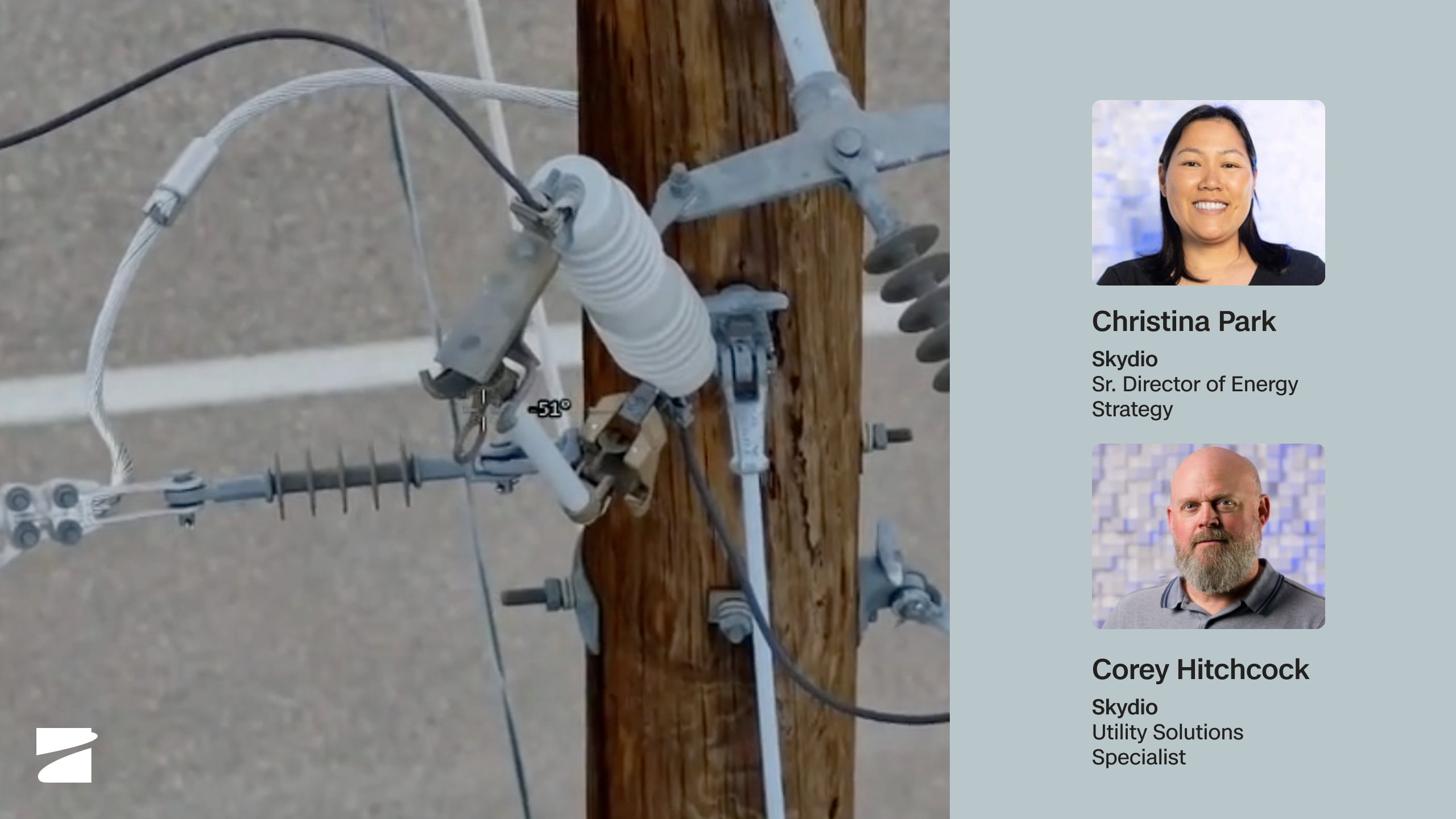
Dock for X10: Remote Inspection & Patrol, From an Office Chair
Watch webinar
Dominion Energy: Asset inspection, from an office chair
Watch webinar
Summiting mount regulation for utilities drone inspection programs
Watch webinar