

The journey to condition-based maintenance for utilities
In the utility industry, the right inspection data is vital. But capturing the right data at the right time, transforming that data into actionable insights, and weaving it into your workflows is a constant battle.
Watch now to learn about the journey from time-based to condition-based asset maintenance, and how drones transform the way utilities can monitor the health and security of infrastructure to make better decisions that optimize cost, risk, and performance—without any guesswork.
Dive deeper into:
- Better asset inspection: Drones aren't just tech toys; they're tools that help Utilities efficiently inspect when and where it's most needed.
- Operational efficiencies: Find out how drone solutions can reduce outages, give detailed inspections, and help balance budgets.
- Data-driven decision making: With real-time data, shift from reactive to proactive maintenance solutions. .
Don't miss out on this chance to learn how drones are shaping the future of utility inspection.
Learn more about how to build a condition-based maintenance program.
- We rely so much on electricity,
- even a, an hour worth of outage time is just gonna be unbearable for
- the end customer.
- I never call a utility unless my power's out, and my overall
- satisfaction with the utility is generally 100%
- satisfied if I never have to reset 12 clocks in my house.
- So when you start looking at how that translates into benefits,
- and with more and more things having electronic components and relying on, you
- know, electricity as a whole, we can now provide
- the utility with an overwhelmingly efficient way
- to make sure that the reliability metrics are met.
- I'm not gonna do too much math in public, but if you wanna kinda dive into what
- that ROI looks like, if you're safe and you have reliable power,
- then, you know, your customers generally
- are gonna be super happy with the service
- that you're providing them. So boom, you got the hat trick of
- KPIs in one turnkey application.
- By y'all that I can't even say it one more time.
- Hi, everyone. Good morning on the West Coast,
- and good afternoon on the East Coast.
- My name is Christina Park. I'm really excited to be here today.
- Um, I'm with Skydio. My current role is the senior director of
- energy strategy, and prior to coming to Skydio this past
- March,
- I was the senior director of a department called Asset Intelligent Solutions at the
- New York Power Authority. So I was at the New York Power Authority for 15
- years, starting in engineering, working in generation, designing turbines,
- uh,
- for our hydroplants, and then moving over to asset management,
- strategic
- operations, and really trying to see how we do our
- maintenance, uh,
- investigating new technologies, and bringing it all together to bring it
- to scale.
- Corey?
- Hey, I'm Corey Hitchcock. I, uh, am a utility solutions specialist
- here at Skydio. Um, background in transmission
- distribution. I was a lineman, uh, and, uh, distribution
- operations, where I was a distribution systems operator.
- Um, my latest or last role at Southern
- Company, uh,
- was the UAS program lead, where, uh, where we developed-
- Mm
- ... uh, a drone program with over 400 aircraft
- and 200 active
- operators as of my leaving.
- Thanks, Corey.
- So for a little background on Skydio, we support 120
- utilities, 83 of which are in the US.
- So you can see here a few of the logos of some of our customers,
- and we are very excited to be in this space.
- Um, one of the investments that Skydio made this past year
- was actually to
- invest in Corey and myself. So recognizing that you can have the best
- products in the world, you can have the best solutions, but
- if you don't understand
- the problems that your customers are facing, that's a very large gap.
- So Corey and I were brought in, and we're very excited to be a part of the
- team to
- really bridge the problems to the solutions.
- So let's dive right in. When we talk about condition-based
- maintenance, and when we
- talk about technology solutions in general, what are they for?
- So for me, I thought about this for a long time,
- and I think one of the things
- that's true of any utility is that decision-making is really, really
- complex.
- Um, a lot of times it's unclear in the midst
- of a lot of different factors
- what the right decision is. Um, and no matter what decision you make, it
- seems that somebody's going to think that you made the wrong decision.
- So there are internal factors that utility decision-makers face,
- uh, such as: How do I prioritize when I have growing scope and I
- constantly have shrinking resources?
- There are also external factors, so: How do I reduce risk to my
- organization?
- If we zoom in on these a bit, we can see that internal challenges are
- abundant. All utilities are dealing with aging infrastructure.
- Um, original equipment and assets are approaching end of life out in the
- field, um, and in our backyards.
- There are also budget constraints, so operations and maintenance costs are
- constantly under scrutiny, and there's always a pressure to lower
- them or
- justify them.
- Additionally, there are resource constraints,
- so the scope continually seems to
- increase. No matter where you are, um, these days EVs
- are a really popular, uh, and, and a forward-thinking initiative as far
- as,
- uh,
- being more clean with our energy, but that load has to be generated somewhere,
- and
- there's increased loads, right? Uh, that's just one example of where the
- scope of your ent- enterprise may increase,
- but you may not necessarily get
- an extra department or extra heads to cover
- that increasing scope.
- Uh, similarly, a lot of utilities are expanding their transmission lines.
- They're building more substations, uh, and trying to do it with the same number
- of
- people.
- And lastly, another problem that I think is very,
- very important to consider
- is that the workforce is aging. So the utility industry is one that
- historically people have stayed at for the duration of their careers.
- It was very common that you would celebrate the retirements,
- um, every
- year of people who had been there 30 years, 35 years, 40 years.
- Uh, and they really accomplish a lot in
- that time and become those subject matter
- experts. But at the end of the day, that's actually very much
- irreplaceable because as they approach retirement age, there tends to be
- a gap between them and their apprentices.
- Uh, this is something that happened to me
- where I apprenticed for someone for over a decade who was the leading, uh, one of
- the leading hydro gurus, uh, in the US.
- And, um, it became an issue because when we thought about him retiring,
- and he actually made it to 37 years, but, uh, at the point of his
- retirement, that, that's a very large gap that's hard to
- fill.
- And so I think the other reality is 22-year-olds
- graduating college these days are not necessarily thinking to stay at
- one
- company for 30 years or 40 years for the duration of their
- careers.
- Uh, it is more of the social norm to jump
- around every few years, uh,
- as they build their careers. So in light of that reality, I think
- that it- the
- aging workforce is a consideration
- External challenges are also demanding.
- So customers, uh, expect safe, reliable, and affordable power.
- So we saw in the little video snippet that most of us only
- call our power companies when our power goes out.
- Um, for investor-owned utilities, there are also stakeholder expectations
- for your investors. You have to show that they're, you
- are making a good return on
- their investment as well.
- We all know that there are regulatory pressures,
- so whether it's NERC, FERC, or
- another regulatory body, compliance and audits are mandatory, and
- nobody wants to be on the receiving end of a failed audit.
- With climate change and the increase in fire, storms,
- and other natural
- disasters, uh, recently we've seen, uh, we've seen that
- abundantly here across the US and even overseas, uh, with roads
- that had a huge fire, um, [clears throat] this summer.
- Uh, this is something where emergency response
- becomes more important than ever.
- And lastly, there's this concept of digital
- transformation.
- So, uh, many times there will be internal
- or external pressure, um,
- to leverage technology and complete this digital
- transformation, but it's not always clear how.
- So in light of all these things, how do you ensure your asset health?
- So historically, maintenance has always been done on a
- time-based,
- uh, practice. Routine inspections and repair, they were based
- on some OEM's original schedule, or based on years and
- years of expertise from your subject matter experts.
- [lip smack] The problem with this is it doesn't account
- for changes in your operating conditions or the environmental
- impact on the assets. So as we said, with the increase in fires
- and storms and floods, uh, those are environmental changes that
- affect your assets. Likewise, if your ISO or if
- your, um, decision-makers decide that they need to operate, uh,
- more heavily or operate more in the rough zone for hydro equipment, for example,
- or start and stop your equipment more often, um, that needs to be accounted for
- because the original OEM's recommendation was based on some
- average, uh, amount of runtime.
- What does this lead to? Well, it means that your assets
- are either replaced too
- early, so you're overpaying, or too late, after a failure.
- So when we look at asset management decisions,
- we see that they are quite complex. Oh, I think that is actually not working.
- Um, so it's a balance, uh, between cost, risk, and performance.
- And so sometimes cost is going to be your priority.
- So if you were told that you have to slash your budget by
- hundreds of
- millions of dollars, you're gonna have to figure out
- which programs are going to
- get cut. Sometimes it's going to be performance.
- If you are mandated to run, um, run your machines
- harder than you normally do, that's going to take a toll,
- but that's just going to have to be the priority.
- Um, and lastly, we all know that risk is always a factor.
- So I know for myself, I live in New York, and this summer we had,
- uh, what we call nuclear winter. We had a, a few days of orange skies
- where there was, uh, dust from wildfires coming down into our
- area,
- which made the air quality index really, really difficult, uh, to bear.
- So I remember keeping my kids home from camp, uh, having notices of things
- canceled. But I thought about this, what if I was out in the field?
- What if I was a lineman out at a utility?
- I have my work order for my daily rounds and the inspections that I
- need to do. [clears throat] As a superintendent,
- you have to make a decision.
- Do I prioritize health and safety and keep,
- uh, my guys inside?
- Or do I send them out because I have a backlog of work to do and I can't risk
- having two to three days of, of being backlogged?
- So in the face of all this,
- it helps you make decisions if you can improve your trade-offs and
- if you have
- clarity.
- So to that end, if we revisit how do we ensure asset
- health?
- Uh, we want to get from a state of time-based
- maintenance to condition-based
- maintenance. And what does that mean?
- As the name suggests, you do the maintenance based on the
- state of the asset at any given time.
- So how do you measure that? Well,
- asset health is easy to assess when data is easy to gather.
- I think the hardest part of understanding what the condition of your asset is,
- is because you don't have enough information,
- or you don't have enough of the right
- information.
- And what does this do for you? It accounts for wear and usage.
- So unlike time-based, where you don't have any, uh,
- factor for operating conditions or environmental impact, uh, the
- condition-based maintenance [clears throat] will account for how
- you're using your
- equipment. And ultimately, this leads to assets being replaced just
- in
- time.
- So how do we get there? I think it's one thing to have an
- idealistic view
- of the future, um, and a vision of where you want to be,
- but it
- also really matters to have a path to get there.
- So if we think about how we do maintenance, this is a
- representation.
- Hopefully, you can see a little bit of your own
- utility in these, uh,
- diagrams. But whether you have stacks, whether you have dams,
- transmission or distribution poles, solar farms, or substations,
- uh, and these are just some of the examples
- that we've seen our, our customers have
- as use cases, these all have inherent risks and dangers.
- So from this diagram, you can see we have people who
- are up in the air.
- Whether they're rappelling, whether they're put up by a bucket truck,
- um, they
- are at a fall risk, um, and they are being held on
- only by some training and some amount of equipment.
- In order for them to be up there, that also requires other people to be
- there
- doing the inspections with them, perhaps not necessarily inspecting,
- but making sure that, uh, they're, they are safe.
- [clears throat] On the bottom, you can see these lines leading out.
- A lot of solar farms and substations tend to be remote.
- So now you're spending a lot of time with your truck rolls getting your personnel
- out there in order to do these inspections.
- In addition, with substations, uh, and also with, uh, transmission
- environments, you're dealing with energized lines.
- So all of this leads to safety risks, which everybody who
- works at a utility takes precautions and is aware of what they're signing up
- for,
- but we would all love to reduce our exposure to risk.
- So if you look in the upper right-hand corner, you can see this heat map of five
- factors that I think are important to measure
- when it comes to figuring
- out how to make your best decision.
- So for risk mitigation, you can see that the way maintenance
- is done now opens up
- to a lot of risk. The time efficiency is also low, because
- with manual inspections, you have to drive all the way out to where
- they are and go
- back and forth. Um, your cost-effectiveness in terms of how
- you're
- using your personnel and how often you can get this data
- is also pretty
- low. And you may or may not even have a digital
- record.
- So I think some utilities today are still filing
- paper records in a filing cabinet.
- Even if you go digital, where is that data being stored? Who can access it?
- Uh, I think we would love to have a fully
- digital record that's available to
- everybody so that the information that one person captures,
- uh, can be used by other, uh, stakeholders in the
- organization.
- The one good thing about how inspections have always been done, which is why
- [clears throat] utilities have been running for so long, is your asset
- expertise is rather high. So your experts, whether it be
- a transmission tower, whether it be concrete, um, whether
- it be your solar farms, your experts are actually out there looking at them
- with
- their own two eyes. So they are there.
- They are able to assess, uh, to the best of their ability
- while they're out there,
- uh, and make decisions. Sometimes they need to make decisions
- while they're out
- there.
- Um, but I would say if you take all these five factors in
- aggregate
- and you sum them up into a confidence, a decision confidence
- meter, I would say that the decision confidence
- is relatively low.
- I think from my own experience, I definitely remember having so many,
- um, requests and, and, um,
- [lips smack] things that are broken, things that need to be fixed, uh, things
- that we should look at, and then having to think about, well,
- how do I know
- whether to address this issue or that issue?
- I have only a finite number of people.
- How can I get there and get it all at once?
- And I, I think from my experience, most of the time maintenance was very
- reactive. Whatever was the biggest fire, metaphorically or
- literally at the time, that's what got addressed.
- Uh, when a rotor cracks, when a draft tube is leaking, uh,
- when a substation
- catches fire, those are things that need to get...
- Everything needs to be dropped, and that gets the first priority.
- But in doing so, you may actually be ignoring something
- else
- that is deteriorating, um, that could use some preventative
- maintenance.
- So if we move to the next stage,
- if we introduce drones at all, the advantage of using drones is
- that you get your eyes up in the air, but you get your people on the
- ground. So you can see immediately that these three people who were
- originally up in the air are now on the ground,
- and we've eliminated the fall
- risks.
- So your risk mitigation now is getting better.
- It's gone from red to yellow.
- [clears throat] We can see also that out in the substation
- and in the solar
- farms, um, they can have larger standoff distances
- between,
- uh, the equipment, particularly the energized equipment,
- and the worker.
- Your time efficiency is also going to improve because
- with the drone, you can actually get around.
- The time that it takes one to rappel down a dam and do the concrete
- inspection and then move over and scale all the way down, uh,
- that's quite
- arduous. So you can actually save a lot of time by
- using these
- drones to get around and get a full 360 view of your asset.
- Your digital record is increasing because everything
- is captured
- digitally. You can take all of these photos.
- You can time-lapse them to do analysis.
- Uh, you can store them, have, uh, have them on a data management platform so
- that even the person who's out there in the field can transmit them,
- uh, back to headquarters for the engineers
- or the superintendents to take a look
- at. Um, this makes escalating issues much, much easier
- and more efficient, um, and decreases the chances
- that something might slip
- through the cracks that needed a second opinion.
- Your cost-effectiveness does go up a bit. The drones are an investment.
- And in this scenario, this would be if you hired pilots, um,
- with drones to come and look at your assets.
- The downside to this is, depending on who you hire,
- someone who's an
- expert pilot may or may not be an expert in your actual assets.
- So you lose that asset expertise if you get a shot
- list and you get the photos you want, and then your asset expert
- actually has to sit down and look through the photos
- and do the analysis
- themselves. So [clears throat] this does add an extra
- step, an extra
- cost,
- and it means that in real time when you're doing, uh, an emergency
- response scenario or if you have someone doing an inspection,
- if there is, um, a flashed insulator or if there's,
- uh, a woodpecker hole or some- something that's deteriorating kind of
- maybe around the corner from where the shot list is, uh, the pilot may
- or may not catch that depending on how well they know
- exactly what they're looking
- at. So that is one of the risks of just going
- to a pilot with a drone.
- So the next stage to go down the line would be to equip your frontline staff
- with
- drones. So this can be a very daunting task,
- I think particularly for people who have never flown,
- uh, a robot before or have not had a whole lot of remote
- control
- experience with a controller. And this is something that I think
- is... can be met with a lot of resistance, um, depending on your staff, their
- comfort level with technology, whether they think technology
- is gonna come and
- replace them. Um, and I think this is a really interesting way to go
- because drones are really a tool that you can use in your toolkit.
- So for example, if you're out in the field
- and you're a welder, you have to
- have a welder certification. You have certain amount of training
- that you go
- through so that you can be an expert to, uh, to do your job properly.
- So a drone in a way is-
- Like welding rod. It's, it's another tool
- that your people out there can use
- in order to do their jobs better. So here again, we get all the benefits of
- keeping them on the ground, so the risk mitigation, uh,
- is still where it was
- in the last step. But you can see on this heat map
- that we are really
- turning more yellow and even green.
- [clears throat] So your time efficiency and your cost effectiveness go up because
- you don't necessarily need to hire someone outside your organization in order
- to do these inspections. Uh, they can go out as they normally would
- and collect the data as they normally would, uh, except now instead
- of having to pull out a handheld tablet or pulling out pen and paper
- to record, uh, all of that can be seamlessly, uh, uploaded to
- your system.
- Your digital record continues to build, um, and now we've
- corrected that asset expertise and brought that up.
- So at this stage, I would say your decision confidence
- is pretty high,
- and you can get to the point where you can detect small problems before they become
- big problems.
- So up to here, if we talk about how do you get to
- condition-based maintenance, you can see these three steps: manual
- inspections, pilots with drones, and then frontline staff with drones.
- And this is really where the industry is today.
- I think a lot of drone programs, uh, within utilities have gone
- down this route, uh, sometimes starting within an R&D space,
- sometimes
- starting in an operation space. Uh, but piloting, uh,
- no pun intended, but, uh, doing proof of concepts with a few
- drones and a few pilots, getting certified
- and doing the inspections.
- And I think that they are seeing a return on their investment
- because of the
- safety, uh, that's increasing as well as the data
- that's coming in
- that helps them make the decisions they need to make.
- That being said, if you think about scaling a program, uh,
- really across
- your enterprise and putting it into your workflow, uh, and
- changing the way that you, you operationalize a technology,
- there's really a limit to what you can do with the drones that are on the market
- today. So this is where Skydio stands apart,
- I think
- where it's not just about the hardware, but it's about the software and the
- AI and the autonomy. And I would argue that without that AI
- and autonomy,
- you actually can't scale a, a full drones program in a
- very efficient way,
- um, in a way that all of your frontline
- workers are going to be
- excited and willing to pick it up and fly it because drones are
- historically very difficult to fly.
- I think the first time someone put one in my hands, I was not very
- comfortable flying it around. Uh, I think I ended up kind of flying it
- backwards
- 'cause I got turned around and I was a little confused by the joystick.
- But if I was near an energized environment or an energized line, I think I would
- just stay far away from it. And that is a lot of the resistance that I've seen
- and that, uh, we've heard, um, from some of our customers,
- that the change
- management to get this tool into everyday people's hands is
- really, really high. So this is where having the, um,
- [clears throat] the safety net of the obstacle avoidance gives
- your pilots the confidence so that your frontline workers can
- become pilots without needing a ton of training time.
- So as we go along this journey,
- what is the next step? The next step is to go to remote operations.
- So what if we could save the time of your workers, not only keeping them
- on the ground, but keeping them indoors, keeping them away
- from really remote areas, keeping them out of the substation
- altogether,
- particularly if you have a substation with original transformers that,
- uh, could possibly have a failure at any
- moment.
- So here you can see in this diagram, we have a product called Dock.
- Dock is our remote solution. It's kind of a garage
- or a drone in the box,
- where it lives out in your field. It lives out at a remote substation
- that may be
- 10 hours away, uh, from headquarters.
- It lives out in your solar
- farms there. Um, and what it does is you can
- control this. You can see a person from a computer can
- control the drone,
- set it on a mission. You can h- fly it directly.
- You can have a pre-programmed mission.
- Uh, you can even consider it like your
- sprinklers.
- So there are a lot of security applications with this, particularly with
- substations, um, as there have been a lot of thefts,
- vandalisms, and
- even shootings in the last couple years. So you can set it like a sprinkler.
- It goes off at a specific time. You can vary the times that it goes off,
- and
- it takes the data for you to make sure that, uh, you know the state of your
- asset at any time. So for example, if you had, uh,
- a remote substation that was eight hours away to drive to, well,
- that would take at least one worker a full day to get there, a
- day to do the inspection, and a day to come back.
- And even so, what if it failed the day after they came
- back and
- the next inspection wasn't for another quarter?
- Um, that's something that could be avoided with Dock.
- So you could put this remote solution out there, you could run every day.
- Uh, the drone will run, it'll come back.
- As soon as it comes back to its house, it's gonna recharge its battery and upload
- the data, and you can check. And more often than not,
- your data will probably
- tell you that your equipment is fine.
- But you can also track those small detections and those small indicators,
- um, as they grow, uh, either with time lapse or with, uh,
- other analytics that you could place on top.
- And so you can see in this heat map that with a remote solution, your
- risk mitigation has really gone green.
- You've taken the human out of the field entirely unless they need to go
- out there to be deployed for a repair.
- Um, [clears throat] your time efficiency
- and cost effectiveness have gone up.
- Um, I think we've estimated that it costs about $5,500 a truck
- roll. Uh, if you think about, uh, man-hours and, and gas
- and all of that time, it goes up. Your digital record has really
- been built. You can get all of the data you want, um,
- and there will be
- ways to sift that down and to figure out what's meaningful
- In the future. Uh, and then you have...
- Your as- asset expertise actually goes up even
- more, because
- if I'm sitting in headquarters controlling this dock, and I
- think I see something but I'm not sure, it's a lot easier for me to turn
- over my shoulder and ask my colleague to come over and analyze this
- with me together, um, or to go around and continue to fly it to get a closer
- look, rather than have to drive all the way back
- or text pictures
- from my phone when there may or may not be cell reception.
- We can share that information a lot more readily with this solution.
- So your decision confidence at this point becomes very high.
- And another added benefit to this is you can capture intellectual capita-
- capital and transfer knowledge much more easily.
- So if we talk about that aging workforce problem,
- with all this information,
- you can take someone who maybe doesn't have 30 years of experience where they
- can just look at a crack and know exactly how it's gonna propagate,
- but they can
- take the data, they can analyze it over time,
- and they can have more confidence,
- uh, to make a decision that's not just based
- on years and years of
- experience, uh, but based on empirical data.
- And then what does the future look like?
- So I think this is the end state, that you get to a central digital
- monitoring station. So whether it's for emergency response,
- uh, whether you have some sort of control room
- where you can have a
- one-to-many solution. So you can have someone in a control room,
- uh, managing all of these docks and these drones.
- They could be pre-programmed to go and get all of this information,
- synthesize the data down, and get to meaningful conclusions.
- So it doesn't really do any good to have more and more data
- if you have to have someone sit there and sift through it.
- So, uh, the beauty of this is Skydio has a new feature
- called Skydio Extend, where we are partnering with, uh, other
- vendors. Um, some of them are in your workflow,
- uh, like Esri. Some of them are, uh, new vendors that are
- applying analytics, uh, like Buzz Solutions, where you can apply
- these on top of Skydio's captured data to filter out and figure out,
- uh, what is actually meaningful in your data.
- And then the person in your control center can actually transmit that out,
- talk to the people at the sites, and just address the issues at hand.
- So if you look at the heat map here, now we are about as green as you can
- get. You have your as- your asset expertise there.
- Not only can this person, uh, control all of this and share all this
- information, you have a digital record that's available
- to your entire company.
- Um, your time efficiency and cost-effectiveness go up because at
- the end of the
- day, you've hired your workers because of their
- expertise, not
- necessarily because of their ability to drive out to a location.
- Um, [clears throat] and you can maximize their time doing what
- they know best.
- And ultimately, this lowers your risk mitigation because
- we are
- risking the machines, we're not risking the people.
- Uh, we are only sending people out there, uh, when they need to actually take
- a, a, an act- a corrective action.
- So this allows you ultimately to optimize your job plans,
- um, create a meaningful spare parts strategy,
- uh, and allocate
- your resources properly.
- So if we go back to the original eight problems that we looked at, we can see
- that the internal challenges are addressed.
- So for aging infrastructure, now we have maintenance being done at the
- right
- time.
- Regarding your budget constraints, your O&M costs are now justified.
- Um, I would argue that they will surely go down because you
- will
- detect, uh, deterioration and signs of failure, and be
- able to take mitigating actions before they become a failure.
- So this is going to save you on the emergent work, uh, or the forced
- outages that occur today. [smacks lips] For resource constraints,
- these are
- tools that help staff tackle the increasing scope that exists, and
- also help plan, uh, in order to
- increase the scope even more. Because the only, uh, prize
- for doing good work is more good work, right?
- And so,
- uh, the aging workforce as well, uh, now we have a digital record, and
- this aids with the knowledge transfer.
- So we can now pass down with, uh, empirical evidence as opposed to
- passing down tribal knowledge anecdotally.
- When we look at external challenges, these are now mitigated.
- So stakeholder expectations will be met because your
- reliability increases. And on top of that, if you are in a
- situation where, uh, you have to make a really tough decision,
- you
- actually now have the data to prove why you chose to do A over
- B. And that is something that can be explained to your
- stakeholders.
- For regulatory pressure, data is now available for the audits.
- Um, you can make decisions, uh, based on [clears throat] the
- data you have but, uh, when you get audited, you are required
- to hand over documentation.
- For climate change, your emergency response time decreases
- drastically. I think with the solutions
- that we have today, it's very
- exciting to think about what emergency response will look like, uh, with
- remote options. So much like law enforcement has a drone
- as a first responder concept, that is something that could be applied to, to
- utilities as well. So in the face of a storm...
- I live in New York. We had a very, very wet September.
- Um, so every time there's a storm, everybody's worried the power
- is gonna go out.
- We have tree limbs that are falling everywhere.
- Um, my town really, really loves trees.
- And so inevitably, we always have a power outage somewhere in
- our town,
- and [clears throat] we also have flooding because we have a very high water table.
- So what does this mean? This means that if we can have somebody go out there,
- put a
- drone in the air, they can actually assess
- which power lines are
- down, which trees need to be repaired, uh, which streets are flooded,
- so that emergency response crews know the best possible route to
- get there. Um, you can use this information to decide how
- many people do you
- send, which people do you need to send.
- Um, and this will ultimately result in time
- and cost savings.
- And lastly, digital transformation.
- This is really the way to achieve digital transformation.
- It is a way to change the way that your actual operational workflow,
- um, works. Um, it's not just a
- one technology solution that's off in the corner that's being used by
- two or three different people, but it's a way to actually change your
- entire
- process so that, uh, people are comfortable using the
- tool, but also, uh, relying on the data that it brings.
- So the accessibility of data is definitely something to be
- considered.
- So in this journey to condition-based maintenance, you can see now from red to
- green that you can make the shift from time-based to condition-based.
- And what's interesting to me is that, uh, it's definitely a journey
- and it's a path. Like I said before, you can't get from start to end by
- just making a purchase. Um, there are many steps that
- go in between in order to do the change management necessary,
- uh, at the executive level all the way down to
- the field level,
- because people need to believe that any change that's being made is
- actually useful, that it's good for the organization.
- And I would argue that in taking these steps
- and building up your
- program, you can show incremental gain.
- For every investment that you make, you're going to see a return.
- You're going to see the value of that.
- You're going to see that people, um, learn how to use this
- and really have it become embedded in your processes.
- So even though the end vision is something that we'd all like to get to,
- I think that taking each step along the way
- is, is critical. And here at Skydio, we're really excited
- because we consider ourselves to be partners to our utilities.
- We're not here to just sell a solution, drop it off, and have you figure out how
- to use it. But, uh, we have a very robust customer support
- and customer
- success team that will come out, that will unbox with you,
- that will give you the
- training, and really set everything up to make sure
- that it's gonna work.
- Because at the end of the day, your success is our success.
- So we wanna walk with you every step of the way, troubleshoot, kick the tires,
- and ultimately make our products better.
- And I think I'm very excited to announce, for those who haven't,
- um, been following us, that last month we released our new
- enterprise drone,
- the X10. And with this drone, this was the result
- of years and years of feedback, probably from many of you.
- So we, we listen to our customers. We know that everything is not
- perfect. Um, but we aggregated the feedback of
- what you need to do your job, and the response to
- that was the X10. So we'll show a little, uh, video clip
- of the X10.
- [gentle serene music] Behind every flickering light,
- every open road,
- every safe community,
- you'll find people.
- People who keep our civilization running and who depend on having the right
- information at the right time.
- It's here for them.
- Skydio X10, it's here. With the best sensors ever in a
- drone this size.
- The first of its class with the FLIR Boson Plus.
- 640 by 512 radiometric thermal imaging with maximum
- sensitivity.
- A one-inch 50 megapixel sensor with a custom wide angle lens,
- or the 64 megapixel narrow angle camera to capture the data you
- need, even during low light inspections.
- Transition zoom can read a license plate from 800 feet and identify
- cars from three miles away.
- You've never seen like this before.
- It's here, and it's ready for anything.
- X10's durable, lightweight airframe goes from backpack to
- flying in under
- 40 seconds and thrives in the most challenging environments.
- It's tough, quiet, and resistant to electromagnetic
- interference.
- And the open modular platform is built to adapt with sensor packages and
- attachments to get the job done.
- Capable of flight command from 7.5 miles away using the ultra bright
- controller with a multiband option for operations in a contested
- environment.
- An optional 5G gives X10 unlimited operating range anywhere there's a
- cell signal, unlocking remote command and control from any connected browser.
- Zero mark. Copy, Marine unit one. We have assumed control of Skydio
- X10.
- So personnel on the ground can be fully focused on the mission at hand.
- Marine unit one, we have individuals stranded on the roof
- of a residence.
- We will guide you in.
- It's here. A new era of onboard AI and computer vision
- lights the way with Nightset,
- enabling autonomous flight in zero light conditions.
- [upbeat music] Obstacle avoidance
- can now do the work for you, even in the darkest environments.
- Turn complex jobs into completed jobs with the automated capture of critical
- data, while onboard modeling takes you from
- images to insights in
- minutes for immediate action.
- The best sensors ever in a drone this size, piloted by the most advanced
- AI in the sky
- to get you the details you need whenever you need them, wherever
- they are.
- [upbeat music]
- Designed, assembled, and supported in the US,
- and trusted around the
- world.
- Capture every last detail, night or day, rain or
- shine, when it matters most.
- [upbeat music]
- All right. Um, I was just telling my colleagues this
- video
- never gets old to me. I'm, I'm so excited about our new product.
- Um, so we'll go into a Q&A time now. Uh, we have some audience
- questions that have come in over the chat that we will address, and if you have
- any other questions, please drop them into the chat.
- Uh, they could be about this presentation
- or about the X10 or any of our
- other products. So-
- Uh, looking at the first question.
- [clears throat] So Jared White, uh, "How are other energy pilots
- flying their lines and support structures?
- What angles are they capturing of their structures?"
- So Corey, I'm gonna toss this one to you.
- I think you're muted, Corey.
- I am. So that kind of depends on, um, on what it is you're trying to
- inspect and the level of detail of your inspection.
- Um,
- uh, it can range from cotter pin level defects
- when you're really trying to
- do, um, to replace a, uh, a climbing inspection.
- Uh, and so you take more pictures, more angles, um,
- you know, be in a lot more places. But if you're just doing kind of an overall
- inspection, post-outage or post-operation, um,
- and you just wanna find, like, what the gross defect is, uh, you know,
- you
- might, you might take a lot fewer photos and, uh,
- from, from a lot
- lesser angles. So it just kind of depends on the
- application.
- Thanks, Corey.
- Mm-hmm.
- Um, the next question we have...
- Actually, a lot of these are technical, so they may get kicked to you.
- [laughs]
- Yeah.
- Um, Jason McGill, "Remote sites do not always have cell
- signal or an
- ISP. What transmission solutions have you found
- to be effective?
- We often piggyback on our SCADA network when and where it's available, but that's
- not always an option."
- Yeah. So, so with the announcement from, uh, from Starlink,
- um, that the entire United States is now covered by
- Starlink, uh, we kinda, uh, look at going to
- Starlink for, you know, the back haul for remote-
- Okay
- ... very remote dock operations. Um,
- we have used and found great benefit from using, uh,
- the, uh, small cellular modems, uh,
- Cradlepoint modems, uh, 4G that can, uh, fail
- over. But, um, to operate the dock, um, you
- only need about 10 megabytes per second, or megabits per
- second, um, up and down, uh, to operate the
- dock with minimal latency. So y- you don't have to have a, you know,
- a crazy fast connection, just a decent connection.
- Great. Uh, the next question, Eric Grumling.
- "So does every tech get a drone?" So
- I think that the vision would be that you put a drone and the capability to
- fly it into everyone's hands. Whether they get one or not, or whether
- they share, I think that is kind of up to, up to the supervisor.
- But I think having the capability to be out in the field at any time,
- um, [clears throat] is, is really valuable.
- And another way to think about remote ops is you could have someone, for example,
- in an emergency r- response scenario, the first person available
- may not actually know how to fly the drone, uh, or may not be able to do it in,
- in, uh, a reliable way where they feel super
- comfortable.
- But what they could do is have a drone in the trunk of their car.
- They could go out in the storm if they're the closest car available, uh,
- and they
- could put the drone up in the air. And with a beyond visual line of sight
- waiver
- and remote operations, you could have someone who's back at
- headquarters who is a
- licensed 107 pilot, Part 107 pilot, um,
- fly and get that information in order to, um,
- have the decision-makers decide who's gonna get out there, uh,
- how many people they
- need, et cetera. So, um, I think it doesn't necessarily mean
- that every
- person has to be able to fly the drone, but I think the future vision,
- in my opinion, would be to have it available, um,
- and to have as many
- people, uh, capable as possible.
- Um, next question. "Are there any large telecom utilities
- using
- Skydio?"
- Corey, do you know the answer to this one?
- I know we have a couple-
- Um, I know we have telecom utilities using
- Skydio.
- I think, uh, if you link up with your, uh, your AE or make
- contact with sales, they can put you in touch with those
- people, but I'm not
- exactly sure who they are right now.
- Yeah. I do know that, uh, telecom towers, uh, has been a use case that
- we have studied, so I, I, I do know we have some customers.
- Well, and we've also built, um, the 3D capture for tower
- scan to allow for the, uh, uh,
- automated capture of vertical structures.
- So the, the aircraft will identify what's going on
- inside the volume,
- uh, and then once it figures it out, it'll start capturing data
- automatically, um, so that you could build a 3D model of that,
- uh,
- that telecom tower.
- Great. Um, so this is kind of along the lines of
- something I just mentioned, but, "Is filing waivers with the FAA a service
- that
- you provide, or are we responsible for filing?" So
- Skydio does
- have a regulatory services team, so this is a consultative service that we
- offer, uh, that you can opt into. We actually have people who used
- to work, uh, at the FAA or, or on these, uh,
- procedures, um, and currently are on the board, uh, that decide
- kind of [clears throat] how these, um, how the processes evolve.
- So, uh, we have a tremendous amount of expertise
- in this space, uh, and this is
- something even for myself at the New York Power Authority, uh, we used
- Skydio in order to, uh, get our BVLOS waiver.
- And I'm very proud to say that we have, uh, an extremely high, if not
- perfect, success rate so far in eventually getting
- everybody the waivers
- that they apply for. So technically, you as the utility need to
- apply under your own name, but, uh, with our regulatory
- services, they will help you create, uh, your application
- so that it has the best chance of passing.
- Um, next question. "What is the resolution of the HDMI
- output on the controller, big screen versus on controller?"
- Uh, it's gonna be 1080p, uh, out from the, uh...
- It's a full-size HDMI out connection on the back of the
- controller.
- Great. Um,
- okay, I think this goes back to the BVLOS topic.
- "What is the relative timeframe for obtaining a permanent BVLOS
- for these docks?"
- Corey, can you take this one?
- Uh, it, it varies based on the situation.
- Um, I would say sub six months.
- Um, you know, some analysis has to be done at, uh,
- at your sites for,
- you know, um, airspace analysis, uh, other
- ground risk analysis, and then, um, a safety
- case developed, and then the waiver's submitted.
- Um, but generally, I've, I've seen them happen around
- six months or less.
- Um, and they give you...
- Uh, we now have the ability, or we've had customers
- obtain waivers with, uh, performance-based standards
- in that, as long as it's a limited access facility
- in Class G
- airspace and some other, um, you know, requirements that,
- um, you can operate a dock there. So it's not necessarily site-specific.
- It's more situation specific.
- Yep. So there are a lot of different options.
- I think for utilities that are starting out that want to vet, uh,
- or do a
- proof of concept on remote operations, our regulatory services
- team will also work with you to choose.
- So for example, if substations is your application, they will
- work with you to choose which substations would be good candidates
- to do
- a proof of concept on, which are going to be most likely to get
- approval,
- uh, for your BVLOS waivers. And, and also, uh, I think it's,
- it's up to you to try and choose, um, a proof of concept where you
- will hopefully see some results. Um, is there a cost for a ta-
- for the additional service for obtaining the BVLOS waiver? Yes.
- So regulatory services has a couple different packages, which if you talk to
- your sales rep, you can inquire about that.
- But these are ad- add-on services, um, on top of the hardware and
- the software that you can purchase.
- Um, any support with the X10 to embed GPS
- metadata in captured video to support full motion video
- capabilities with the Esri platform?
- Uh, yes. You can caption your video, uh, and, and have
- video metadata, uh, that you can use any, in any of the, uh,
- you know, those platforms.
- Yeah. So as I said before, we have, uh, Skydio Extend,
- which we just launched this past September.
- Um, if you go to the website and look for Skydio Extend under services,
- you can see a list of, uh, various platforms that we
- integrate to. So Esri is one of them, and we are growing the list,
- uh, as we go for all of our customers and in all of our core verticals to make
- sure that you can get your end-to-end digital solution.
- Uh, what is the average latency observed
- during flight in remote
- areas that utilize a network such as Starlink?
- So the latency obviously depends on your connection.
- Um-
- [coughs]
- ... ideally the, the aircraft operates, uh,
- during a remote connection and remote operation around
- 100 milliseconds of latency. But, uh, it's, it's not
- noticeable, uh, from a control standpoint.
- Like that's, that's really low latency, um, when you're actually like physically
- controlling it from the, uh, you know, from a remote location.
- Uh, but, but that latency's definitely dependent on
- your network
- architecture, you know, all that stuff.
- Great. Um, and one more for you, Corey.
- How often would it be necessary to radiometrically recalibrate the thermal
- camera?
- So your thermal calibration is going to...
- I mean, that, that's really gonna be a specification
- based on your company
- processes and procedures and like your thermography program.
- Um, you know, it's... We, we don't really have, uh,
- anything right now that, that says, "Hey, you need to do it X amount of
- time." That's all gonna come from your, uh, internal,
- uh, thermography program.
- Great. Um,
- so what problem do you find to be the most common, uh, or the most
- important across utilities? So, uh, I think from my
- experience, uh, not only having been in a utility
- but also since
- I got here working with a, a lot of our customers, it really depends
- on what department and what level of the organization.
- So hopefully this, uh, presentation hit a chord somewhere with
- one of
- the eight problems. I think that if you're an executive, uh, typically
- budget and cost, um, and resource allocation is going to be,
- uh, some of your heartburn, as well as [clears throat] maybe, uh,
- regulatory pressures. Uh, whereas I think if you
- are somebody out in the
- field or you're an engineer, uh, performance is usually your, uh, your
- priority. And so
- what success means to you is probably not getting a call at 2:00 AM
- on a Saturday
- that you have to come in because something just failed, right?
- So, uh, I think no matter what level and what department you're in in an
- organization, there is a benefit to thinking about how to do
- things better and
- how to use technology in a meaningful way.
- Um, are there any plans for integration with
- docks and
- distribution automation?
- Corey?
- Uh, yeah. So, so the idea, the, the,
- the work that we're doing today with docks is, is kind of paving that
- path. Um, we don't have a timeline for when true,
- uh, you know, when a distribution automation scheme
- operates, the drone
- automatically goes and, and patrols.
- We don't have a timeline for that yet, but it's definitely something we're, we're
- actively working towards. Um, the, uh-
- [coughs]
- ... event-based, event-based patrol is something that, uh, I'm-
- I've been pretty passionate about from the beginning of, of the UAS
- idea in utilities. Um, and, and we're really like on the
- cusp of it. Um, and the, the work we're doing today with dock
- is gonna get
- us there.
- Great.
- Um, how often can X10 fly from the dock to do
- security patrol?
- Well, that's gonna be dependent on a, on a few different
- variables. Uh, how big is your security patrol?
- Uh, so, so basically how long, uh, of a flight is it,
- because the drone's gonna have to land and then recharge, uh,
- and then to, to get ready for the flight, the next flight, um-
- One of the things about security patrols in Docks is the ability
- to, uh, randomize or
- semi-randomize the patrol of the Dock so that, um,
- you know, bad actors can't make pattern-based, uh,
- intelligence ana- they can't make a, a pattern, develop a
- pattern-based intelligence analysis of, you know, when's that, the
- drone launches every day at 3:04, so I'm gonna go at
- 3:05. Um,
- uh, you know, so that's something that, that we're working towards.
- But, uh, uh, it, it, it really depends on how long your flight
- is.
- Um, but the Dock has a very, uh, high-speed recharge
- capability, so, um, you know,
- I, I would say
- two Docks you could probably run
- almost continuous, you know, flights at your facility
- if that's something you
- wanted to do.
- Great. And along the lines of that question,
- how will the repetitive charging cycle
- of Dock affect the battery?
- So our batteries are rated per cycle.
- A cycle is 80% discharge and
- an 80% re- at least 80% discharge and 80% recharge.
- Um,
- most, um, Dock flights that I've seen, I mean, you can have
- longer flights, but they're, they're typically less than 80%.
- So, um, it really doesn't have any other effect
- on, uh, the, the, the cycles of the battery.
- Um, a- and, and the charging performance, it really doesn't have any
- effect. The, also, the Dock is, um, heated and cooled
- for the ability to maintain optimal battery temperature and battery health,
- uh, in extreme environments.
- Great. Uh, what are the minimum requirements for a
- Dock network?
- Uh, I...
- You need to check with, uh, with your AE on this, but, uh, as
- far as I know, it's 10, 10 Mbps up and 10 Mbps
- down. And, uh, um, if your
- temperatures do not dip below 23 degrees,
- uh, it's 120 volt connection. If you do have
- temperatures below 23 degrees, you need a 220 connection.
- Great. Um, what is the accuracy range of temperature
- readouts with the radiometric sensor?
- And can you use FLIR post-process tools with X10 images?
- So I think, uh, we have to look at the, the spec-
- All of the, the FLIR specifications are listed on the spec sheet,
- but I believe
- it's less than 30 millikelvins of sensitivity,
- millikelvin of sensitivity. Um, I'm not exactly
- sure, but, uh, that's what I remember.
- Uh, but you can use, uh, f- any of the radiometric
- JPEGs that we get from the FLIR Boson+ sensor in any of the FLIR
- tools, um, you know, any of that suite a- a- in your
- normal workflow for, um, thermographic analysis.
- Thanks, Corey. Um, and I think we have one more.
- To obtain the low latency, is the video resolution down-scaled to
- minimize latency? What is the resolution of the video feed for
- remote
- flights?
- Uh, we're gonna have to get back to you on
- that.
- I know it's, uh, it's variable scaling, but I'm not sure what that is.
- I don't know that answer.
- Yeah, so I think if there aren't any additional
- questions, or
- if you do have questions that come up later, uh, or if there
- are questions that we
- weren't able to, uh, answer today, uh, please feel free to reach
- out to your account executive. So, uh, everybody has one
- that's assigned to their region. So if you go to the Skydio homepage,
- uh, or in the chat, I think some of the information should be
- placed down there in
- terms of how to contact us. We would be happy to get you, uh,
- more specific answers
- for some of these technical questions.
- Um, but really excited to have this chance,
- uh, to
- present to you guys today and really talk with utilities.
- I think utilities are an exciting industry because it's
- essential, but very
- much underappreciated. Uh, or at least that's how I felt
- when I worked at one.
- And I think that it's one that is on the cusp of really
- revolutionizing the way operations and maintenance a- and the
- workflow is done. So, uh, utilities I think
- are also a very collaborative
- industry, so I really encourage you all to reach out
- to one another.
- Um, if you saw any of the logos that we placed up in the beginning
- and you know someone at a utility that, uh, we currently have a relationship with,
- please, uh, please do reach out and, and ask, uh, how they like working with us
- a- and our products and our solutions.
- And, um, one final plug is, uh, for those who
- will be at the CIE Transmission and Distribution Conference, uh, in
- November, uh, Skydio will be there, and I look forward to seeing you.
- I will be there with some of my, uh, colleagues,
- and look forward to talking with
- you.
- Thanks for joining today. [upbeat music]
- Yeah, I mean, you can almost read that name tag from
- that early switch right there.
- That's what we want.
- That's great. Definitely significantly improvement.
- I was seeing how I could read the license plate on the other side of the parking
- lot over here. And it's still legible. Yeah. Wow.
- The applications are endless for us. We're trying to integrate it into
- everything.
- We can do this quicker, more effectively, remotely.
- Big time game changer for us.
- Pretty much plug and play.
- The design I like. Much simpler. It's just simple fold,
- spring arm. Leaps and bounds improvement.
- Yeah, the gimbal is slick. Yeah. Lighter.
- A lot lighter than it looks.
- I like this technology personally.
- The obstacle avoidance and the, the way they, they don't wanna run into
- anything makes a big difference.
- Our chief tried to crash. It didn't happen.
- The quality of the zoom, and now that that boost button, that's, that's
- pretty cool.
- Showing realtime build out of a 3D
- model. It doesn't, like, pop out.
- The ability is priceless really.
- That's really
- cool.
- Yeah. We drive eight hours to a project site,
- and if we don't
- collect everything, we're, we're hosed.
- You can read the expiration on that.
- [laughs]
- Yeah.
- Yeah, that's pretty impressive. Uh, with that resolution, you can do it from a
- quarter mile away pretty easily.
- It's the easiest thing
- that we could have. Right. It's priceless.
- Exactly what I've been asking for for two years now.
- Very impressive
Watch Time
55 Mins 7 Secs
Related Webinars
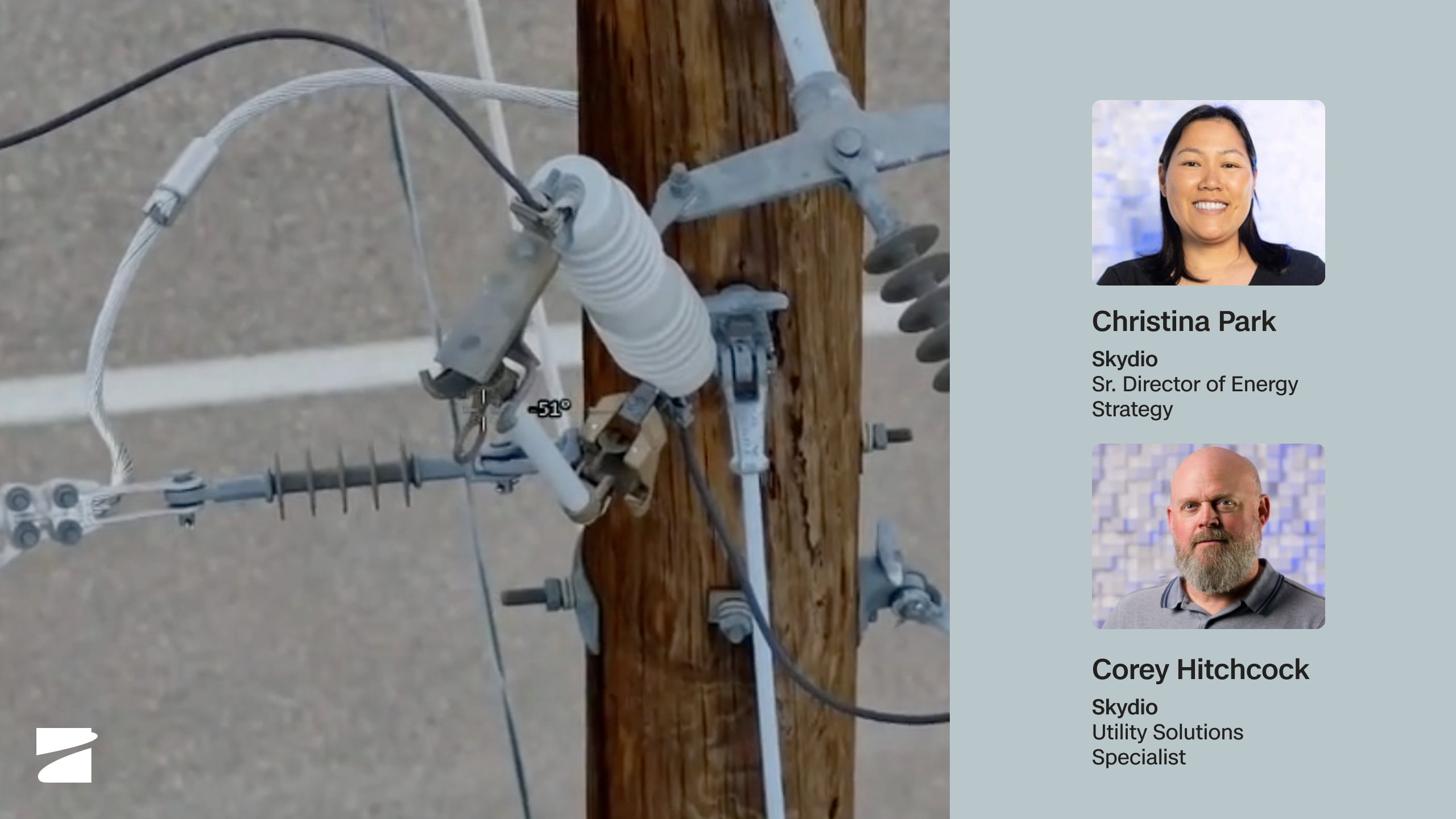
Dock for X10: Remote Inspection & Patrol, From an Office Chair
Watch webinar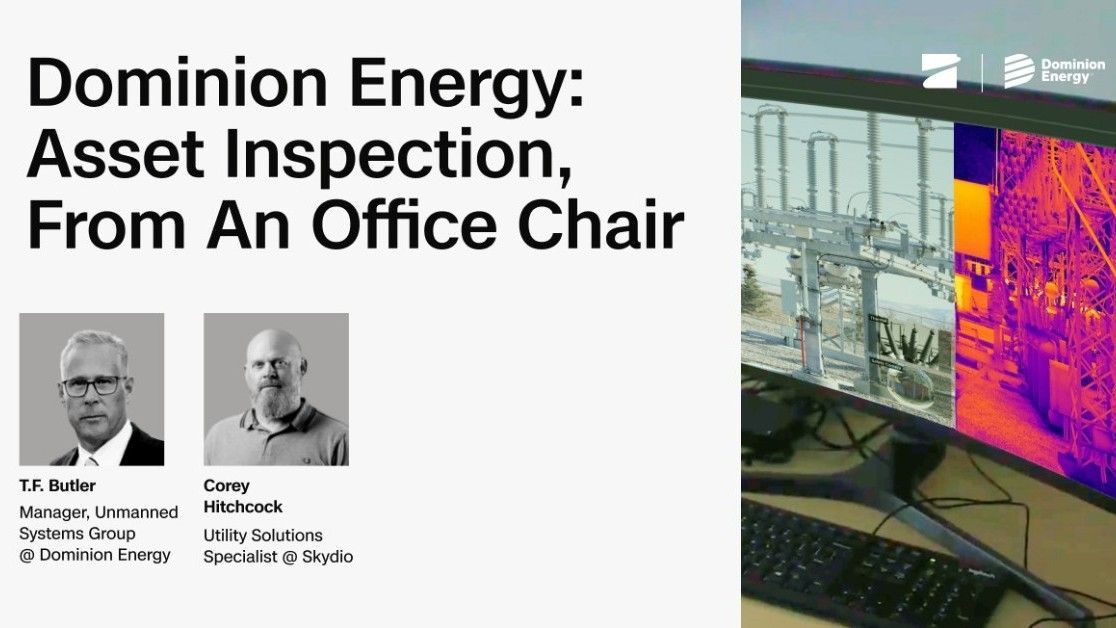
Dominion Energy: Asset inspection, from an office chair
Watch webinar
Summiting mount regulation for utilities drone inspection programs
Watch webinar