

Skydio Ascend ’24 keynote
At this 1-year anniversary of the launch of Skydio X10, CEO Adam Bry celebrates visionary customers and their successes using this technology in high stakes scenarios with incredible impact. Then he introduces Skydio Dock for X10 and demonstrates how pairing this with Skydio DFR Command or Remote Ops software is transformative for law enforcement, utility reliability and resilience, and defense.
Learn more about Skydio Dock for X10.
- [rock music] [drone buzzing]
- [rock music]
- Please welcome Skydio CEO and cofounder, Adam
- Bry.
- [rock music]
- [audience cheering]
- This is such a special thing we all get to be a part of.
- We build some of the most advanced technology in the world,
- and we deploy it in service of the people who protect our security
- and help to keep our civilization running.
- We make flying robots that give you superpowers,
- help people do their
- jobs better, help to keep us all safe.
- Now, we are a hardcore technology company
- through and through,
- and we're here today to announce some incredibly exciting new technology
- products.
- But the longer we do this
- and the more advanced our technology becomes,
- the more that I've come to appreciate that it's really all about the people.
- And this group of people in the room here today, all of you, is the most special
- group of people in the world to me. Our visionary customers coming
- together with our incredible team,
- and all of us working to collaboratively build this incredible future together.
- Now, we have hundreds of folks in the room here
- today.
- We've got 10,000 more joining remotely.
- Thank you all so much for joining us.
- Now, we all met here a year ago
- with a big question:
- Could the autonomy technology that Skydio is known for come together
- with best-in-class hardware to deliver a complete solution for the
- next chapter of drones in enterprise?
- And we had an answer to that question with Skydio X10.
- Now, Skydio X10 delivered a combination of
- autonomy,
- sensing, modularity, and versatility that had
- never existed before in a single platform, let alone a medium class
- drone that could fit in a backpack and get in the air in less than 30
- seconds.
- But as I said at the time,
- what really mattered is what happened next,
- what you all did with it.
- And the demand and reception for X10 has been stunning even to us.
- Now, the metrics tell the story.
- So here we're going to look at usage.
- This is flights per week from the date of first customer shipment.
- We'll start by looking at Skydio 2 and X2 combined.
- These are both great products. They did amazing stuff out there.
- We're not showing the Y-axis, but trust me, this is a lot of flying.
- Now let's look at X10.
- Completely blows it out of the water.
- At its one-year anniversary,
- X10 will be our highest usage product ever by a factor of 5X.
- And across the entire Skydio customer fleet -- actually, this is
- just our online systems, so this excludes the government systems,
- which
- some of our biggest customers. Just the online systems will do
- 250,000 plus flights this year.
- What does that really mean? What does 250,000 flights mean?
- Well, 250,000 flights means 250,000 stories.
- And I actually think the best way to understand this is not looking at the
- aggregated statistics, it's looking at the specifics.
- And so I want to share some of those stories with you here today.
- Let's get into the details. The details really matter.
- Let's go to Orlando, Florida, earlier this year.
- Officers from Orange County Sheriff Office were called out to a potentially violent
- individual on the 18th floor of this high-rise hotel.
- Let's see what happened.
- [door knocking] Sheriff's office.
- Units responding to the 25. The room is going to be on the 18th floor.
- They're refusing to open the door and no personal contact has been made.
- They're saying he's extremely violent and it's reduced to one adult in the room.
- Okay, sir, we do have a drone operator down here.
- Do you want to see if you can throw that up there so we can get eyes in on
- that
- window?
- Yeah, 10-4.
- There it is. It's that one. It's that window right there.
- [radio beeps] Just signal 14, I have eyes on him with a drone outside.
- He's got like a shower rod.
- All right.
- Copy that.
- He's just trying to barricade that now.
- Yeah, he's trying to move stuff over.
- And there's literally a yellow chair on top. I think that's your best bet.
- So it looks like that there is a space, and then the barricade is past the
- front door. [radio beeps] We're not sure
- if he's trying to start like something on
- fire in there, so start working on breaching.
- All right, hit hard.
- Can it work?
- Hard.
- [door banging]
- So the most critical moment in that video is actually easy to miss.
- From the ground, it's impossible to see what's happening in
- that room, and when the
- officers were outside the door, they obviously ...
- they a- they actually couldn't see inside either.
- But if you notice, they popped up a phone.
- On that phone, they had a live stream from the drone.
- So those officers outside the door knew exactly what was happening in the room,
- and
- they knew the exact moment that person became a danger not only to
- themselves,
- but everybody else in that building when they were thinking about starting a
- fire.
- The officers did phenomenal work. They coordinated a response.
- They entered the room. They kept everybody safer.
- This is the kind of thing that's only possible with an autonomous drone that can
- get up there, fly close to the building, and get that kind of real-time
- information. Incredible work by Orange County Sheriff's
- Office.
- Now, to help set the stage for this next story,
- I want to share a number with you.
- It's estimated that power outages in the U.S.
- cost upwards of $50 billion a year.
- That's why our energy utility customers work so hard to keep the power on, because
- they know
- that in the best case, a power outage is just an inconvenience.
- In the worst case, it leaves critical services unavailable.
- And oftentimes power outages are caused by serious disasters
- when equipment fails.
- So I want to go to a substation in the U.S.
- earlier this year, where one of our customers
- was doing a routine inspection with a
- drone. So first of all, they've got this aerial vantage point,
- so they're up in the
- air. They're seeing these bushings on a switch
- that you couldn't see from the
- ground, and in the radiometric thermal camera,
- you can see that two of those
- bushings are actually about 60 degrees hotter than the baseline, the one on the
- right, and this is indicative of a serious issue.
- This is the kind of thing that a drone makes easy to detect,
- and it's the kind of
- thing that easily prevents a critical failure.
- Now let's go to Bethel, Alaska. Now, for many of you, Bethel probably needs
- no introduction, but for those unfamiliar, Bethel is a small, remote town in
- northern Alaska, far away from any critical services,
- and they have some pretty
- extreme weather in Bethel. So let's see what they
- were able to do with the X10
- Everybody was on a Teams call and see me live as I was
- flying around. Back when we had Murdock, it took a few weeks for us to get any
- funding. It took a while for images and for the media to actually
- relay all the incident and all, you know, the emergency
- to the people who make the decision to declare emergency or not, uh, such as Mike
- Dunleavy in the governor's office.
- And
- with this circumstance, we were able to show him right now, the
- day of the flooding. So he was able to make decisions within a
- day of, of the incident versus a week, a week and a half
- when we had Murdock. Time is, is of essence.
- You know, the longer we take, the more people can be hurt,
- the less people that
- don't get food, they don't get shelter, they don't get what they need to restart
- their lives.
- So you heard him say it there. The X10 transformed what would be weeks
- or days
- of response time down to minutes and hours, and there's
- 250,000 other stories out there like this.
- X10 is seeing high usage in incredibly high-stakes
- scenarios with incredible impact.
- We also know that everything's not perfect out there,
- and earlier this summer, we started hearing reports like this from
- our
- customers, where they did a software update
- and some important things got
- significantly worse. And I want to use the opportunity here to
- share a little bit
- about what happened.
- So here we're looking at a chart of wireless system performance.
- On the X axis we have range, so the further away you get,
- the weaker the signal
- becomes. And in the Y axis we have the video
- quality.
- And in baseline, we would expect the performance to look
- something like this.
- Unfortunately, after our May software update,
- it looked like
- this.
- We introduced some regressions that caused serious pain out there in the
- field for
- many of you. This is something that we're ultimately responsible for as a
- company,
- that I'm responsible for as the CEO of Skydio.
- Now, fortunately, our team was able to figure out what went wrong.
- They wrote some code. We were able to fix it.
- In August, we got back a little bit beyond our
- baseline performance.
- But the fact that we went backwards at all is completely unacceptable.
- So what are we doing going forward?
- Well,
- the most obvious thing, the most important thing, is we
- are doubling down on
- testing in our customers' environments.
- We're scaling up our testing infrastructure.
- We're getting out there in the field more, and we're also doing a lot of user
- acceptance testing with our biggest customers so that we can s-
- trial new software
- before we roll it out to the entire fleet.
- On top of that,
- we're really investing in automated test infrastructure.
- So what we're looking at here is an anechoic ch- chamber.
- So this is a wireless test infrastructure.
- We use this very heavily for development.
- So it blocks out all external radiation.
- It enables you to simulate a perfectly clean, infinite environment, so you can do
- repeatable wireless tests. We're now doing heavy automated testing in
- here as well.
- So before every software release, we can run a regression suite,
- make sure that
- everything is performing as it should.
- And we're actually investing in automated testing across all of our systems.
- So we have a simulator. We run hundreds of thousands of simulation
- flights,
- and now we're starting to extend this to the real world.
- So as we're developing software, an engineer can actually make a change,
- push that code to a vehicle, have that vehicle run an automated flight test
- in real time. This enables us to move faster
- while maintaining the
- integrity and reliability of the system.
- But even with all this work, connectivity is still,
- still a pain point for drone
- operations. We know this. And if we take a step back
- and kind of think about the
- history of connectivity in drones, basically everything has been based
- on these point-to-point links. And, you know, the system might advertise
- that it
- gets 10 kilometers range. It's gonna cover everything you need to
- fly. It's great.
- Now, in practice, in many environments, that comes down quite a bit.
- You know, when you get into an urban environment,
- there's other sources of
- interference, and you might go from 10 kilometers down
- to just a few hundred
- meters. And the story is actually even more challenged than
- that because there's
- occlusions and other things that get in the way
- that block the point-to-point
- wireless signal.
- Now,
- in a one-to-one manual drone world, this actually isn't
- that big of a deal because
- you don't want to fly anywhere that the pilot can't see the drone
- anyways.
- So there's kind of a natural pairing between point-to-point wireless link and
- manual drone world, and these things kind of work nicely
- together.
- But our vision is much bigger than that.
- We want to put drones everywhere they can be useful.
- We want them to be able to do useful work across the city, and we think
- this requires some fundamentally new paradigms in connectivity.
- So step one for us is introducing Skydio
- access points. So this enables you to get physical
- separation
- between the operator and the controller and where
- that wireless signal is
- coming from. Now, why does this matter?
- It's useful in almost every scenario.
- So on the battlefield, it means that you can have a soldier undercover
- and they can
- place that radio up to 300 feet away.
- Could be on top of a structure so it's got better coverage.
- They're safely flying the drone from, from undercover.
- The radio is up where it's going to get great range.
- Super powerful. In a public safety context,
- you could put it on the roof of a
- police car so you can be sitting inside the c- car flying the drone.
- It's connected over ethernet. The radio is where it needs to be.
- You can even put it up on top of the building.
- Now step two, which we're really excited about,
- is Skydio Connect Fusion.
- So Skydio Connect Fusion seamlessly blends the point-to-point
- link from either the controller or the access point
- to, to 5G infrastructure. So the drone can have both links active at
- the
- same time, it can automatically detect which one
- is healthiest, which one is best,
- and it can dynamically switch between them as it needs to to accomplish the
- missions. You get the benefits of both links.
- So this is a product that's in late-stage development now.
- We've done testing in a lot of real world environments, so this is data from a
- dense, dense urban area where we did systematic
- sweeps to evaluate the
- coverage of both the point-to-point link and the LTE link.
- We're getting great results. Did this in our local big city in San
- Francisco as
- well. So this is technology that we'll be rolling out towards the end
- of this year,
- early next year. The beginnings of this
- are already available now.
- You can dynamically switch manually between, uh, 5G and, and the
- point-to-point link. We're very excited about this,
- and we're really excited to be working with T-Mobile to bring a lot of this to
- life. You know, putting a drone on 5G is not as simple as just activating
- a SIM card. There's a lot of work that goes on under the hood.
- These are different from phones. They operate at altitude. They fly fast.
- They can see multiple towers at once.
- So there's a lot of hard tuning that goes into making this system work.
- And today
- we're even more excited to be announcing wireless priority service on
- T-Mobile for our public safety customers.
- So this means that you're going to be able to get priority access so that the
- traffic for the drone will be prioritized when there's congestion, so you can
- respond to critical incidents.
- So we're headed towards this vision where we can do useful work across the city.
- We're excited to announce another major milestone towards that today as well.
- So NYPD got the nation's first beyond visual line of sight
- waiver with no visual work to do flights across the city.
- This is really a landmark achievement that enables them to s- to take a big step
- forward this, towards this, uh, this DFR and smart city future.
- And this is really just one of many data points that we're seeing across the
- country. We've gotten 40-plus regulatory approvals.
- 25 of those don't require a visual observer, and this has enabled our
- customers to fly at over 1,000 sites across the country.
- So let's do a little bit of quick review.
- [clears throat] We've got a great drone in
- X10 with great sensors, advanced autonomy.
- We've got Connect Fusion to get that drone connected everywhere you want
- it to be doing useful work.
- And we're breaking through the BVLOS barrier all over the country.
- There's still a little problem with this picture, though.
- You still need a person there to fly the X10. They've got to charge the batteries.
- They've got to be on the ground. They've got to launch it.
- They've got to land it.
- In many ways, this person kind of works for the drone.
- That's not the way it should be. You should have drones out there all the
- time
- doing useful work for you. They should be responding to incidents,
- inspecting your
- infrastructure. All that data should be back,
- fed back to where you are,
- where you need it. The drone should work for you.
- This is the future we envisioned.
- That's why we started Skydio.
- That's why we bid on autonomy,
- and that's why we created the Dock for X10.
- [instrumental music]
- [cheers] [applause] [cheers] [applause] Woo!
- All right, let's see what this product's all about.
- For the people with the toughest jobs in the world, having the right information at
- the right time is the difference between success and failure, between
- life and death.
- And every second counts.
- Skydio Dock for X10.
- Station docked X10 is where critical work happens.
- Get airborne in 20 seconds.
- Operate remotely from anywhere in the world and get the data you need to
- act.
- X10 features category-leading visual and thermal sensors to capture the details
- you need with the modularity and versatility for any mission.
- You are trespassing on private property.
- Dock keeps your drones ready to fly
- even in the toughest conditions.
- Scorching heat, freezing cold,
- day or night.
- Go beyond visual line of sight with built-in weather
- sensors and airspace awareness, plus world-leading autonomy with
- Skydio Pathfinder to confidently get X10's sensors wherever you need
- them.
- And get limitless range with Connect Fusion.
- Seamless switching between point-to-point and 5G connections.
- Operate fleets of drones everywhere all at once with Skydio
- Remote Ops, from multi-drone operations to planning
- and
- scheduling missions for continuous data collection.
- For public safety agencies, Skydio DFR Command is the ultimate
- software suite for drone operations.
- Respond to incidents with a single click,
- share live video with Ready Link,
- and use augmented reality overlays for precise visual orientation.
- Manage your fleet, upload evidence, and build community trust.
- It's all at your command.
- Skydio Dock for X10,
- a fully integrated hardware and software solution from the drone to
- the
- dock to the cloud to keep our community safe, keep our
- lights on, and help secure our nation.
- [dramatic music]
- [audience cheering] [audience applauding]
- All right, so there are, there are a lot of products to working together
- to make
- this happen. You've got the Dock, you've got the drone, you've got
- Connect Fusion, you've got the remote operation software,
- and then you've got the
- integrations to get the data everywhere it needs to go.
- But all of this is really in service of a very simple goal.
- All of this is about getting those sensors exactly where you need them in
- as low a friction way as possible to get the information people need to make better
- decisions and get better outcomes.
- And the way that I think about this, Dock for X10 is really the world's best
- automated data capture platform.
- And really, the number one feature you need to make
- this work and make it
- valuable is reliability.
- So we talked about a year ago we launched X10.
- Two years ago,
- we introduced Dock for Skydio 2 and X2.
- This isn't the first Dock we've developed.
- And over the last two years, our customers have done over 400
- deployments, and our
- customers have done over 70,000 flights.
- This is all over the US and even internationally with our
- customers and partners in
- Japan.
- And over those two years, we've gotten a ton of real-world
- learnings.
- We've gotten out into the field. We've seen what it takes to make these
- things work
- and deliver value. We've, we've dealt with the high taxes in
- California.
- [audience laughing] The bad jokes you can blame on the marketing team.
- So we've seen what it takes to deploy these systems, to make them useful.
- We've learned a lot of hard lessons about reliability, and we've rolled all of
- those lessons into Dock for X10 to make it the most robust,
- the most reliable Dock system on the planet.
- Now, it's one thing to talk about reliability,
- but we
- always believe that, you know, seeing, seeing is different.
- And so in addition to bringing Dock for X10, we, uh,
- we
- brought this thing, which we call the Wind Wall.
- So what the heck is the Wind Wall? This is a piece of infrastructure we
- developed to stress test the Dock.
- So this thing draws, draws twel- 12 kilowatts.
- It can generate winds up to 30 miles an hour.
- We've done over 5,000 flights, uh, Dock for X10 in front of the Wind
- Wall to refine and tune the systems.
- And so we figured we might as well show that to you here live.
- So, uh, can we get some wind going?
- [machine whirring]
- All right. Honestly, I think that looked a little bit too easy.
- Maybe we could turn the wind up a little bit.
- [machine whirring]
- Little more.
- There we go.
- [audience cheering]
- [audience applauding] No problem. So what's actually happening there?
- Well, a lot is happening. So the drone has a physics model.
- It knows everything about how it should behave, and it's using that physics model
- to estimate the exact wind speed. And then it's predicting into the future
- using
- that same physics model to figure out exactly what it needs to do to compensate,
- perfectly hold its position, do a precise landing, and those last few
- centimeters of error are taken care of by the smart platform.
- So we know we can deal with wind, no problem,
- but wind isn't the only thing that
- you're gonna have to face out there in the wild.
- So why don't we, uh, why don't we see if this thing can handle rain?
- Can we get some rain here on stage?
- Look at that, built-in rain. So raining on the Dock is no problem.
- The real question is, can we fly in the rain?
- So X10 is IP55 rated, so it can fly in light to moderate
- rain. This is actually beyond light to moderate
- rain.
- This is, like, heavy rain. This is two inches per hour.
- So this would be a pretty serious rainstorm.
- [audience cheering] No problem for X10.
- But-
- [audience cheering]
- [audience applauding] Honestly, though, I think the rain by itself also looks a
- little bit too easy, so maybe we should add in the wind
- together so we have a real
- storm going here. Can we turn the wind back on?
- [cheering and applauding]
- Pretty sweet. So
- X10 is, is using computer vision heavily to make
- all this work.
- It's got onboard navigations. It's using its user camera to detect
- that Dock,
- localize, hone in, and do a precise landing.
- It's very challenging to do that in the rain,
- because you start to get water on the
- lenses. It's even more challenging to do it at
- night.
- Now, try as we might, we could not figure out a way to get this
- tent dark enough to
- really simulate night during the daytime, uh, so we're gonna do the
- next best thing. We filmed this last night.
- We'll show you night plus wind plus rain, the ultimate boss level
- for the Dock for X10, and I think we've got a video of
- that so you can see what
- this looked like last night.
- [drone whirring]
- [clears throat] Really incredible work by our engineering team.
- So what, what's the secret to making all of this
- work?
- Well, honestly, the secret is there is no secret.
- There's a million hard problems in here that we've solved over the last 10 years.
- Everything we've learned from deploying these systems, we've built almost 50,000
- drones, shipped them to over 2,000 enterprise
- and government customers.
- All the learnings we've gotten from that
- trickles back to making our systems more reliable.
- We've also done a t- ton of hard work on Dock for X10.
- So up to, up to now, we've done 35,000 plus flights on this
- system. We're continuing to accumulate them at a
- rapid rate,
- and we've done a huge amount of reliability testing.
- So we've taken the Dock, we've frozen it, we've baked it, we've shaken it, we've
- cycled it over and over again. We've learned a huge amount in doing this.
- But the real key, I think the single most important
- ingredient, is the tight
- integration between hardware and software.
- So we designed the drone hardware, the Dock hardware,
- the software running on both
- of these devices, the cloud software.
- All of these things are tightly coupled together such
- that they're tightly coupled
- together, they're tuned, they're fine-tuned,
- they're iterated together to make the
- complete system
- work the way that it needs to.
- So I'm gonna guess what some of you may be thinking:
- when can you get one?
- Well,
- the good news is we've already started doing field trials,
- and we'll hear a little
- bit more about that in a minute.
- We're gonna start doing our first customer deployments in early access at the
- beginning of next year, and even though we're officially
- announcing this product
- today, many of you have actually already placed
- orders.
- So we're building a bit of a backlog.
- We expect new orders placed today to start delivering sometime next summer.
- But to see what this thing is actually doing in the wild now,
- I'd like you to hear
- from some of our, our early testing partners.
- [upbeat music]
- To be able to pre-position drones on top of our triple E stations, and
- those drones being able to remotely deploy and operate beyond visual line of
- sight for drone operations is the game changer.
- We want drones and Docks all over the city of Oklahoma that can respond to a call,
- can respond to an officer, and give them eyes in the
- sky before they even arrive on scene.
- Seeing what the Dock for X10 can do up here, I think we're one step closer to
- making that a reality.
- You can say, "Hey, I'm done." You can hit return to home with
- the little, uh, with
- the little icon there.
- Oh, wow.
- That's awesome.
- [laughs]
- Seeing these new Docks here on site are real impressive
- because we really wanna push the limits of getting out well beyond,
- you know, 10 miles, and really interested in the autonomous
- effort.
- Being able to launch a drone automatically, fly predetermined
- missions, looking at our critical zones.
- With Skydio, we've had an incredible opportunity for us
- to see the new Docks in
- action, and be able to work hand in hand with the
- engineers to understand why we do
- things certain ways so they can better understand our problems and how to solve
- them.
- The Skydio X10 Dock is definitely the future for drones from
- our
- perspective. Skydio was able to deliver on that technology.
- [upbeat music]
- We have two of them up here being launched remotely, and it's working.
- You know, there's over 40 mile per hour winds,
- it's over 100 degrees, and it's been
- able to work in situations where we'd never dreamed we'd be able to use a drone.
- Very impressed with the capabilities of the product.
- We feel that the opportunities with this type of technology is tremendous,
- and we're just scratching the surface at this point.
- [upbeat music]
- [applauding] So the drone is great, the Dock is great,
- but this isn't really about
- the Dock or the drone.
- We really think about this in terms of delivering end-to-end solutions that have
- the impact we know this technology can have, helping to keep our community safer,
- help to keep the lights on, and help to secure our nation.
- So we're gonna talk through each of these, and we're gonna start by how drones can
- be used in public safety.
- Oops.
- Oops.
- So like many of you,
- I had the chance to see some of the pioneering DFAR programs that got stood
- up five years ago. And DFAR is one of these things where
- when you see it,
- you kind of just can't unsee it. It's such a powerful technology, it's so
- transformative for public safety, and all of us owe a huge debt of
- gratitude to the agencies that did incredible pioneering work
- and a lot
- of manual effort to stand up and prove out this concept.
- And ever since we saw it five years ago, it's really been a product north star for
- us at Skydio. X10 was a major step forward towards
- delivering on
- this vision, and Dock for X10 completes the story.
- So I want to show you how this should work.
- An event can be detected in a city.
- You can localize that event with a sensor.
- That position is fed into dispatch, which goes into DFAR software.
- A drone is launched and can fly itself on- on scene.
- The information that drone generates is shared with the people who need it in
- real
- time,
- and they can resolve the situation quickly and safely.
- DFAR fundamentally changes outcomes, and you can see this in
- the numbers.
- So these are global statistics.
- When you get there in more than five minutes,
- the probability of making an arrest
- is less than 20%.
- You get there in less than five minutes,
- and that goes up to over 60%.
- Drones fundamentally accelerate response time.
- They're also amazing for efficiency.
- There's a lot of data that suggests that you can clear up to 30% of calls
- without
- having to send an officer at all. This is a huge savings.
- But most importantly,
- there's evidence that suggests drones can reduce
- the- the use of force by up to 50%.
- This is the single most important number.
- DFAR saves time, it saves money,
- saves resources, and it's gonna save lives.
- So the real question is how do we do this?
- Well, it's kind of complicated. There's a lot of different pieces
- that need to come
- together. There's hardware and software.
- There's operating procedures that need to change.
- And we know
- that there are alternatives out there on the market.
- We see a lot of these kind of patchwork solutions where maybe you're getting a
- drone from somebody, you're getting a dock from somebody else,
- then there's a
- couple pieces of third-party software and you're kind of trying to stick them
- together. There's some holes there that you're left to fill on your own.
- It can be made to work, but it's just fundamentally not scalable.
- That's why we created Skydio DFAR Command.
- [electronic jingle] This is designed to be
- the ultimate software platform.
- I know we're excited about DFAR Command.
- [laughs]
- [laughs]
- I am too.
- The ultimate software platform to run a DFAR program end to end.
- So we break down DFAR into three key phases: ready,
- respond, and resolve.
- And DFAR Command covers all of these.
- So in the ready phase, it'll show you where all of your assets
- are.
- It shows you the health of the assets.
- But it's also got the integrations to get the data you need in to drive
- DFAR, so integrations with the CAD system to get
- call time and
- location, integrations with, with, uh,
- body cameras, you know where your officers are.
- For the respond phase, we've built the world's best remote
- piloting interface. It enables you to fly
- and control multiple drones
- simultaneously.
- We continue to invest in features under the hood with autonomy to make this
- useful,
- so we're today introducing Skydio Pathfinder, which uses building data
- to find intelligent routes through cities.
- So not only can it pre-plan paths around buildings, it knows about airspace
- constraints, wireless coverage zones, and it takes all of this into account to
- find the safest, best, fastest path to get you where you're
- going.
- Not only does it work in urban environments,
- it works in rural environments, so it
- has terrain data, it can find its way through a valley
- or around a mountain.
- A key part of responding is getting the real-time information to
- those who need it,
- so Ready Link fits perfectly into this story.
- You can use the QR- QR code or the link that's generated.
- You can share it with anybody who's going to benefit from this live stream.
- This is one of our most popular features across public safety.
- But the work isn't done.
- In the resolve phase, all that data you generate automatically
- uploaded to your
- evidence system.
- And we're also building features like a transparency dashboard that enables you to
- build trust with your community by showing them what you're doing with your drones
- and the impact that it's having.
- So let's take a look at DFAR Command in some representative scenarios.
- So these are illustrative, but you can see that you get these,
- these predefined
- zones that you can put into the software. So these group together relevant assets.
- They show you where drones are. They show you the, the state
- and health of the
- fleet, group together incidents.
- So here we're looking at Oklahoma City, where they've mapped them to their
- divisions.
- We can look at a more rural deployment. So this is Pasco County, Florida.
- So this is a larger operating environment.
- Here you might put some docks around your more populated area, but you could also
- merge this with a patrol-led DFAR model with drones launched out on patrol
- in the, uh, in the sparser populated areas.
- All of this nicely integrates together.
- If we wanted to look at a more local example, we could go to San Mateo County.
- So here we're seeing their districts.
- And, uh, we might as well go more local than that.
- So here we are in DFAR Command in Seascape, California,
- and it looks like we've kind of found ourselves in the middle of a real-time
- crime
- center. So we have Fusus by Axon up here.
- We've got Officer King, he's got his body camera live streaming
- into
- Fusus by Axon. And the data from that body camera is actually being
- fed into DFAR Command. So his position is going to show up in DFAR Command
- because that could be a really helpful relevant signal.
- [electronic jingle] So, oh, let's see what's going to happen here in
- Seascape.
- Looks like we, we might have a stolen vehicle, so this
- is another alert coming by
- Fusus. And, uh, fortunately, we've got Officer Deepu John here.
- So-
- [cheering]
- Adam
- L- let's see what we can do in DFR Command.
- Yeah, it looks like we have a hit from the ALPR
- here at Seascape Resort.
- I'm gonna send a drone out there and coordinate a response.
- S- so you'll notice on the left we've got the
- map.
- The location of that incident is being rendered by the, the red icon,
- the flashing
- red icon. The location of the dock is in blue.
- It's about 20 seconds from when this incident comes in to
- when we're launching the
- drone. So this drone's getting airborne right
- now.
- 2 Charlie, good morning. DFR Command. I see that you're responding to the ALPR
- hit.
- I'm sending DFR1 out to your location.
- So not only is the location gonna show up in the map, it's gonna show up in
- augmented reality in that live video feed.
- This gives you exactly the context you need to see where you're headed.
- 2 Charlie, we're about 10 seconds out.
- 2 Charlie, DFR1 is on scene. We'll advise if we have
- eyes on the vehicle.
- 2 Charlie, I have a possible. Gray Subaru just turned southbound on
- Seascape
- Resort Drive. We're gonna track the vehicle with DFR1.
- So the augmented reality shows the location of the incident.
- It also can overlay all of the streets.
- You get the context to see what street you're on.
- You can even see the hotel room numbers here.
- 2 Charlie, we're still tracking the vehicle.
- Looks like the vehicle's making a right into a residential parking lot.
- Close call with the tree. Wasn't a close call at all thanks to
- Skydio Autonomy.
- We kn- we know there's a few folks out there
- that wanna do remote operations
- without autonomy. That seems nuts to me, but to each his own.
- Uh, 2 Charlie, vehicle's pulling into a parking spot on
- the right side.
- Driver door's open.
- We have a male that exited the vehicle. Blue jeans, black tank top, tan hat.
- 2 King on the air. 2 King, I'm getting reports of a large party at
- the south end of
- Seascape. I see you're nearby. I'm gonna send DFR2 to your
- body cam location.
- Uh, 2 Charlie, be advised we still have eyes on the
- suspect.
- He is running down a path on the right side of the parking
- lot.
- We're still tracking the suspect.
- All right, he looks like he just spotted the drone.
- He just looked up.
- He's ducking under some trees on the left side of the path.
- We're gonna fly down lower.
- We still have him on thermal. We're gonna go down and see
- if we can order him out
- with the speaker mic.
- This is the Metropolitan Police Department. We see you with the drone.
- Walk up the hill and towards the officer with your hands up where we can see
- them.
- Busted.
- All right, 2 Charlie. Looks like the suspect is cooperating.
- He's walking up the hill towards you with his hands up.
- So this is actually not far-fetched at all.
- We hear more and more reports from our customers of people actually surrendering
- to
- drones.
- DFR1 to Central. Looks like, uh, 2 Charlie's gonna have one in
- custody here.
- [laughs]
- All right. 2 Charlie, if you're good, I'm gonna send DFR1 back to base,
- and we're
- gonna start the automatic evidence upload.
- 2 King, 2 King, I'm 15 seconds out from your location.
- S-
- I see the tent.
- So we've got two drones in the air now.
- So there was a noise complaint somewhere on the south side of Seascape, and we're
- using augmented reality again to render the location of that body camera.
- So that blue pillar is the location of the officer on the
- ground, Officer Brian
- King.
- Uh, 2 King. We're arriving on scene now. We see the tent.
- I'm gonna fly down a little bit lower, see if we can get a better look.
- Yeah, 2 King, you can disregard this.
- This looks like just a pretty cool gathering of industry experts.
- [laughs]
- [cheering] DFR2, DFR2 is returning to base.
- Adam, I'm gonna hand it back to you. Looks like we have an all clear.
- All right. Protect and serve. Nice work, Deepu.
- [cheering]
- Pretty amazing stuff. That was all live.
- All the stuff's integrated. It all works together.
- We flew two drones at once.
- We responded to two incidents, all managed live from right here on stage.
- You mentioned this, but it's kind of, you know, it's subtle but important point.
- So all the evidence we just generated is gonna get automatically uploaded,
- and we're also introducing,
- we're also introducing a new feature, which is the Skydio watermark.
- So we know having watermarks on body cameras is incredibly valued, valuable.
- It gives you the timestamp, gives you the time, location, goes into
- evidence. You can synchronize it. So now the drone can do the same thing.
- You can line it up with the body camera footage.
- It tells you what sensor was active.
- Everything you need from an evidentiary perspective.
- So we're fortunate to work with a lot of incredible
- pioneering customers, but one of the most special to us
- is the Oklahoma
- City Police Department. And I'm really excited today to
- welcome Captain Jason Bussard from Oklahoma City to the stage to share a
- little bit
- more about their program.
- [upbeat music]
- Hey, thanks for having me, Adam.
- Yep.
- I appreciate it. You know, uh, uh, Macario's right.
- This is where the magic happens. I mean, I learn so much from you all.
- Uh, I remember going up and seeing Las Vegas PD, uh, Brad
- and his team, and
- learning how to manage large groups of drones at the same time.
- New York PD came down, and we spent some time a couple weeks ago.
- I mean, you really get to know each other 'cause
- that's, that's where the magic
- happens. You get to know these guys.
- Uh, the more you know them, the better the product's gonna be.
- Uh, 'cause they get that instant feedback, and it helps me when you all
- interact with them. And as you're developing your program, it,
- it'd
- be
- I mean, pattern it after what Rick Smith
- and Adam's done
- over these years. Hey, it works now.
- Um,
- uh, just watching Adam work with his team.
- Uh, he's had a passion for drones as a kid,
- and then he's developed that into a
- company. He surrounded himself with quality
- leaders.
- A- and those quality leaders, he empowered them to do the job they
- needed to get done, and they grasped that vision of the
- drones as a first responder, drones for law enforcement,
- drones for utilities,
- and have pushed it, the envelope, incredibly well,
- and we're greatly appreciative
- of that. And as you're developing that program for yourself,
- I mean,
- that's what I've tried to mirror a little bit.
- I mean, I'm fortunate to have Dax Lepore.
- Uh, he, he has taken that vision and run with it.
- I, I don't do the day-to-day stuff.
- He runs it, and he's surrounded himself with great
- people and great leaders,
- so the program's grown and developed, and that's how we've developed our program
- in
- Oklahoma City, at least.
- Well, you're, you're too kind, Captain Bussard. I mean, I...
- You guys have done some incredible work.
- I think maybe to, to give people some of the context
- and background, it'd be great
- to hear just kind of the quick history of the program.
- Like, how you guys got started, what kind of deployment models you've
- done, and
- then maybe we could talk a little bit where we are now and where we're going in
- the
- future.
- Okay. Yeah, we'll try to do that in a two-minute session.
- Um, so i- in 2019-
- Take as much time as you want.
- [laughs] Thanks.
- We're here for you.
- Uh, I'm sure you are. In 2019, we went live with an RM- uh, an
- RMS, a records management system, and
- we knew it wasn't what we needed. They spent 20 years trying to get it
- and do- and
- done, and it was archaic by the time we got
- there.
- So,
- you know, we need to replace our body-worn cameras.
- We needed to have in-car video.
- We need to have LPR, e-citations. We needed a whole slew of things,
- and we wanted
- that all to work together. And, you know, at, at the time, there wasn't a whole
- lot of companies that did that. Uh, you know, we had...
- We brought in the blue company, the orange company,
- and the yellow company,
- uh, Axon, uh, [laughs] a- and seen what they had, and
- they all presented what they had and did big shows.
- But Axon had the vision, uh, to be able to tie things together, to have
- real-time,
- everything meshed. Uh, I mean, we spent a lot of time developing
- that records
- management sy- sy- system. You know, 18 months, 100-hour
- weeks. Uh, it, it was brutal. But during that time, 2020
- happened,
- and that kind of changed law enforcement.
- No longer did we have a plethora of people wanting to apply.
- We were 200 officers down. So, you know, looking at how can
- technology help law enforcement,
- I, you know,
- I looked around and looked at different things that I could spend money on,
- and drones obviously was the answer, the force multiplier.
- But how to do them and how to do them in Oklahoma City
- when you're short of
- manpower? And Chula Vista was a great model starting out, but that
- requires two people, I mean, a person on the roof
- and a person flying the drone,
- and, uh, we didn't have people. We had zero people.
- I said, "Then, man, that's not really gonna work." A,
- a great model, and it is very
- efficient and effective, but we didn't have the manpower to support
- that.
- And then we looked around and said, "Okay, what else is out there?" Uh, you had
- drone units where, you know, the- there are specialized people to fly these
- drones,
- great pilots, but they take 20 or 30 or 40 minutes to get on scene, and
- we're 620 square miles, so that's difficult.
- Said, "I, I really want to put these drones in the
- hands of the people who are
- there on scene
- and enable them to be able to fly it," but I was nervous about that
- because, well, these are inexperienced pilots.
- Uh, sure, we have some Black Hawk pilots
- and Apache pilots on a part of our
- program, but we also have people who've never flown
- a drone getting these
- drones and using them. So
- I, I didn't have a good idea of what to do,
- and fortunately, you know, I've known
- Matt M- Mercie for several years, and when he was with other companies,
- I, I worked with him and he... we developed a nice trusted relationship.
- And he said, "Jason, I got something for you.
- You won't believe this.
- It'll blow you away, but I have a drone that you can't crash.
- I, I, I promise you, it'll work." Uh, and I said, "Nah, y- you gotta be
- kidding." And he did, he brought it, and we pulled a girl out of the academy, a
- farm girl. I'm, I'm sure she had a flip phone.
- I, I mean, she did not, could not use technology to save her life.
- But a fabulous person, don't get me wrong.
- Uh, and said, "Hey, fly this."
- And she said, "What are you talking about?
- I don't know how to do that." And she took the controller, and she
- was able to fly
- it.
- And we said, "Crash it.
- Crash the drone." And she's like, "You're kidding.
- No." I said, "No, I want to see you shatter that drone.
- I, I don't believe this guy. I want you to see you destroy this drone."
- She said,
- "Okay," and she tried. She tried flying into a tree.
- She tried flying into windows.
- She tried flying into buildings.
- Couldn't do it. I said, "All right, you've sold me." [laughs]
- A- And so from that point on, we developed, uh, the drone program.
- Uh, we rolled that into our Axon contract.
- We got 16 drones, so we had one drone on every shift at
- every division available 24 hours a day, seven days a week to respond to any
- call in that area. So they're there that quick, that fast, and doing the
- job they needed to do to save our officers and save our citizens.
- That's, that's great stuff. Really fantastic work.
- [applause] Now, now you guys...
- I know you guys are also interested in DFR.
- We're really lucky to get to partner with you to deploy early version of the dock.
- But I understand that you're also doing some re-
- DFR operations very recently.
- Can you share a little bit more about, about what you've done the last couple
- weeks?
- Sure, yeah. Uh, we have the state fair every year,
- and it's a great event.
- About a million people show up every year. So we...
- You know,
- as a technology person who looks over and sees what, what's
- working, what's not working, it's a great environment sort of to see.
- Year to year, it's the same number of days, 11 days,
- same location, same time of
- year, same number of people, so you can compare year to year to year
- what
- works and what doesn't work. And so this opportunity we had
- with, to fly X10s this year was great.
- Uh, I mean, we hand launched because obviously we
- didn't have the docks yet.
- Uh, [laughs] but, uh, and we had three drones that we
- kept flying a- and there was times that, you know, we would fly out in the
- parking lots, uh, with a Night Sense- Uh, we see people...
- You know, you, you see them wandering in the parking lot.
- They're not walking to the gate. You know they're doing something weird.
- They're not doing what needs to be done, and we light them up.
- And all of a sudden you see them go fwoop,
- and walk away, walk to their car, get in their car and drive away.
- We just prevented something from happening.
- There was a time we kicked a, a group of juveniles out.
- We followed them for an hour and a half with drones.
- Pi- piggybacking the drone, so, you know, the drone, when it needed to come back,
- we'd find another one there and fly the other one back.
- So we had one on scene watching them walking miles away,
- and we knew what they were doing. And of course, you know, they
- were waving to us
- with one finger and whatever. They knew we were there.
- Uh, a-
- and through that, I mean, we prevented things.
- But the big tell is a million people, all these cars
- in the parking lots for hours on end,
- we had zero auto burglaries and no cars stolen during the time the
- fair was open. That's never happened. Not even close.
- [audience cheering]
- All right. Well, Captain Burz- Burzer, thank you so much for joining us here
- today.
- We're incredibly thankful to be working with you,
- and we can't wait to bring DFR to
- OKC.
- Yeah. Appreciate it. Thank you.
- [audience cheering]
- All right. So the way that we think about our products
- and our technology here is
- we're really trying to build the ultimate integrated drone solution.
- We've got the dock, the drone, DFR command,
- but we know that this stuff doesn't exist in a vacuum.
- And we kind of think about this, this complete system as this information
- spoke. But you need to connect it to the hub in
- order for it to be useful.
- And when we look out in the market, we see what our customers are doing.
- By far, the me- the most common hub that we see
- is Axon.
- They've built a phenomenal ecosystem of devices from tasers, body
- cameras, fleet cameras. They've got a great ecosystem of
- software to aggregate this data, make it useful, integrate it into your
- operations. So we're incredibly excited to be
- partnering with
- Axon to make this seamless and easy for you to adopt.
- And I'm really thankful today to have the CEO of Axon, the founder and CEO of
- Axon, Rick Smith, joining us live to share a little bit
- about his vision for drones
- and DFR.
- [upbeat music]
- Appreciate it.
- Hi. Uh, thanks Adam. It's really an honor to be here.
- Um, you know, like Adam, I'm a founder, uh, who is passionate
- about a problem I wanted to go after.
- I'm just a little older than he is, doing this a little longer.
- Uh, my passion stemmed from a situation where
- two of my friends were shot and
- killed, and I just became passionately interested
- in the
- topic of violence as a technology problem.
- To me, it's still bizarre that the way we stop people in twenty
- twenty-four
- is we blow holes in them with bullets.
- And so of course, I'm best known at our company for the
- Taser.
- We're on a mission to bring Captain Kirk's phaser to life.
- Uh, and from there we've had this guiding
- principle that helps us make
- decisions. There's many things you can do as a
- business.
- And look, we're a public company, there's a lot of pressure about,
- you know, what sort of products you're gonna
- develop.
- And this principle that, look, we want to do things
- that ultimately protect life.
- And in fact, two years ago we distilled
- that down even more
- specifically to we want to work on things that are gonna have a
- measurable impact and inspire
- our teams and our customers and our partners.
- Like,
- what if we could achieve something that would change the world?
- And so after a fair amount of analysis and really think about this, we announced
- our moonshot. There's this idea we believe we could cut
- gun-related
- deaths by fifty percent over a ten-year period in policing.
- Now, I want to be really clear. This is not [clears throat] a critique of
- police
- using lethal force.
- It remains the most reliable way to stop a threat.
- This is a critique of us, your technology vendors and
- ecosystem. We need to give you better tools.
- And we came to fifty percent by personally read hundreds of
- OIS, uh, uh, officer involved shootings
- and officers that were
- shot and killed. We want to bring both of those numbers
- down.
- Now, of course, we started with this from the perspective
- of what if we gave
- better, less lethal weapons so you wouldn't have
- to resort to lethal force as
- often if we gave you more range and it worked better.
- And that's a big part of this.
- However, if we really want to stop this, we've got to take a holistic view.
- No one single tool is going to do it.
- And one thing that shocked me as I read through all these
- lethal force incidents, ninety percent of them, nine out of ten
- times an officer uses lethal force.
- And the moment they choose lethal force, it's because they are personally at risk.
- It is their own safety. So they show up to help others,
- and often the threat turns
- to them. So nine out of ten times the officer's
- deploying lethal
- force in protection of themselves.
- So of course, that begs the question,
- what if we didn't have to put officers at risk,
- right? And as a technologist, I tend to look around the world and okay,
- what
- technology solutions are there? Well, it's pretty obvious drones and robotics
- could give us the ability to not put human beings at risk.
- That'd be a major step towards this moonshot goal.
- And in fact, this idea is not a new one.
- For hundreds of years, human beings
- in dangerous situations, whether it's in policing
- or frankly even in war,
- would send in
- not human beings in the high-risk situations, you know, they'd send in a
- canine.
- Well,
- canines obviously bring lots of capability.
- We don't want to put them at risk either. And they also have some limitations.
- They can't really show you what's happening inside a building.
- They can't talk to you. They may bark a little bit.
- It's kind of hard to determine what's going on.
- But imagine, you know, if your canine could fly.
- And ultimately a well-constructed drone program, you're not going to care what
- the dock looks like. Like great tech isn't the thing
- that distracts you.
- When you really get the tech working right,
- you shouldn't have to think about it.
- A cop on the street, it should be like, "I've got my intelligent flying
- partner that can show me what it sees, that can communicate,
- and that can get anywhere faster than I could." It's kind of like a
- flying superhero K9. So yeah, this is a bit comedic, but,
- uh, this is how I think a great drone program
- should ultimately work.
- Now, we take a lot of great pride in building
- tech ourselves,
- but any time we look at, uh, a new area we want to go, first
- thing we'll do now is we'll do a scan and say, "Okay,
- who's out there already doing
- this? Uh, and is there somebody we could partner
- with that's already
- solved this problem?" And over the past five years,
- we have widely partnered with a
- variety of drone manufacturers. I'd say three, four years ago we
- identified it's unclear, like, who the leader is going to be.
- Uh, and we, we keep our systems open and we still continue to partner widely.
- But what's become clear in the past year is there is one company that has emerged
- as the clear leader, uh, and that's Skydio.
- Uh, you know, Adam made what I'd say some people might
- have thought a risky bet
- years ago going all in on autonomy.
- I'd say that's kind of a similar bet to what Elon Musk did with St- with, uh,
- SpaceX betting on reusability of rockets.
- And those big bets take a long time to mature.
- They're high risk when you make them, but when they pay off you see breakout
- capabilities. And so as we look at the real possibility
- of drones, yeah, it's not
- standing there on the side of the road flying one.
- It's when the drone just shows up. Now, to do that,
- you've got to do all the things
- Adam talked about today. You've got to have a drone
- that flies largely by itself
- reliably. It's got to be where you need it pre in
- place.
- You've got to have the network of connectivity.
- And then ultimately, we're proud to be a part of this now
- passing data feeds
- back and forth. For yesterday was the first time I saw
- that augmented reality
- overlay. Uh, that was fantastic. Like, where you can now see where
- officers are based on our body cameras feeding into their system.
- And so earlier this year, we announced a real tightening of our
- partnership with
- Skydio, and that means we're now sharing
- engineering resources, building a more
- integrated experience. Uh, and the Dock I think
- is kind of the last piece
- of this puzzle that will bring together and make DFR
- eyes in the sky available to every officer as simple as if every
- officer had a well-trained K9. Uh, again, but connected to human
- intelligence and able to show you video feeds and all the fantastic things we can
- do with this ecosystem. So Adam, thanks for letting me be part of your show
- this
- morning. Congratulations on building a great
- company and a great capability.
- We're, uh, delighted to be partners.
- All right. Thank you so much.
- Thanks.
- [upbeat music]
- So Skydio and Axon together, we've got the complete integrated
- solution to bring DFR to life.
- The DFR era is here, and we are ready to run trials.
- So the Dock may not be available till the second half of next year, but you can get
- started on DFR today. We are setting up our teams to show up in a
- city, run a 30, 60, 90-day trial. Whatever you want to do, we'll
- staff it, we'll run it so you can see the kind of
- impact this can have for your
- agency and your organization.
- All right.
- Let's talk about keeping the lights on.
- So what does this really mean? Well, it's pretty simple.
- It means you ne- need to go down less, and when you do go down,
- you want to get back on as quickly as possible.
- So we dive into each of these a little bit deeper.
- Going down less is really all about reliability.
- Now,
- the status quo in, in inspection is
- time-based schedules where you're going out, you're inspecting, you're replacing
- your assets on a time-based schedule.
- The gold standard is condition-based maintenance.
- From a resiliency standpoint, this is about incident response.
- When something goes wrong, you want to get there as quickly as
- possible.
- You want to know what happened so that you can plan around it and fix it.
- And underneath all of this, you have the need to maintain the security
- and
- integrity of your assets.
- And Dock for X10 is transformative for all of this.
- It gives you a complete real time digital understanding
- of all of your assets so you know the condition of all your assets.
- If something goes wrong, you can be there in seconds or minutes.
- You can understand it. You can share that information with your organization.
- Dock for X10 completes this story.
- So as you are probably gathering, we love live demos at Skydio.
- We maybe love them a little bit too much.
- Keeps us up late at night, but it shows off what the product can do.
- So we think it's best to just see this live.
- And to help demonstrate this, I want to bring somebody special to the
- stage.
- So I first met Cory Hitchcock five years ago when he was working at Southern
- Company, one of our energy utility customers,
- and it was immediately
- obvious that he was just a visionary in the space.
- He had a vision for how you could deploy drones to help energy utilities run more
- safely and efficiently. And fortunately, a year and a half ago,
- we were able to convince him to join Skydio.
- So please join me in welcoming Cory Hitchcock to the stage to show you what D-
- Dock
- for X10 can do for energy utilities.
- [upbeat music]
- All right.
- All right. Hey, everybody. So, so backstage I was building this, uh,
- this 3D model or, or 3D mission, but, uh, I got
- a, a, a request to gather some data from one of
- these breakers.
- It's gonna be breaker Charlie Bravo 850.
- We're at a energized 345 kV substation
- in, uh, Corpus Christi, Texas. This is an AEP station.
- Uh, and we're gonna go grab a counter reading,
- uh, something pretty difficult
- to do off of this breaker. Uh, the
- distribution control center wanted to know, uh, what that counter reading
- was and
- make sure that it was good. Uh, so we're gonna start this mission,
- uh, and we're gonna grab the counter reading
- from a prearranged
- mission or preplanned mission. And then, um,
- this is definitely live, so, uh, it may take just a second to get
- the, uh, the aircraft ready to go. Um, we
- are-
- Gonna grab the mission one more time.
- There we go. Okay, so mission's ready to go.
- We're gonna go ahead and launch.
- Uh, this mission is, like, a full breaker
- inspection. Uh, it's autonomous.
- The first, um, thing you're gonna see is the drone take off and
- then grab a, a overview shot of the breaker.
- It's kind of like the standard, uh, kind of security and safety
- inspection. Uh, and then once we do that, we're gonna move
- into, uh, in close proximity to the breaker control
- panel, and, uh, we're gonna grab the counter reading.
- Normally, this would require, like, a truck drive.
- We're literally looking at something that's mechanical, something that,
- uh, that you have to see with your eyes to
- verify.
- So, uh, so we're gonna,
- uh, move in, and now we're, now we're rocking this
- autonomously.
- Um, the little window to the bottom left
- is where
- the breaker, uh, counter reading is, and we're looking
- for echo charlie two. It's gonna be the middle phase.
- That's what operated over the weekend.
- Uh, so we're gonna, um,
- adjust ... Let me adjust the camera down a little bit
- so I can
- see the breaker. There we go, echo charlie two, and I can
- confirm that breaker reading's 147.
- Uh, while we're here, we're gonna let the drone move to its, uh,
- second waypoint.
- That's gonna be the SF6, uh, gas pressure gauge.
- So this, this breaker is an SF6 breaker.
- Uh, uses the gas as its arc-snuffing medium.
- Uh, and that's gonna be green. So it's, uh, this is a go,
- no-go gauge. [phone rings] Oh, hold on a minute. Hello?
- Ariel Ops Center, this is engineering. Are you there?
- Oh, hey. Yeah, what's up?
- The first MOAB switch off the breaker was operated multiple times during the
- recent
- storm. I don't have anyone to roll a truck right
- now.
- Can you go check that it's closed and also check the fence line for
- post-storm
- integrity?
- Oh, yeah, yeah. So I'm gonna take over manually here.
- And, uh, so I stopped that autonomous mission.
- I'm taking over manually.
- We're gonna fly and check out that MOAB.
- So the cool thing about this, this ability is that this is a
- remotely operated switch. The switch, uh, was closed from an operations
- center hundreds of miles away. Uh, that operations
- center doesn't have any real-time intelligence other than an amp
- reading of the state of the switch.
- So we're gonna pop up here and check out these contactors with the,
- uh,
- the RGB camera. So we're gonna zoom in on those contacts.
- All right, we can see the contacts. I don't see any discoloration.
- They look closed good, and I can see some, uh, electrical joint compound
- there in the paddles, so that, that all looks good.
- We're gonna back out and check it with, uh, thermal and see if there's any delta
- across the, uh, the three phases.
- All right, I don't see any.
- All right, cool. So we're good there.
- And the last thing we're gonna do is go check the fence.
- Um, we've had some, uh, some security issues at this, uh,
- very remote substation, so we're gonna see ...
- Oh, wait a minute, wait a minute, I see somebody right there.
- Oh, they're running away. They must have seen the drone.
- I think, uh, I think we're good. Oh, they got wire cutters in their hands too.
- Look at that.
- Well, they're, uh ... It looks like they're out of here.
- Uh, we'll take some photos and, and report them, and uh,
- and then we'll also increase our frequency of security patrols of this station.
- Uh, but right now we're gonna go ahead and return to home.
- Uh, it's really cool because the drone's gonna
- navigate through this energized
- environment autonomously. Uh, so it's, uh, using the collision
- avoidance, and it's moving its safest path home, uh,
- which I, I still get excited about. It doesn't get old.
- Like, uh, [laughs] it just doesn't get old.
- So we're moving back to the dock here.
- The dock's already open. And uh, and we're gonna land,
- and then once we land,
- we're gonna upload the data, uh, autonomously or
- automatically, and then it's gonna go to the cloud where,
- uh, you can
- integrate, uh, with, with, uh, whoever it is you use to analyze the
- data. And I'm gonna let Adam talk a little bit
- more about that.
- [audience cheers]
- [upbeat music] Love those live demos. All right.
- So Corey set it up there. The question is, what can you do with all this data?
- We don't just care about capturing it.
- We want to deliver the complete end-to-end solution, and this is another
- area where partnerships are having a real impact.
- So we've got five amazing technology partners that can ingest this data.
- They're using Skydio Extend to get the data very quickly into their cloud
- systems,
- and they're building an incredible suite of AI analytics.
- So they can detect damage, they can see the health of the assets,
- they can
- monitor the health of a solar farm. So all of these folks are here today.
- I highly recommend you go out and check out their visualizations
- and the kinds
- of insights that they can deliver with the data that you generate.
- So we know this is a journey. We have customers
- that exist everywhere on the
- spectrum. We have folks that are just getting started giving drones to
- their
- frontline staff. We have folks that are doing remote operations.
- And I always like to say the future's here, it's just not evenly distributed.
- We have customers that are already starting to experiment with
- central digiting-
- digital monitoring. As a company, we're set up to work with you
- across this spectrum. We can get you started with,
- with frontline inspection,
- and we can also go all the way to central digital monitoring.
- All right.
- Let's talk about securing our nation.
- So usually, when people think about drones in the
- context of defense, you think
- about frontline use. You think about soldiers putting these
- things in the air to
- get better information on the battlefield, and that is super, super important.
- We're gonna talk more about that in a bit.
- But national security actually starts well behind the front
- lines. The US has over 750 military installations
- covering 27 million acres. 2.3 million people live and work
- on these facilities around the world.
- We're really talking about hundreds of small cities all over the world.
- And securing these facilities is extremely challenging.
- You don't have to look very far to hear stories of bases being broken into,
- things going wrong.
- And in the best case, this is just incredibly expensive because you
- have to shut
- the whole base down. They go onto high alert.
- In the worst case, it can lead to, to the use of force and
- unfortunately, uh, really bad outcomes.
- So
- in addition to this,
- a lot of the assets that live on these bases
- are at historically
- unhealthy low levels. These things
- falling into disrepair,
- and we know that these are applications
- that drones can help with.
- There's all kinds of useful things you can do with Dock drones on bases.
- So the most obvious is perimeter ser- security and control.
- I think this is so obvious that it's just an inevitability.
- I can't imagine a future where we don't have Dock drones helping to secure the
- perimeters of our military installations.
- And there's actually a lot of parallels here to drone as first responder.
- So all the technology that you saw for DFR maps almost perfectly
- to the kind of
- security operations that you would want to do on a military
- installation.
- In addition, you can use that same asset, that same Dock drone, to
- inspect ships. They can inspect planes.
- They can inspect other infrastructure on base, so every building needs to be
- inspected. A lot of these bases have their own power
- generation and transmission.
- Those assets can be inspected. Same thing you saw with the energy
- utilities.
- You can also use them to count inventory.
- So there's all kinds of great stuff you can do with a Dock drone on a military
- base.
- But everything we've talked about today so far assumes that you have access to the
- internet. It's an online architecture.
- You've got the drone connected over 5G or LTE.
- You've got the Skydio Remote Op software running in the cloud, and this has a lot
- of benefits. It means that you're, you're leveraging all the investments
- that we've
- made into security, the security investments of our cloud
- partners.
- It's low cost, low friction. It's the right answer for almost all of
- our customers.
- But we know it's not gonna work for many of our government customers.
- A lot of folks face pretty, pretty onerous restrictions on the kinds
- of software
- that you're allowed to buy, how you're allowed to deploy it,
- and those restrictions
- exist for good reason because they operate with extremely high security
- postures. These are very sophisticated customers who
- can manage and run their own
- infrastructure, and they operate in austere environments
- where they need
- flexibility.
- So that's why we created this local network architecture.
- So this enables you to do everything you just saw with Dock and remote
- operations but in an offline context, and there's three key
- ingredients here. So the first is X10D.
- X10D is the version of X10 that's designed to not depend on the
- internet, so it can be completely offline
- or it can just connect to a local
- network.
- Dock for X10D is the parallel to that.
- So this is a Dock that's designed to operate offline or on a local
- network. Uh, these, these can use different radio links.
- We recommend getting started with Skydio Connect SL.
- And then the final piece is being able to deploy Skydio Remote Op
- software on infrastructure that you control and manage.
- And we've been, been investing in this architecture over
- the last couple of years.
- We've actually been into the field and we've deployed it with some of our
- customers. So we've gotten the chance to bring some
- of these use cases that we've
- talked about to life in actual field operations, and we've gotten some
- incredible feedback from our customers that helps us develop it
- but also has helped
- validated that there's real value here to be created.
- Skydio drones are also already doing asset inspection.
- So Skydio drones are being used by Lockheed Martin to inspect the C-130.
- We have drones out there that are being used to 3D scan our naval
- vessels.
- This is another one of these ones that's so obvious it just has to be the future,
- where you can put a drone in the air, you can get a complete digital picture.
- You can see rust. You can see the health of the asset.
- We've got partners that are doing great work on this,
- automatically detecting
- damage.
- So Dock drones can have an enormous impact from a national security perspective.
- But the frontline use is still really, really important, and I'm
- incredibly proud of the work that we've done over the last three years
- as Skydio
- has become the world leader among allied nations for ISR drones on
- the battlefield. We've delivered over six thousand drones
- to the US and
- our allies. This covers two hundred plus distinct
- organizations
- in twenty plus countries. And fortunately,
- most of our customers aren't at war, but Skydio drones are
- becoming a key element in joint multinational
- exercises all over the world. I'll give you just a couple of examples.
- So
- there's a great name here, Wallaby Walk in, uh, in Australia.
- So this was using drones for explosive ordinance disposal.
- Project Saber Junction in Europe.
- This was the US Army demonstrating the ability to rapidly deploy across Europe
- with our partner nations. And finally, Project Convergence, so this was
- operation here in North America deploying cutting-edge AI and robotics and
- experimenting with the future of how all these systems can work together.
- And one of the things we take pride in as a company is we always want to be there
- in the field alongside you, helping to make sure everything's working,
- enable you,
- train you, get the feedback so that we can constantly im-
- improve our systems.
- So for many of these, our Skydio team has actually gotten into
- the field along with
- our customers to make this stuff successful.
- And we continue to invest in X10 to make it the best platform in this space,
- so we're working on increasing surviv- survivability.
- We've got best-in-class autonomy.
- Macario mentioned the, the, uh, the multi-drone demo.
- It really is special, and this shows the direction of where the
- whole space is
- going.
- But we've also designed X10 to be an open modular system.
- You can put payloads on there, and we're in-- continuing to invest in
- the, the ecosystem around this, in particular working with the open
- standards that
- are out there. So you can do-- use this system with ATAK.
- You can use it with MISB for imagery data.
- We're RAS-A compliant in the communication protocol, and we've got a great
- ecosystem of partners that are building solutions around on top of
- X10. We're seeing some incredible things come
- together.
- Now, most of our customers aren't at war,
- but unfortunately, two of them are, and there's nowhere in the world where
- this
- technology is more relevant or more important than Ukraine.
- I've had the opportunity to visit a couple of times, and what the Ukrainians are
- doing with drones is incredible
- Their perseverance, their innovation in terrible circumstances
- in
- defense of their nation is, is truly inspiring.
- They're using drones at a massive scale that the world has never seen before,
- and we've delivered a lot of drones to Ukraine.
- These drones have been deployed in the most severe electronic
- warfare environment the world has ever seen.
- Just like everywhere else, we've learned a huge amount from
- that in addition to all
- of our other customers. We've taken all of those learnings,
- we've rolled them into
- X10, and we are committed to making X10 the
- most useful,
- survivable, capable small UAS on the front lines of
- Ukraine where it's needed most.
- Ultimately, all of our customers will benefit from the
- investments that we're
- making there.
- Now, one of the things that Ukraine has done,
- it has heightened everybody's alert. Where are drones made?
- Where are they coming from? And who ultimately controls them?
- Now, as that has happened, a lot has been said and written
- about the U.S. drone industry, the relative strength, their weakness, the
- competitiveness. It's very obvious that there's a competition going on
- against
- China
- in this space.
- And as the leading U.S. company, a lot has been said
- and written about Skydio.
- It has not escaped our attention that we've picked up a handful of very
- vocal
- critics over the last couple of years.
- And
- one of the themes that comes up enough
- that I want to address it head-on here today
- is the competitiveness of the industry, and in particular, this idea that
- Skydio's lobbying 'cause we're not competing on our products.
- So yes, we're gonna dive into this.
- So I want to take a little bit of a step back.
- Let's think about where this industry has been and a little bit about where it's
- going. So
- these things started off looking like consumer toys.
- You know, you give your kid a quadcopter, they fly it around on Christmas Day, it's
- great. But there's just no question now
- that this is essential
- technology for our most critical industries. We've seen it here today.
- We see it out there in the world. And as important as drones are now,
- they're only gonna become more important because we're still living in this kind of
- one-to-one manual world where you might have one operator flying one drone, you've
- got one drone per thousand soldiers. We're headed to the opposite of that.
- We're headed towards a future where one person can command and operate 10,
- 100, 1,000 drones.
- Now, to accept a future where we're dependent
- on our geopolitical
- adversaries for technology this critical would be completely insane,
- and that's not a Skydio opinion. This is consensus opi- opinion among
- the U.S. government, and it goes back almost 10 years,
- starting in 2017.
- So 10 plus agencies have either banned these drones or voiced
- serious concerns about the national security implications, the cyber security
- implications,
- spans multiple presidential administrations.
- Now yes, Skydio does have a lobbying team.
- When we speak up on this issue, we believe in long transition periods,
- funding to
- help ease the pain for customers that have built programs on
- Chinese technology. But I'll tell you, most of what that team is focused
- on is budgets for our customer to build and scale programs.
- In fact, the, uh, the example you saw from Bethel,
- Alaska earlier, that was
- supported by a grant that we advocated for along with our
- customer.
- And then we're also working on the regulatory frameworks that makes drone dr-
- make
- drones more useful in more places, like the waiver that we were able to,
- to get in,
- in partnership with NYPD.
- And our competitor outspends us by a factor of four in lobbying.
- Something tells me when they're lobbying, they're probably not lobbying for
- customers' budgets. But the truth is, this is a much bigger issue than just the
- two of us. This spans every critical industry.
- This spans telecommunications equipment, chips, social
- networks, cars, raw materials like steel,
- ports, cranes.
- It really doesn't matter what Skydio or DJI has to say.
- This is a global issue. It's about competitiveness.
- It's about national security.
- And it's starting to take on an air of inevitability, but the inevitability
- doesn't mean it's not painful. You know, there's people out there that have built
- businesses around and on top of Chinese systems.
- They're proud of the work that they've done, and they should be.
- There's nothing wrong with that.
- I can tell you where our focus is. Our focus is on the future,
- and we believe the
- potential of this, this industry is 10X where it is today.
- I really believe we're still in the first or second inning.
- We can create a world where we have 10X the impact, we create
- 10X the value, and we're trying to build as big a tent as
- we possibly
- can for that world. We've got 20 plus Skydio resellers or
- technology partners here today. We've got 2,000 customers
- around the world. We've got hundreds of other partners
- that we're working with all
- over the place. And the thing that we're most focused on is the
- products and innovating to build this future.
- We've talked about a lot of this here today.
- We announced Dock for X10, Skydio Connect Fusion,
- Pathfinder, DFR Command. These are just a few examples.
- We're, we're pushing the state-of-the-art as fast
- as we can to pull this future
- forward, and we know everything's not perfect.
- We've talked about that here today as well.
- Sometimes innovation is two steps forward, one step backward.
- When we make a mistake, we're gonna fix it, we're gonna find it,
- we're gonna figure
- out what went wrong, and we're gonna do everything we can to
- make sure it doesn't
- happen again.
- Is Skydio the underdog? Yeah, I think you'd have to say
- that we may still be the
- underdog. I think the U.S. may still be the underdog.
- But from a historical perspective, betting against U.S.
- innovation in aerospace is a losing proposition.
- [audience cheering] That's right.
- [audience applauding] This is the country that invented the airplane.
- This is the country that ramped aircraft production to help
- win World War II.
- This is the country that broke the sound barrier,
- put a man on the moon.
- After we were originally behind in the space race, we caught up and won,
- got to the
- moon first, pioneered
- commercial space flight, commercial space travel.
- Now, the future of aviation is about electrification and
- autonomy, and the leading edge of electrification
- and autonomy is
- drones. The leading edge of drones is Dock and remote
- operations. This is the future right here, and the stakes are high.
- We have an opportunity to keep our community safer, help keep the lights
- on, help to secure our nation.
- And ultimately, it all comes back to the people,
- and I can tell you when the people
- at Skydio wake up every day, we're focused on making our products
- better and making
- you more successful. It is such an honor for us to partner with
- you on this
- journey. Thank you so much for joining us at Skydio
- Send, and I can't wait to see
- you out there in the field.
- [audience applauding] [upbeat music]
Watch Time
1 Hr 19 Min 52 Sec
Related Webinars
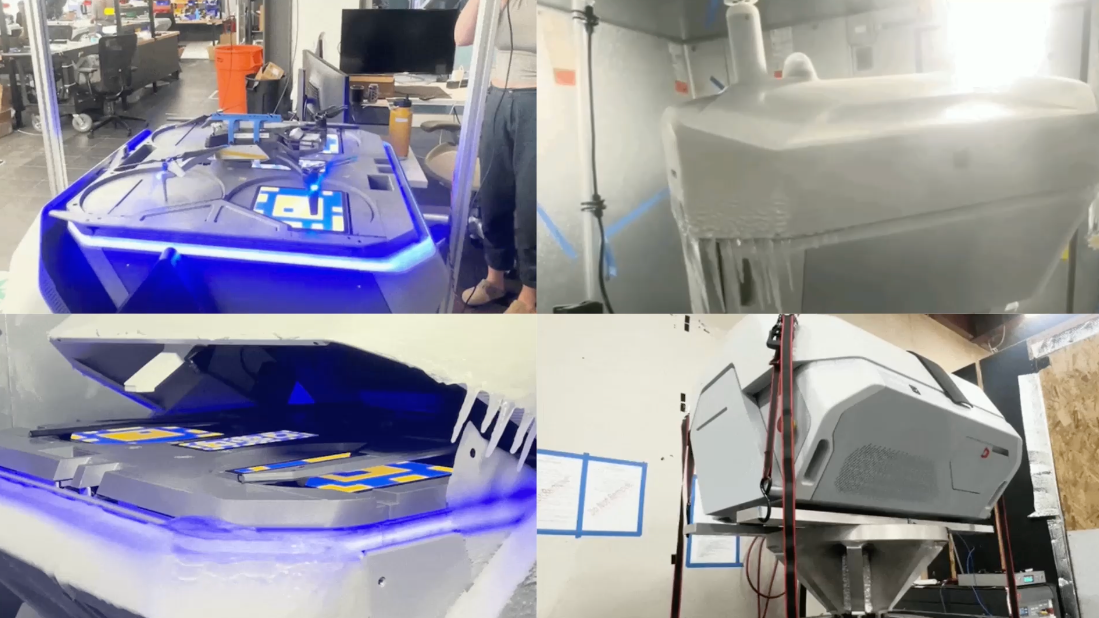
Skydio Dock for X10 Engineering Q&A | Skydio Ascend ’24
Watch webinar
Drone as First Responder: Changes in Policing, Changes in Prosecution
Watch webinar
Demo: 1 Remote Operator. 2 Inspections. 1 Response. No Field Dispatch
Watch webinar