
The BVLOS Revolution Continues: Introducing Multi-Drone Operations
 Jenn Player
 Jakee Stoltz
In the past three years, Beyond Visual Line of Sight (BVLOS) operations have evolved from one-off exceptions to scaled reality. The Skydio Regulatory Team has consistently led this evolution by partnering with leading public safety agencies and critical infrastructure organizations to develop simple, safe, and scalable regulatory pathways.
Now, the next milestone is here: multi-drone operations. We announced the initial breakthrough in September 2025 when the Las Vegas Metropolitan Police Department (LVMPD) received FAA approval allowing a single remote Pilot in Command (PIC) to oversee up to 4 Skydio X10s simultaneously. New York Power Authority received a similar approval in January 2026. This month, the FAA created a streamlined process for public safety organizations to obtain a multi-drone operations waiver, with 12 additional agencies receiving approval:
- New York City Police Department
- Brookhaven Police Department
- San Mateo Police Department
- Sunny Isles Beach Police Department
- Oklahoma City Police Department
- Omaha Police Department
- Redmond Police Department
- Lakewood Police Department
- San Francisco Police Department
- Jefferson Parish Sheriff’s Office
- Pasco County Sheriff's Office
- Ontario Police Department

What Multi-Drone waivers enable
As organizations scale their drone programs, the number one hurdle quickly becomes staffing. Single-drone BVLOS operations already greatly increase the efficiency of drone programs by reducing the amount of travel required to conduct an operation and allowing organizations to consolidate staff around centralized command centers. An officer or linemen no longer needs to drive to the operating area and instead can remotely operate a Dock-based drone from anywhere in the US.
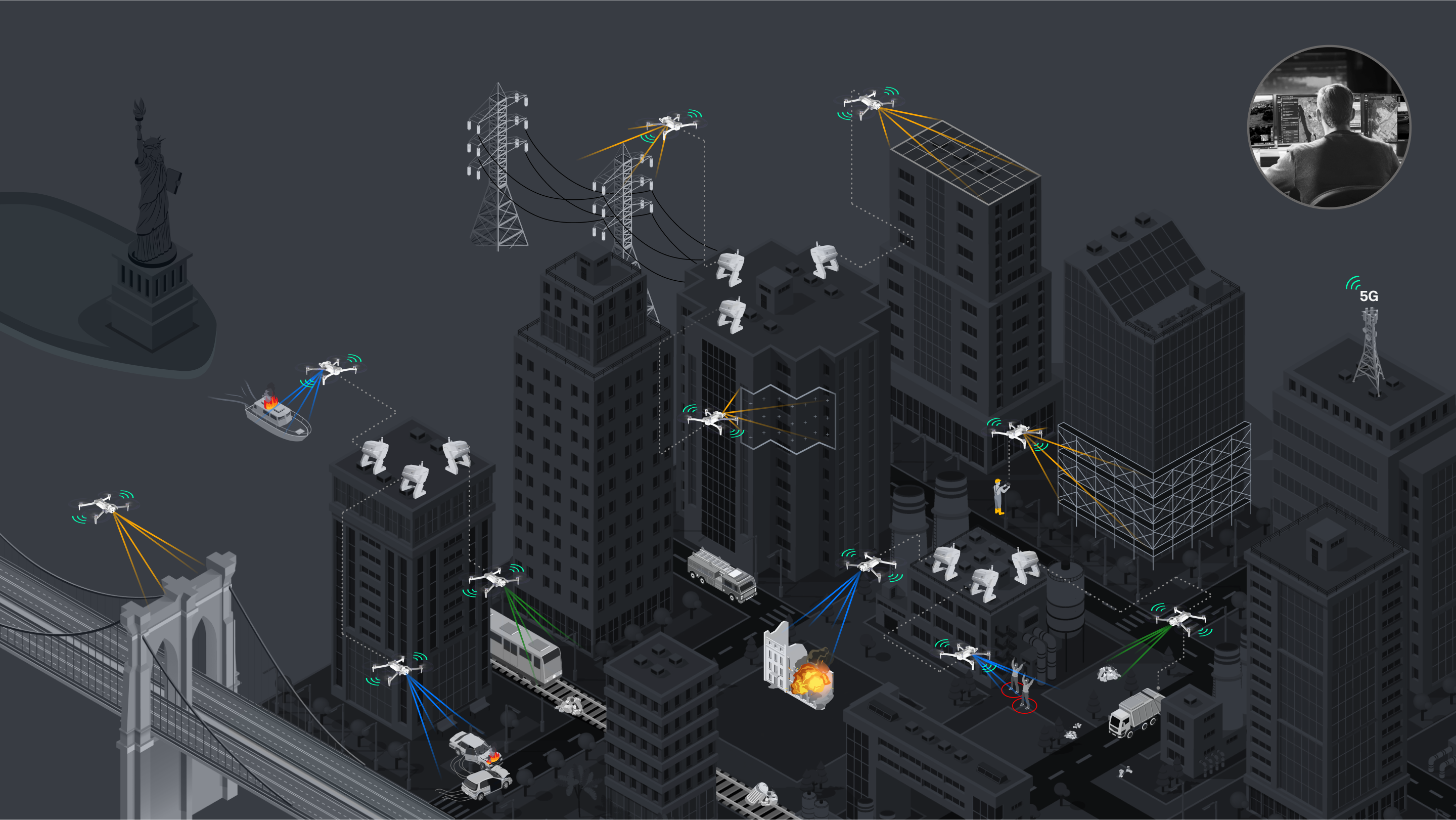
Multi-drone operations, enabled by our latest software release, will again transform BVLOS operations by allowing 1 pilot to safely operate up to 4 drones. Allowing one operator to simultaneously operate multiple drones lets organizations scale their drone programs without the need to proportionally increase staffing.

Multi-drone operations provide benefits across use cases and industries
Drone as First Responder (DFR)
For long-duration public safety missions, a single pilot can now summon a second drone to fly to the mission location and relieve a drone that is running low on battery. Skydio Autonomy reduces the need for a pilot to navigate both drones to and from the mission location, allowing a single pilot to focus on the mission and provide continuous overwatch over an emergency call.

Similarly, a pilot may be finishing one call for service as another call for service comes in. The pilot can immediately dispatch a second drone to the new call for service and let Skydio Autonomy manage the first drone’s return and landing.
Asset Inspection
An organization may need to conduct an inspection of multiple assets simultaneously. Using pre-programmed missions, a pilot can initiate up to 4 inspections at the same time (at one or more locations) and supervise their progress.

Site Security
Similar to asset inspection, an organization may want to operate more than one drone simultaneously to monitor one or more sites. Using pre-programmed missions, a pilot can initiate up to 4 patrols simultaneously and supervise the status of each drone.

Understanding the approval
These multi-drone approvals build on a proven BVLOS framework for single drone operations that feature:
- 200’ Shielded Operations: Operating at low altitude, typically up to 200 feet AGL or within 50 feet of a structure, where crewed aircraft rarely operate.
- ADS-B Integration: Skydio’s built-in ADS-B In integration is simple to use and helps operators remain well clear of low-flying, cooperative aircraft.
Skydio Autonomy: The Key to Manageable Pilot Workload
To transition from single-drone operations to multi-drone operations, the FAA requires operators to answer a central question about pilot workload: how can a pilot effectively supervise multiple aircraft without decreasing safety?
Our answer is Skydio Autonomy. The skills of an expert pilot, powered by the world’s most advanced AI and sensors, allow any pilot to fly further, smarter, and with confidence—day or night, that now includes new features which make multi-drone operations simple and safe for operators. These features change the operator’s job in multi-drone operations: less “hands-on flight control” and more “orchestration”.

Multi-drone UI
A single user interface displays all the information a pilot needs to know at a glance:
- The location of all drones on a map with layers including ADS-B traffic, markers, and geofences for situational awareness
- Cockpit views for each airborne drone with live video, flight controls, telemetry, and alerts.
- The ability to seamlessly switch between drones with a single click for manual control as needed.
The user interface also includes new Fleet Commands, which allow a pilot to command all drones with a single click, including pause, descent in the event a low-flying aircraft is nearby, or even return to land.
Pathfinder
Pathfinder allows pilots to intelligently and safely navigate the drone through complex environments with ease. Pathfinder dynamically routes the drone to the desired location with minimal pilot interaction, while considering things like:
- Terrain changes and structures
- Altitude limitations
- Customer preferences
Intelligent Contingency Management
Skydio Autonomy already includes intelligent response to contingencies, such as automatic:
- Return to landing for low battery or loss of connection
- Parachute deployment in the event of a loss of control
- Landing in designated safe landing zones in the event the drone is unable to land in the Dock
These features have been updated for multi-drone operations to ensure that in the rare event something goes wrong during an operation, the system intelligently and safely responds without increasing pilot workload.
The Arc of Autonomy: Stage 4
In 2021, Skydio laid out an evolutionary path for the industry called the Arc of Autonomy. This framework aimed to move the industry forward from inefficient manual operations to remotely-operated, autonomous drones capable of delivering valuable services 24/7, just like any other piece of basic infrastructure today.

The Skydio Regulatory Team has made steady progress along the Arc of Autonomy:
- In 2020, we played a key role in facilitating the first Tactical BVLOS waiver for the Chula Vista Police Department, which allows public safety personnel to fly a drone BVLOS at low altitudes in emergency scenarios without visual observers or detect and avoid (DAA) systems. Tactical BVLOS approvals were issued to over 600 agencies (before the concept was retired in 2024).
- In 2021, we worked with BNSF Railway to secure the nation’s first national remote operations approval for dock-based drones.
- In 2023, we worked with major enterprise customers like Dominion Energy and New York Power Authority to unlock scalable remote operations without visual observers.
- In 2024, we worked with leading public safety agencies, including the NYPD, LVMPD, and OKCPD, to unlock DFR without visual observers. Over 1,100 public safety organizations have now secured Part 91 waivers to conduct shielded remote operations up to 200’ AGL, with the use of ADS-B In, and without expensive and cumbersome DAA technology.
Today’s announcement marks the achievement of Stage 4 and the shift from “one pilot, one drone” to “one pilot, multiple drones”.
Implement Multi-drone operations in your organization
Skydio’s world-class regulatory team has the experience you need to navigate these approvals and make your drone program safe, simple, and scalable without proportionally increasing your staffing. As we enter a world of multi-drone operations, where a single pilot can simultaneously operate more than one drone, we can help your organization pursue waivers to conduct multi-drone operations. We’ve delivered these results to agencies like LVMPD, NYPD, OKCPD, SFPD, and more, and we’re ready to help your agency achieve the same success.
We look forward to continuing to work with our customers to break regulatory barriers and usher in the next frontier of flight.