Meet F10 Lightrunner: Fixed Wing Performance with Quadcopter Simplicity
Skydio CMO Macario Namie and F10 Product Manager Harrison Zhu introduce the Skydio F10 Lightrunner fixed-wing drone. F10 launches in seconds, flies 100 mph for up to 120 minutes, covering a 30 mile radius. This session walks through how F10 brings long-range response into existing DFR programs, with up to five aircraft launching and landing from one MegaDock, no ground crew or specialized pilots needed. We close with a live audience Q&A on deployment, airspace & BVLOS, connectivity, safety, training and more.
- Flying robots are changing outcomes in cities across the nation.
- They're saving lives and helping our core industries keep
- civilization
- running.
- But the need for aerial intelligence is everywhere.
- To go far and get there fast, you need something with wings.
- A flying robot that can be remotely operated and launched from an autonomous
- dock.
- [drone buzzing]
- Skydio F10 Light Runner is a revolution in aerial robotics.
- F10 covers a thirty-mile radius, nearly three thousand square miles,
- and it gets there fast with speeds up to one hundred miles per hour,
- all while flying for a really, really long time.
- But flight performance is only half the story,
- because why operate one drone
- with five people when robotic take-off and landing means one
- person can remotely operate five F10s from a single MegaDock?
- F10 is like nothing you've seen before.
- Traditional fixed wings block their own camera's view.
- F10's side-eye design means you never lose sight of what matters.
- Most importantly, F10 needs to work for you, and
- you, and you.
- That's why we developed Foresight, autonomy that dynamically
- plans and maneuvers F10 as conditions change.
- Just click what you want to look at, and Foresight takes care of the rest so
- you
- can focus on the mission. Does this sound familiar?
- That's because F10 is part of Skydio's family of flying
- robots.
- A drone for every type of mission, all in one ecosystem.
- [upbeat music]
- F10 doesn't just improve on aerial intelligence, it completely
- revolutionizes it, and the world of flying robots will
- never be the same.
- [upbeat music]
- All right. Good morning. Good afternoon.
- Thank you everybody for taking time out of your busy day to come and join us and
- learn a little bit more about the Skydio F10 Light
- Runner. My name is Macario Nami. I'm the chief marketing officer.
- I'm also joined by Harrison Zhu, who is our product leader for
- this product. Uh, we're gonna spend a few minutes walking
- you through the
- product, a lot of the specifications, exactly how it works, uh, and hope to
- answer as many questions as we can.
- Uh, you know, two years ago, Skydio announced Dock for X10,
- uh, which is, uh, a fully autonomous, uh, uh, capability
- that allows the X10 to respond to emergencies that are far
- away, to be able to conduct inspections
- autonomously, uh, and, and much
- more. The X10 itself as an aircraft is highly, highly versatile.
- Uh, it can run in urban canyons, it can run in, uh, rural environments,
- uh, and it has proven to be, uh, an extraordinary aircraft.
- However, it cannot do everything.
- Last year, we announced R10, which is, uh,
- perfectly suited for, uh, indoor, uh,
- flights, uh, as well as confined spaces, dark
- spaces, uh, for inspection purposes as, uh, as well as
- emergency response. And, uh, two weeks ago we announced
- F10 Light Runner. Uh, and the reason we did that is
- because, uh, we, uh, across our family of flying robots, we
- know that some missions simply require you to go very
- far and to go very fast. And, uh, as we have
- learned, if you want to go far and you go fast, you don't do that
- in a helicopter. You don't do it in a roto craft.
- Uh, quadcopters are extraordinarily powerful
- and, and versatile, uh, but they
- are not designed for this. Uh, the form factor that matters
- the most is a wing. This is why when we go to the airport, uh,
- we are flying on airplanes and not helicopters
- when we seek to cross the
- country. Uh, so, uh, winged, uh, form factor
- is, is really the mechanism that allows us to deliver the kind of
- specifications that F10 has.
- Um, and you would imagine
- that, uh, there would be a lot of fixed-wing drones
- out there in the
- marketplace, but there really aren't.
- And that's because there's still a lot of, uh, challenges to do what
- it is that you want to do with a fixed-wing
- architecture. Uh, and so we really set out to design
- F10 to solve three primary challenges.
- One is ensuring that no matter, uh, what environment that you're in,
- no matter, uh, what flight path is required, that you can maintain
- visibility of the subject that you're trying to look at, uh, whether
- that's, uh, moving or not. Uh, we want to make this
- very, very, very easy to fly, uh, so
- and for, and to provide as much automation
- and autonomy as possible
- so you don't have to have strong expertise and hundreds of hours of
- flight experience in order to get the benefits from a fixed-wing
- drone. And the third is to try and remove the number of
- people required to be able to scale this, to be able to use this
- capability. So we built and, uh, looked at what can we
- do to autonomously launch, uh, as well as land
- or catch the F10 without requiring any people in the
- field, uh, and to make it, uh, a really, really small team that can
- do quite extraordinary things. We believe we have solved these
- challenges with F10 Light Runner and its fully
- autonomous docking station, which we call MegaDock.
- And I'm gonna turn it over to Harrison to walk you through how we
- did it
- Thanks, Macario. Um, hi, Harrison Zhu again, staff product manager
- here, uh, leading the F10 effort. Um, I'll walk you through a little
- bit of the high-level capabilities of this platform.
- I'll then take you through, um, the sort of more detailed engineering
- explanations of how we were able to solve the three sort of major
- problems with
- existing fixed-wing drones. I'll then show you what the flight
- experience looks
- like and what this all looks like when it comes together,
- and then go through a
- little bit more of the FA-- uh, FAQ type, um,
- type activities at the very end.
- All right. And I should be able to move slides here.
- So these are the top-line numbers.
- You heard about them in the video, but I'll just sort of reiterate that
- F10 will fly at a hundred miles per hour.
- This is the FAA limitation for ground speed.
- We literally cannot go faster per, um, per the FAA.
- It will fly up to a hundred and twenty minutes.
- Um, this is not necessarily at a hundred miles
- per hour, but you can
- actually get a hundred and twenty minutes of endurance out of
- this platform.
- It'll cover approximately a 30-mile radius, so that means getting out to
- 30 miles and having, uh, some useful time on station.
- That translates into twenty-eight hundred square miles of coverage area, which
- is just mind-boggling. The charge time will be approximately
- forty-five minutes, and that is after the battery is heated or cooled
- to the nominal charging temperature, um, which should take, you know, five
- minutes in a worst-case scenario.
- Um, and again, you can put up to five F10s in one
- MegaDoc.
- And the takeaway from the sort of top-level specifications is that this
- platform together brings an insane amount of capacity and
- capability to, um, wherever it's deployed.
- And to give you some more context for that, um,
- I've got some slides. So in a-- with a five-minute response,
- you can get out
- to eight miles, anywhere within eight miles in just a
- five-minute time span. That's about two hundred square miles of
- coverage area.
- At the 15-minute timeline, you can actually get out to about
- twenty-five
- miles, so about two thousand square miles of
- coverage area.
- Um, the max response is about 30 miles, so twenty-eight hundred square miles
- of coverage area. And, uh, the vast majority of counties
- are basically smaller than this. I believe it's about ninety percent of
- counties
- are actually smaller than, uh, this footprint.
- Speaking of counties, to put it in a more specific context,
- Douglas
- County, Colorado, um, is eight hundred and forty-four square miles,
- so
- you can actually cover easily the entire county with
- one MegaDoc and a, and a set of F10s.
- Clark County, on the other hand, is a little bit bigger.
- It may take a couple of more. Um, it's about eight thousand square miles.
- Large, large county. Um, lots of stuff to get to.
- And with just three MegaDocs, you could be basically anywhere within the
- county,
- uh, in, in just 15 minutes.
- Going a little bit larger 'cause that, you know, seems almost too easy, uh,
- fifty-seven thousand square miles is, uh, what the State of Georgia covers.
- There are about twenty-four-- or sorry, two point four million distribution poles
- in, in this location. And with 18 MegaDocs, you'll be able to
- cover almost the entire state. Um, that's the current
- sort of format of MegaDoc. We are eventually going to build what we call
- dock hopping, where you can take off from one dock
- and then land in
- another, which should extend the range and drop that number from 18 MegaDocs
- to, um, something slightly lower.
- We'll have to figure out how the math shakes out, but it's gonna get better over
- time.
- Ultimately, this will just give you an incredible
- amount of capacity and capability
- for rural and urban su- uh, suburban response.
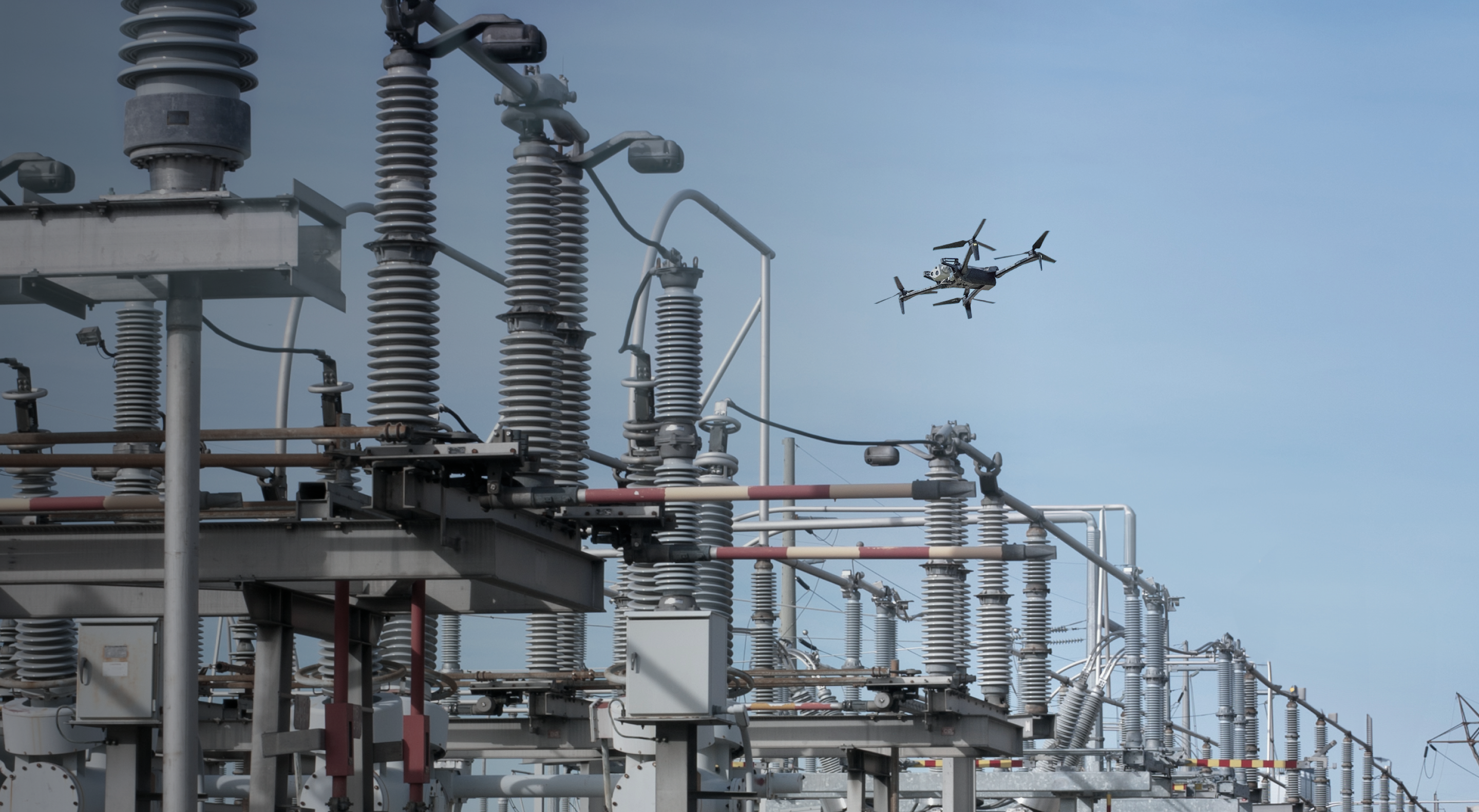
- Automated corridor patrols as well for oil and gas, transmission line.
- Uh, it'll also give you the capacity to search
- and try to find people in
- wide-open areas. Uh, and then, of course, because of the speed,
- F10 will be incredible for high-speed pursuits, uh, which hopefully turn into
- lower speed pursuits and just follows, um, once the aircraft is
- following and in the air.
- All right. I'll take you through, uh, the more detailed engineering explanations
- of
- our solutions for one, two, and three here.
- So to maintain visibility of what you're looking at, um, there are a couple of
- challenges and a couple of solves.
- The main solve that we have actually put into F10 is the
- side eye design, um, which basically is our way of
- describing us putting the gimbal out on the left wing tip
- and making the entire-- building the entire aircraft basically
- around that. So the fuselage is offset to the right.
- Um, and you're probably looking at this thing
- and thinking, "That should not
- fly." That's, um, what I'll, I'll also say that that's mostly
- what people said about the B-2 bomber and, uh, and the-- through the,
- through the, uh, talent of engineering, um, they were able to make the
- B-2 fly, and now it's iconic, and we think, uh,
- it'll be basically the same with
- F10. Um, so this thing is perfectly asymmetric.
- Uh, we have some of the smartest engineers on
- the planet basically writing
- custom optimizers to design this aircraft.
- In the same way that, um, Formula 1 cars are not designed by hand,
- uh, F10 is not also designed by hand.
- It is, it is computer optimized to be stable, um,
- and effective
- through all phases of flight, despite this sort of odd-looking
- configuration.
- Um, what this does for us is actually when-- allows us
- to, when we are turning left predominantly,
- like sort of
- NASCAR, right? Um, it allows the gimbal to be basically be on
- the
- lowest point of the orbit or of the aircraft, looking
- primarily downwards. When we do that, that translates
- into almost zero occlusions from the aircraft actually, uh,
- getting in the way of the camera.
- A little bit more of a visualization here.
- Um, so you can see on the left, this is a competitor platform.
- Um, it's going to cast a shadow on the ground
- every time one of its
- landing gear or, um, or wings gets in the way.
- On the other hand, on the right with F10, uh, you basically get no
- occlusion
- Another challenge in sort of keeping the subject or target
- in view, uh, is actually pointing the gimbal itself.
- So once it's below the aircraft and it is capable of seeing
- all the things around it, um, downwards, it's then sort
- of, uh, the pilot or the sensor operator's
- challenge to be able to
- actually track something, um, while the air- aircraft
- is actually flying.
- So Shadow is the subject, uh, track and follow
- feature that we have on X10. We are rewriting it
- completely to actually be adapted to the fixed-wing
- platform. So Shadow will,
- um, detect subjects. You can then follow those subjects from,
- uh, from, from the platform, and it will fly the aircraft
- around obstacles, uh, to maintain consistent,
- consistent view of, uh, of, of tra- char- uh,
- sorry, of,
- uh, targets or subjects.
- Of course, if you don't have connectivity, you can't see anything, and that's why
- we're bringing Connect Fusion+ forward through to F10.
- Um, so Connect Fusion+ is the technology that we use to, um,
- put multiple cellular networks on a single aircraft or multiple
- cellular radios on a single aircraft.
- F10 will have two of these cellular modems, if not three.
- We're still trying to figure that out in testing to see if three
- is necessary.
- Um, but it will have at least two cellular
- radios on board, and this
- should get you coverage of the vast majority, uh, of the United States.
- Of course, once you can see things, if the experience isn't simple,
- then you need to train pilots for, you know, months, if not years.
- You may need up to two people to actually, uh, actually operate the aircraft,
- um, and that is gonna get in the way of your
- ability to adopt and scale, uh,
- technology like this. So, um, we
- have addressed that with a couple of different technologies.
- The first is Foresight. So this is basically the autonomy,
- uh, Skydio autonomy rewritten and adapted to, um,
- the, the new F10 fixed-wing platform.
- It is going to take in
- a ton of data. Basically everything about the environment
- that we can feed it
- that might play into how a pilot would decide how to fly an
- aircraft, we are going to feed, uh, Foresight, and Foresight is
- basically just going to fly, uh, the drone almost completely on
- its own.
- It's gonna take into account things like geo-fences.
- It's gonna take into account things like the aircraft's, uh, own sort of
- structure and, and visibility. It's going to take into account winds.
- It's going to take into account, um, any number of these things, and
- what that ultimately allows us to do is actually produce an experience
- that, um, we like to call one-click flying.
- Um, so previously with other fixed-wing
- aircraft, you would have to drop a
- number of points in the map. You'd have to then go check those points
- and
- manage the altitudes and, you know, hmm, there it goes on and on.
- With, uh, Foresight and F10, you'll actually just be able to click
- once in the field of view or even on the map and, uh, and Foresight
- will just take care of it, and F10 will fly itself.
- Of course, um, we have to be safe and fast when we're actually transiting,
- so Pathfinder, Pathfinder Data, um, which is essentially our
- version of Google Maps for the sky, will be fed through into
- F10. Um, Pathfinder will take terrain data,
- it will take building
- data, um, and other sort of obstruction data, uh,
- and feed that
- into our autonomy systems, um, like it does with X10.
- Um, and it will route the aircraft, uh, around
- or over, um, over obstacles or terrain,
- keeping you compliant, uh, with FAA waivers and safe.
- Speaking of, uh, speaking of the FAA, of course, we want to avoid other,
- um, crewed air manned aircraft. So we actually will have, um,
- the Skydio Airspace Assurance System, which is new for F10.
- Um, it's going to incorporate the standard
- daytime obstacle avoidance that
- you might find on, uh, on X10, except we are going to make that
- work all the way up to 100 miles per hour.
- Um, and then for other aircraft in the
- airspace, we actually will have an ADS-B
- detect and avoid system. So if there's another aircraft flying at F10,
- um, and you, and your pilot has not sort of reacted in
- time, F10 will
- take automatic, automatic evasive action and, uh, and
- avoid those aircraft.
- Finally, um, the ground crew problem is, is quite
- difficult and another one of these things that really, really gets in the way of,
- um, of customers and, and a- agencies being able
- to adopt technology like this. Um, I flew fixed-wing
- drones in the Marine Corps, and we had a, a crew of about six to eight people
- on standby, basically twenty-four/seven to launch the
- aircraft that I flew, and
- that just doesn't work for, uh, for the vast majority of customers
- out there.
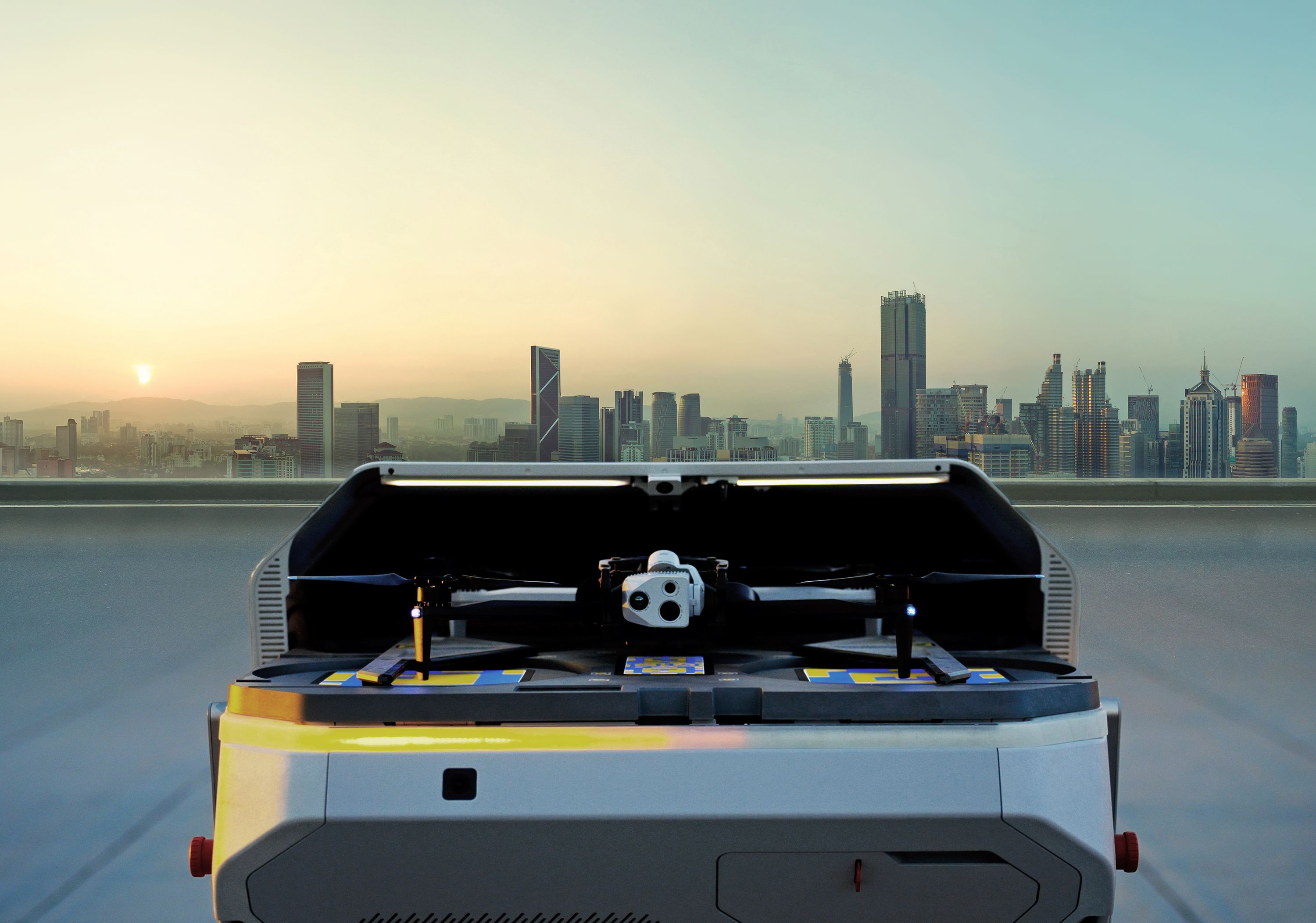
- So we solved this, of course, with MegaDoc.
- And MegaDoc, through robotic takeoff and landing, allows you to have five
- aircraft at the ready twenty-four/seven at the click of a button with
- no ground crew. So a single person really could launch
- and operate
- up to five aircraft, especially with the future multi-drone
- waivers that are
- going to extend to F10. Um, MegaDoc will also,
- uh, have to have power and connectivity run to it, and it also
- has an included HVAC system, which you can see there on the left,
- that will, um,
- optimize and heat and cool the batteries for, uh,
- for the fastest
- charging we can, uh, we can muster.
- Finally, with the fenced-in area, um, the secure sort of launch and
- catch area that we call the front yard, um, you'll, you'll be able
- to, um, make sure that people are out of the launch and land space,
- keeping people
- safe, uh, and keeping your equipment, um, equipment safe.
- You can see here that we actually use, um, use a system on the robotic
- arm, uh, to catch and launch the aircraft with, um,
- suction cups.
- So the suction cups are a sort of very well, um,
- well-tested and well-engineered system that many companies actually
- use in robotic packaging s- uh, solutions in
- warehouses. So we are basically borrowing all of
- that engineering and all of that
- testing to, um, to actually produce an even more reliable
- s- and more, uh, more economically effective solution in,
- uh, in
- MegaDock.
- And with this whole system, like I mentioned before,
- you could have one person
- really operating up to five aircraft.
- Um, in terms of continuous coverage and having drones up in the air, you could
- have about three and a half drones on average in the air, um,
- with a single person and a single MegaDock, which, uh,
- is just an
- incredible, incredible capability.
- And, uh, this video that we're about to bring up
- is what it looks like when
- all that is put together.
- So this is, uh, from our customer demos at, uh,
- at our Ascend
- conference. You can see, uh, the drone actually flying in the map
- w- on the left. It is currently using Shadow
- and tracking the subject
- over here. You can see, um, through these orbits that you'll
- basically get no occlusion.
- Foresight, which you'll, um, you'll see hints of on the left in the
- map with the, uh, the sort of, uh, path indicator in the orbit,
- is just optimizing for all kinds of things, uh, at once and
- allowing, uh, our pilot at this time, Nacho, to, um, to
- go ahead and basically go hands-off at this point, really just
- managing the zoom and trying to figure out, you know,
- let's say, what's in the back
- of the truck, um, you know, or what the driver or passenger might look
- like
- with very, very sort of minimal cognitive load
- and input.
- Of course, if it gets a little far away, Nacho's going to have to sort of adjust
- his orbit, and you can see here that he really does
- that basically just with one
- click. He's just dragging and dropping, in Foresight.
- Um, our planner is adapting to that new, uh, to that new
- orbit and basically giving Nacho what he wants based on the single
- click.
- There are other flight modes, of course.
- You can actually do what we call cursor lock, which is basically taking the gimbal
- and pointing it manually, um, with, uh, with your
- pointer.
- There will also be other manual modes, uh, more manual modes if you really need
- them, uh, such as head and hold.
- Great. Um, so now I'm gonna get into a little bit
- more of the details and some
- frequently asked questions before, uh, answering some Q&A.
- So to start with, um, there will be an integrated parachute.
- So the integrated parachute enables Category Three operations over people.
- We believe this to be critically important, um,
- because as you're keeping your
- communities safe and the power running, you should be keeping the people on the
- ground safe. Uh, it also allows you to comply with, um,
- FAA, FAA regulations. It is also directly integrated
- into the airframe, which makes the, uh, whole system more reliable and, uh,
- and simpler, um, and gives you sort of more,
- more mass savings,
- allowing you to fly further and longer.
- The infrared camera on F-10 is also upgraded.
- We are going to a narrower field of view camera to allow for sort of better
- angular resolution or, uh, better infrared lu- resolution at a
- given, uh, standoff distance.
- In terms of software, F-10 will be compatible with all of the,
- uh, Skydio command
- softwares. Um, the functionality will be sort of
- available in varying
- degrees across them, but it will be compatible
- and flyable from all of those
- commands.
- Speaking of software, Paraverse, um, our simulator, will also be
- available with F-10 in it. Um, we expect that to be out
- somewhat soon, um, so that you don't have to have your equipment
- to
- train. Um, you don't have to have to, or have to put up a live
- flight to train and that you'll be able to, um,
- get your pilots used to the
- experience before, uh, before the hardware arrives.
- Time to launch is gonna be pretty similar to, uh, the dock for
- X10, so 20 to 30 seconds to launch. The cruise speed is
- gonna be approximately 45 miles per hour for best endurance.
- That's when you would see the 120 minutes.
- Our batteries are, uh, custom designed for F-10.
- Uh, they are really, uh, they're much larger batteries to get us
- the
- 120-minute flight time. Um, and because of that,
- they won't be necessarily
- transportable via a passenger plane.
- Environmental ratings will be, uh, IP55, uh, for the,
- for the aircraft itself. Takeoff and catch will be up to 27
- miles per hour like other Skydio aircraft.
- MegaDock will also be compatible with future Skydio fixed-wing vehicles.
- Um, so it's worth mentioning that, um, in all sort of standard contracts,
- you get a
- refresh halfway ber through-- uh, halfway through the contract,
- where we will give you the latest and greatest.
- The, uh, MegaDock will be compatible with those
- future aircraft, and the
- swap procedure will basically be swapping out the cradle, uh, in which the
- drone sits and dropping in the new aircraft.
- Maintenance and repair, which are also included in every standard
- package,
- uh, will be ma- uh, annual for the MegaDock itself
- and the HVAC.
- All the systems on MegaDock are also replaceable, just like Dock for
- X10. So if something breaks out in the field,
- uh, which really shouldn't
- happen, but if something, um, is going on in the field,
- we're gonna come out, and
- we're gonna fix it in place.
- The footprint for MegaDock is about 15 feet wide by 20 feet long,
- so, um, and nine and a half foot high, so approximately two to three parking
- spaces. Uh, maybe like two Texas parking spaces
- and three, you know,
- Hawaii parking spaces. Um,
- deployment will be done primarily by tilt bed, uh, tilt bed truck,
- forklift, or crane. It should take two deployment engineers
- two days to
- actually deploy the, the dock. It's possible that this goes down over
- time, but,
- um, but that's what it looks like.
- In terms of where we want to deploy these things, the general recommendation would
- be secure lots, uh, parking structures, um, or even
- sort of open lots. And, um, and the nice thing about
- the endurance and range and speed of the platform is that you can
- actually deploy-- you've, you've got a much wider selection of
- locations or
- ranges that you can deploy to, um, because moving the dro-
- drone and dock a mile in that direction or a mile in that direction doesn't
- substantially change what you can cover.
- Now that being said, rooftops are, um, possible to be deployed to.
- Um, it is going to require significant effort,
- um, including structural
- engineering sign-off and design potentially.
- Um, so we generally recommend secure lots or,
- uh, or parking
- structures.
- The deployment surface has to be, um, plus or minus three degrees.
- Uh, we generally think asphalt or concrete are going to be better.
- Um, other sort of softer surfaces like dirt
- and gravel may also be
- possible, uh, with a little bit more work.
- Power requirements are gonna be two hundred to, um,
- two hundred and forty volt,
- sixty hertz, um, at a hundred amps.
- So this is basically like, uh, most car chargers, most electric
- vehicle chargers. That's about the same power
- that they require.
- Um, it's going to require a little bit of
- infrastructure work, but, um, but
- nothing, uh, nothing too crazy.
- And, uh, and the network requirements are thirty megabits per second per drone,
- um, upload speed. Um, and the dock itself can actually take in
- gigabit, uh, gigabit Ethernet.
- There, um, will also not be a spotlight on this
- aircraft.
- Uh, we have the infrared camera, but we are looking at spotlights for the
- sort
- of next, um, the next aircraft and that you would get in the sort of
- refresh.
- The Skydio Link, uh, radio will be used primarily for launch
- and land. It won't be sort of used for flight out in
- the operational area.
- That is going to be, uh, almost exclusively cellular.
- That being said, we are looking at satellite, um,
- at satellite options for the next
- version of the aircraft, uh, which again will be included.
- F10 will, uh, hover essentially only for launch,
- land and emergencies.
- You know, this is the way that we actually,
- by being in forward flight, um,
- we can, we can get much more efficiency out of the
- wing.
- Um, hovering will be, uh, will be essentially, um, an
- emergency or launch land behavior only.
- I talked about, um, dock hopping. So we are building the architecture of
- F10 and MegaDock to support this, uh, not out of the box, but
- slightly after, uh, after GA and, uh, and that's just going
- to open up a whole new, uh, new set of possibilities.
- Flights will be done through, uh, through remote flight deck almost
- exclusively.
- Um, controller flight will not be supported.
- In terms of regulatory, no new license is required to fly
- F10. Uh, a Part 107 is, is enough. Um, there will,
- however, be new waivers required to fly F10 beyond
- visual line of sight.
- Um, but, and you might be sensing a theme here, uh,
- waiver
- services are included in all F10 packages.
- We are, uh, gonna be deploying F10 and MegaDock to customers in
- 2027, um, sort of for early testing to start
- and then,
- uh, and then of course, um, through, through the second half of the year,
- GA.
- And with that, I will answer some of the questions.
- So the first question is, "How many training hours
- are required to achieve pilot
- competency?" Um, I think there, there's a couple of ways we could,
- uh, we could maybe answer this. In some sense,
- it's actually, um, we saw customers fly at Ascend,
- and within, you know, two to three minutes they
- were competently flying F10,
- um, which is really, really incredible.
- Uh, it took me about six months in flight
- school, um, to, you know,
- just be able to fly a fixed wing and keep it from like coming out of the
- sky.
- Um, but at Ascend, uh, in our customer demos, we saw people
- really get the hang of it within two to three minutes.
- Um, now that being said, depending on sort of your, um, your
- program and your SOPs, you may want a little bit more training.
- Uh, we would love to work,
- excuse me, with, um,
- with any customers, um, right, who are, who are sort of concerned or have, you
- know, requirements in terms of pilot, pilot competency.
- Uh, we would love to work through, through building a curriculum with you.
- Can I add one, one thing to that, Harrison?
- Mm-hmm.
- The, uh, uh, for, for those who are familiar, uh, we have, um,
- uh, a product called Paraverse, which is a completely virtual
- environment that, uh, is completely linked to the physics of our
- products. Uh, and F10 will be available to
- fly and use inside of Paraverse, which allows for
- effectively unlimited reps regardless of the, uh,
- hardware being present or not. Uh, we hope we will
- make this available obviously as a training mechanism for all customers, um,
- as
- part of their F10 purchases and deployments.
- Uh, and we're also looking at, uh, trying to make F10 flight and
- capabilities available inside of Paraverse even before that, uh,
- as a, uh, sort of a trial run or, or demonstration environment.
- Uh, but that's still a, a few, a few months away.
- Yeah. Thank you. Yeah, absolutely.
- And we'll, uh, we'll be building in probably more
- scenario-based training even
- into, into Paraverse. Um, the next question is, "Can the dock
- run off Starlink?" Um, this is technically possible.
- In general, Starlinks don't usually provide the, uh,
- upload speeds we'd
- recommend for operating multiple aircraft.
- Um, what that means is that the, the dock may take longer to
- upload, uh, flight data after, after the flight is done, so
- video logs, so on and so forth. Um, but it is, it is
- possible to do this.
- The next question is, um, "What is the emergency landing procedure?" So
- in order of preference, the, uh, aircraft F10 will try to
- land in the dock.
- Uh, on the robotic arm. Um, if it can't do that,
- it's going to try to land in
- the netted area in the front yard, um, which you haven't seen yet
- but will be, uh, will be available.
- Um, if it can't do that, it's going to try to find a safe landing
- point, which
- you can specify during deployment.
- Um, and we think we'll, we'll be able to allow you to specify a
- safe landing point
- even in flight, and it will put itself, um, down
- gently at that safe landing point.
- If, um, if that isn't possible, it will deploy the parachute and, uh,
- and,
- and, um, gracefully sort of, uh, come to the ground.
- The, uh, next question is, any plans down the road to make MegaDoc
- functional on a trailer to park it at natural disasters and special
- events? Um, we-- we're taking a look at this.
- Um, there's certainly no near-term, near-term, um, plans to make it
- trailer-able. Um, it's possible that, you know, over time we may,
- we may do something like this, but there are no plans right now.
- Um, one of the things that we, that we believe strongly in with this
- platform because of the sort of range, uh, and speed, um, is
- that it should basically cover most things.
- You know, if you don't have to cover, um, sort of an entire state, um, with
- a single dock, you should be able to put a couple of
- them, um, in the
- sort of key areas that you expect to fly in.
- Um, the next question is, any plans to add functionality, uh,
- models for data collection applications other than just response?
- Um, so we,
- we will obviously have video and photo.
- Uh, we are not planning, uh, at, at launch to make this
- available. Um, we still have to take a look at the data
- coming off of F-10 to see
- what's really gonna work for you. Um, and, uh, but we are gonna
- take a look at that down the road, uh, just not, not in the launch
- timeline.
- Um, the next question is, is it the same camera as the X-10?
- Um, so some of the camera modules are shared.
- So the, uh, the tele, the tele camera module is shared.
- The narrow camera module is shared.
- But the infrared camera is, uh, is upgraded.
- The next question is, while using the shadow feature,
- are you able to nudge the
- camera tracking position, uh, for example, to get better views
- of, of the truck bed? Um,
- the--
- that is a good question. I don't think so at the moment, but that
- is something that we could take a look at, uh, take a look at doing.
- Yeah, that's a, that's a great question.
- The, uh, next question is, do you have any demos of F-10 being
- deployed in a
- city setting with high-rises, elevation increases, uh, so
- on and so forth? The, um,
- the, the short answer here is basically for an environment like that,
- um,
- a sort of really urban city setting, we would expect an
- X-10, uh, an X-10 dock to really be the tool for
- that environment.
- Um, an F-10 will be able to fly in those
- settings, but, um,
- due to sort of how tall the buildings may be or how tall the obstructions
- may be on the ground, uh, and potentially the density of incidents,
- an
- X-10 may actually just be the better tool for that environment.
- Um, but we have, we have plenty of ways
- that we can work with you, um, between
- our, um, our sales folks and our solutions engineers to determine
- where the right, um, you know, or what the right tool is for various
- environments.
- Um, the next question is, so, uh, you need to have cell coverage to
- fly? Uh, that is correct. Yep. And, um, but this is cell
- coverage between potentially, you know, um, at least one
- of two carriers, potentially one of three carriers.
- Um, so we, we believe and actually have studied this and
- about ninety percent of the continental US is covered by, um, a
- combination of two carriers. So, um, so yeah, you, you must have
- cell coverage.
- That being said, um, like I mentioned earlier, we
- are taking a look at satellite
- solutions. Um, there are none that we're gonna be really ready
- and viable on this
- timeline, so, um,
- so that's something that we're looking at for, uh,
- for the next generation of
- aircraft.
- The next question is, uh, what measures were put into place on
- MegaDocs to
- withstand vandalism? Um, yeah, so it's, uh,
- as you can see, sort of made of a shipping container
- and a fenced-in area.
- Um, at some level, uh, at some level, if someone is really, really
- motivated, right, um, you know,
- anything is vandalizable. Um, that being said, if you look at one of
- these out in the wild, the, the container and the fence are nine
- and a half feet
- tall. They're, um, uh, they're pretty difficult to
- get, uh, over and around and pretty, um,
- and pretty substantial. Um, so that's, that's the first, um, that's the first
- approach here. Uh, y- the container can of course be locked by
- padlocks as a normal shipping container would be, and there's no way to enter
- through the, um, through the fenced-in area unless you, um,
- unless you
- climb it or sort of, um, you know, damage it substantially.
- There will also be dock cameras on, uh, on the dock itself
- looking out into the fenced-in area for security purposes.
- There's a dock camera looking into the container, um, for fe- uh, for
- security purposes. And then beyond that, we just recommend
- generally deploying to, um, to locations that are not visible from,
- um, you know, or highly trafficked, right?
- Um, things like sort of parking structures in,
- in a corner or a, a
- lot that is potentially already secured with a fence that is just lower
- probability
- of, um, sort of, uh, people walking nearby.
- The next question is, uh, is there any power backup within the
- MegaDoc to be able
- to fly after a natural disaster when power could be unavailable for, uh,
- multiple days or weeks? There, um, there is not one
- included in MegaDoc itself. That being said, we, uh, we will have
- instructions to be able to hook up external power banks.
- Um, external power banks, you know, you could imagine, uh, any sort of
- solution you would use to feed, feed a similar system that you needed to
- work, um, you know, post natural disaster like a generator
- battery combo. Uh, MegaDoc will actually support
- external versions of those.
- The next question is, uh, "Is there any plans for mission planning,
- K9, or SWAT
- tracking live on the maps via apps on devices like iPhones?"
- Um,
- the-- for, for mission planning, certainly.
- So, um, so mission planning in terms of being able
- to drop waypoints
- ahead of time, um, and actually plan out a mission like you
- might see for inspection and mapping, um, that we are definitely planning on
- doing. Um, I can't say too much about the timelines
- there.
- Um, and then K9 or SWAT tracking live on maps,
- uh,
- via apps on devices, uh, or iPhones.
- So we have, um, we have this capability actually already
- in the
- ecosystem. So we have markers that will show up with, for
- example, um, body-worn cameras such as, uh, Axon body
- cameras. Those will show up. Um, and we actually have a
- new Skydio mobile app that we are working on for, um, for,
- you know, things like this. I don't know if there
- are specific plans to make,
- um,
- to make, you know, the Skydio app show up as a marker from an
- iPhone
- on our map, but, um, that's something that we can take a look at.
- The next question is, uh, "Can it work on, uh, mesh or, uh, MANET or
- mobile ad hoc networks?" The answer is, um, not, uh,
- n-not currently for this version.
- So, um, depending on your use case, you know,
- and depending on how far you need to
- go, the, uh, the sort of mesh networks, um, the
- mesh network solution is actually, um, not always the most
- economically viable. Um, I know sort of in the,
- in the defense world,
- right, um, I used to work with these, these types of systems all the time.
- That's much more, um, much more doable, um, and, uh...
- Let's see. Um, it's much more doable and more viable, um.
- All right. Um, so that's, that's all we've got for today.
- Uh, thank you everyone for tuning in.
- Um, we, we really appreciate the interest
- and the opportunity to get to speak with
- you and give you sort of more details on the system. Um, yeah.
- We'll see you next time.
Watch Time
39 Mins 8 Secs
Related Webinars

Drone as First Responder: Changes in Policing, Changes in Prosecution
Watch webinar
Faster Response, Safer Campus: How DFR is Changing University Policing
Watch webinar
How DFR is driving San Francisco’s drop in auto theft and larceny
Watch webinar