FAQs about site security
How it works
What is an autonomous drone security system?
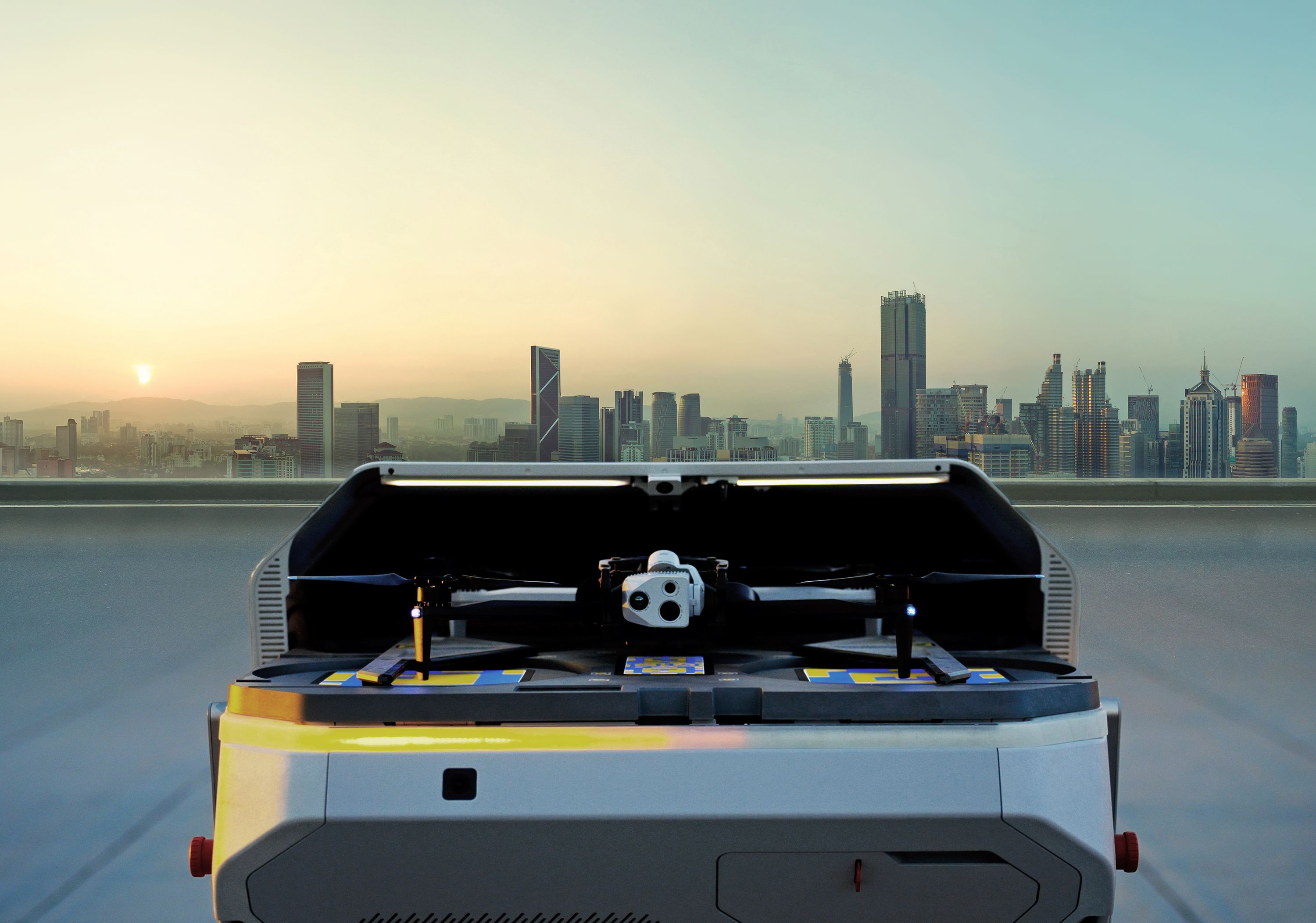
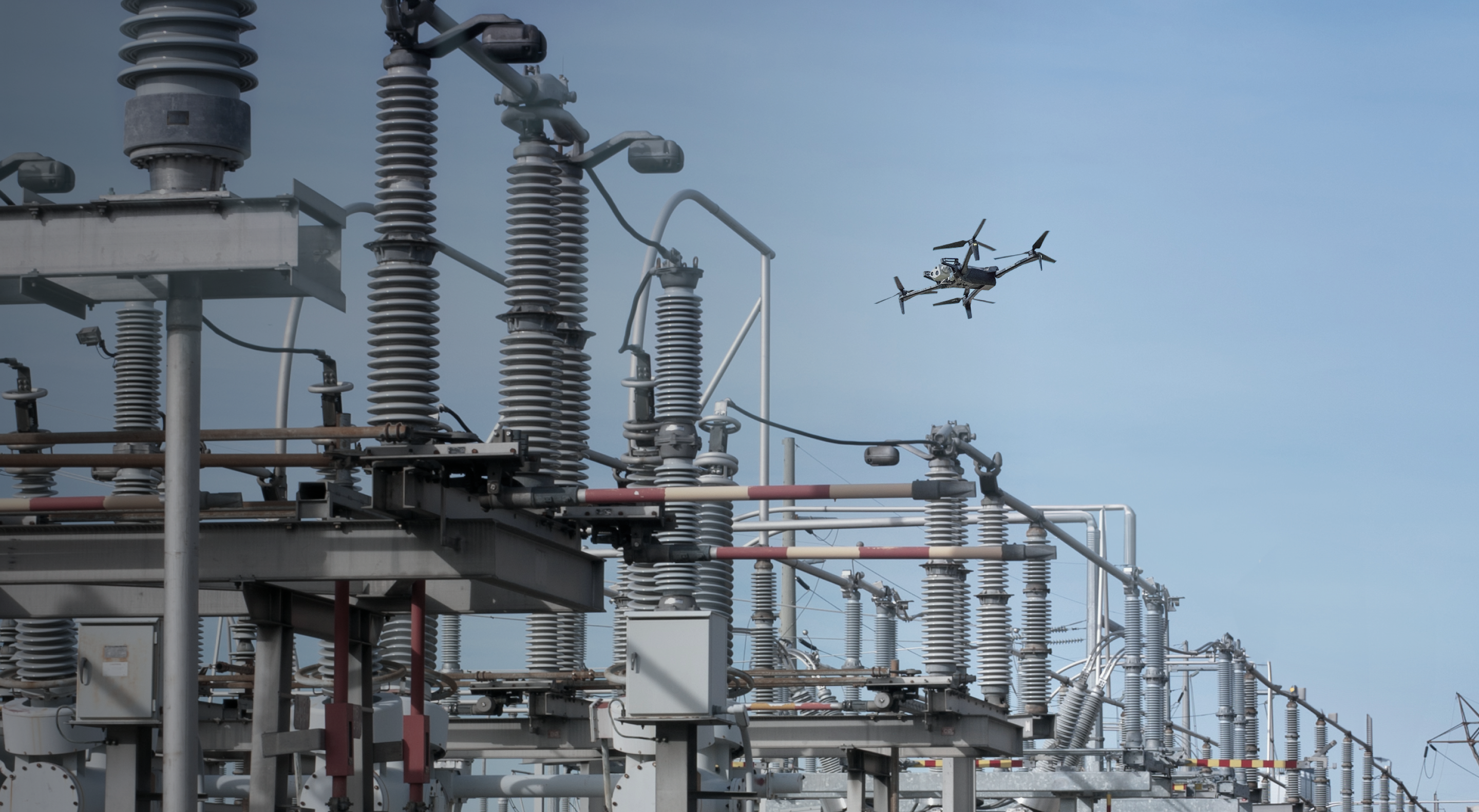
An autonomous drone security system uses docked drones that launch, patrol, and return without an on-site pilot. Drones deploy on a schedule or from alarm triggers, stream live 4K and thermal video to remote operators, and recharge automatically in their dock. Multiple docks can be networked as a Dock Hive to provide continuous, overlapping coverage across a site. Skydio deploys across distribution centers, data centers, energy infrastructure, correctional facilities, ports, construction sites, auto yards, campuses, and military installations — any site with a large perimeter, significant guard labor costs, or high alarm volume.
How quickly does a Skydio drone respond to an alarm?
Skydio drones are airborne in under 20 seconds from the moment an alarm or access event triggers — delivering live aerial video before a guard on foot could reach most perimeter locations. Fixed cameras provide a static image from a single angle. A drone airborne in under 20 seconds reaches the scene in seconds, streaming 4K and thermal video effectively putting a camera exactly where operators need it, when they need it, so operators can assess the situation before committing any physical response.
Can one operator manage multiple drones and sites simultaneously?
Yes. Skydio Remote Ops is a browser-based platform that gives one operator live visibility and control across multiple drones — up to four simultaneously — and multiple sites from a single interface. Operators authorize flights, monitor active missions, and share live video without being physically present at any site. Skydio is trusted by more than 1,200 public safety agencies, 1200 critical infrastructure companies, 450 energy companies, every branch of the U.S. Military, and the militaries of 29 allied countries. A single remote operator using Skydio can maintain consistent patrol coverage across facilities that would require multiple guard posts to cover on foot.
How does Skydio differ from other drone security systems?
Skydio is the largest U.S. drone manufacturer and the world leader in flying robots. Our systems are more autonomous, easier to fly, and are the most secure drones in their respective classes.. The X10 navigates without GPS — critical for dense environments and contested military settings where competitors cannot operate. The R10 extends autonomous patrol indoors, into warehouses, hangars, and correctional facilities that outdoor-only systems cannot reach. Skydio holds FIPS 140-3, CJIS v6.0, SOC 2 Type II, ISO 27001, and AS9100D certifications — a compliance depth no other drone security vendor publicly matches. Skydio is the only drone trusted by every branch of the U.S. military and a growing coalition of allied nations.
Can drones completely replace security guards?
Drones significantly reduce guard requirements but do not eliminate every guard function. Access control, visitor processing, and physical intervention still require people. The proven model is augmentation: fewer guards covering more ground, supported by autonomous patrol, alarm verification, and deterrence that removes low-value dispatches from their workload. Rather than replacing headcount outright, drones help organizations get more out of the people they already have — extending their range, reducing fatigue from repetitive patrol routes, and freeing attention for higher-judgment tasks that technology cannot handle. Guard programs carry 100 to 300 percent annual turnover at most companies — drones reduce dependence on a structurally unstable labor supply while making existing staff more effective and easier to retain.
Getting started
How quickly can a drone security system be deployed, and what does it require?
Physical dock installation typically takes 1 to 3 days, including hardware assembly, connectivity testing, and on-site training. Full operational readiness — covering site assessment, VMS integration, and airspace authorization — varies by site complexity and FAA requirements. The Dock for X10 requires a secure elevated mounting surface, a power connection, and internet via ethernet, Wi-Fi, cellular, or satellite. No special construction is required for most installations. For remote locations without power infrastructure, the dock can be powered by a generator or solar-backed battery systems meeting its power requirements.
What training and support does Skydio provide for security programs?
Skydio offers two purpose-built training resources. Skydio Academy provides comprehensive operator certification — self-paced online, virtual instructor-led, and in-person options — covering aircraft operation, remote ops software, and mission procedures. Skydio Paraverse is a cloud-based flight simulator that mirrors the exact software operators use in the field, so teams can rehearse patrol routes, practice alarm response procedures, and validate dock placement before any live flight. Together, they let new programs build operator proficiency and test full workflows without committing hardware or airspace.
Value and ROI
What ROI can organizations expect from drone security?
Drone security programs deliver returns across three areas: patrol labor reduction, false alarm savings, and incident deterrence. The primary value drivers are reducing patrol headcount (one operator replaces multiple guard posts), clearing over 94 percent of alarms without physical dispatch, and deterrence that reduces incident frequency. Improved evidence quality — aerial video with timestamped GPS telemetry — also accelerates investigation, prosecution, and insurance claims. Skydio provides formal ROI modeling for qualified opportunities.
How does drone security compare to security guards?
Drone security eliminates patrol variance and scales coverage without adding headcount. Autonomous drones patrol on a consistent schedule with no shift fatigue, no missed rounds, and no variance in coverage. A drone is airborne in under 20 seconds from an alarm trigger. A guard on foot takes significantly longer to reach the same location. Drones augment guards rather than replace them entirely.
How does drone security compare to fixed security cameras?
Fixed cameras answer "what happened here." Drones answer "what is happening anywhere" by providing actionable security coverage when and where it’s needed. Fixed systems cannot reposition to follow a moving threat, cover terrain outside their field of view, or provide aerial perspective. When an IDS sensor fires, a drone launches immediately to deliver multi-angle, close-range 4K and thermal confirmation. The two systems are complementary. Organizations already running Genetec or Milestone VMS can stream drone video directly into their existing interface.
Capabilities
Can Skydio drones operate at night or in low-light conditions?
Yes. Skydio NightSense uses computer vision to autonomously avoid obstacles in complete darkness or low-light environments, enabling 24/7 operations without additional lighting infrastructure. Trespassing, theft, and perimeter intrusion regularly occur after hours when facilities are unoccupied and lighting is reduced. Fixed camera systems degrade significantly in low-light conditions without major lighting investment. Skydio drones maintain full autonomous obstacle avoidance at night — the same reliability available in daylight. The spotlight attachment is necessary to illuminate subjects at night — ensuring operators can clearly identify individuals and activity in the scene for assessment and response.
Can Skydio drones navigate without GPS?
Yes. Skydio’s Visual Inertial Odometry (VIO) is a core AI-driven navigation system enabling precise flight in GPS-denied environments (indoors, urban canyons) by fusing camera data with IMU sensors. It does not solely depend on GPS for stable, autonomous flight. This allows the drone to operate in environments where GPS signals are unreliable, blocked, or actively disrupted — including dense building clusters, tree cover, and contested electromagnetic environments where GPS jamming or spoofing is a realistic threat. No major competitor documents GPS-denied operation. The X10's visual navigation operates reliably in both commercial and defense contexts.
Can Skydio drones fly indoors?
Yes. The Skydio R10 is built for tight quarters and indoor environments. It maintains autonomous obstacle avoidance and full mission capabilities in confined spaces. Every major drone vendor — Flock Safety, Sunflower Labs, Nightingale Security — explicitly serves outdoor perimeter use cases only. The R10 extends drone response into warehouses, hangars, parking structures, correctional housing units, and other interior spaces inaccessible to outdoor-only systems.
How does Skydio address the unique security challenges of correctional facilities?
A Dock Hive — three networked docks — provides 24/7 coverage across a correctional perimeter, handling routine patrols and alarm verification while keeping officers on their posts. More than 94 percent of alarms can be cleared without requiring a correctional officer response. You can plan autonomous drone patrols to cover your exact patrol needs. Every flight is logged — GPS-tagged video, timestamps, and flight telemetry are captured and stored automatically for every mission. If an incident occurs, supervisors can replay any patrol to see exactly what the drone saw, when, and where. That creates a permanent, searchable record of perimeter coverage that a walking patrol can never produce — no reliance on officer notes, no gaps in documentation. This frees officers to focus on supervising inmates, managing posts, and responding to verified threats rather than chasing false alarms across the perimeter.
Skydio drones launch immediately when an alarm fires and deliver live aerial video within seconds, allowing operators to confirm whether a threat is real before dispatching any physical response. AI analytics detect people, and vehicles in real time, filtering nuisance alerts before they reach the operator. The combination of sub-20-second response and AI-assisted filtering clears more than 94 percent of alarm triggers without requiring a physical human response.
What is the "94% of alarms are false" statistic based on?
Research by economists Erwin Blackstone and Simon Hakim of Temple University, published in the International Review of Law and Economics, documented that 94 to 99 percent of alarm activations are false. The International Association of Chiefs of Police (IACP) puts the figure at 98 percent, based on its resolutions on alarm response policy. Seattle Police Department data from 2023 showed that of 13,000 residential and commercial burglary alarm calls, less than 4 percent were confirmed to have a crime that resulted in an arrest or report.
Integrations
What security platforms does Skydio integrate with?
Skydio connects with the platforms enterprise security teams already operate. Video streams into Genetec Security Center or Milestone XProtect VMS. Flights launch automatically from IDS (Intrusion Detection System) events — including fence sensors, perimeter motion detection, door and gate contacts, and access control triggers from platforms like Axon and Axon Fusus extend situational awareness for GSOC operations. Scylla AI analytics add ALPR, firearm detection, and behavioral analysis. For organizations running IDS platforms not listed, open APIs and webhook-based triggers connect any system capable of sending an alert.
How does Skydio integrate with Genetec or Milestone Video Management System?
Skydio drone video streams into Genetec Security Center and Milestone XProtect as live camera feeds. Operators view drone footage alongside fixed camera feeds in their existing VMS interface without switching platforms. Event-triggered integration is also supported: when an alarm event fires in Genetec or Milestone, it can automatically trigger a Skydio drone deployment. Contact Skydio for an integration guide specific to your VMS version and configuration.
Can drone footage serve as legal evidence?
Yes. Skydio captures aerial video, photos, and GPS-tagged telemetry with automated timestamps and SHA256 evidence hashing, establishing a verified chain of custody from the moment of capture. Evidence uploads directly to Axon Evidence with CJIS-aligned security protocols. SHA256 hashing verifies footage has not been altered. GPS coordinates and precise timestamps establish the exact location and time of observed activity — supporting criminal prosecution, civil litigation, insurance claims, and compliance audits.
Data security and compliance
Is Skydio NDAA compliant and on the Blue UAS cleared list?
Yes. Skydio drones comply with NDAA Section 889 and are included on the Blue UAS cleared list maintained by the Defense Innovation Unit (DIU), identifying drones approved for Department of Defense use. Both statuses are mandatory requirements for federal, DoD, and most critical infrastructure procurement. Skydio is the largest U.S. drone manufacturer, designed and manufactured domestically with a supply chain built to satisfy these requirements explicitly.
What cybersecurity certifications does Skydio hold?
Skydio holds SOC 2 Type II, ISO 27001:2022, FIPS 140-3, CJIS Security Policy v6.0, and AS9100D certifications. Skydio Cloud is also TX-RAMP Level 2 certified. Skydio's cybersecurity architecture aligns with FBI and CISA guidance on UAS cybersecurity. Full certification documentation is available at the Skydio Security Trust Center.
How does Skydio protect surveillance data?
All data is encrypted in transit and at rest using AES-256 encryption. Skydio is the only drone manufacturer with a FIPS 140-3 validated cryptographic module — the federal encryption standard required for government and critical infrastructure procurement — embedded across the X10, X10D, Dock, and Controller. Role-based access controls, audit logs, tenant-level isolation, and SHA256 evidence hashing ensure every action is authenticated, traceable, and tamper-evident. Organizations control where footage is stored: on-premises, private cloud, or Skydio's U.S.-hosted cloud (AWS). Skydio does not sell or share customer data with third parties. Full details are published at the Skydio Security Trust Center.
Regulatory and privacy
Do I need FAA authorization to fly security drones at my facility?
Most commercial drone security operations require FAA Part 107 compliance and may need waivers for nighttime flight or beyond visual line of sight (BVLOS) operations. Part 107 requires operators to hold a Remote Pilot Certificate and comply with local airspace restrictions. Skydio's Regulatory Services team has developed standardized approaches for security program authorization that significantly reduce the time and complexity of FAA approval.
Are there privacy considerations for flying security drones?
Recording on private property for security purposes is generally permissible, but recording public spaces or neighboring properties may be subject to local ordinances. Best practices include posting notice that drone security patrols are in operation, configuring geofencing to restrict flight to the property perimeter, and establishing documented data retention and access policies. Skydio's platform supports configurable geographic boundaries, role-based access to footage, and configurable retention periods.
Border Security
How do Skydio drones support border patrol operations?
Skydio drones support border patrol operations by delivering rapid, real-time aerial situational awareness for surveillance and response - helping agents identify and track activity, confirm routes, and coordinate safe interdictions. Skydio drones are deployed for on-demand reconnaissance and share live video into common tactical workflows. According to CBP's national operations director for sUAS, drone operations now account for nearly half of all air-assisted apprehension events along U.S. borders. Where infrastructure supports it, docked autonomous operations can also enable persistent overwatch and event-driven response without needing an operator at each launch site.
Can Skydio drones operate in remote areas without cellular connectivity?
Yes. Skydio missions can be conducted in locations with no cellular coverage when paired with Starlink satellite internet connectivity. For shorter-range operations, Skydio Connect External Radio extends point-to-point range from the Dock. Connect Fusion automatically switches between point-to-point radio links and available cellular or satellite connections, maintaining reliable operator contact regardless of the infrastructure limitations of the deployment location.
Base and military security
Is Skydio approved for use on military installations?
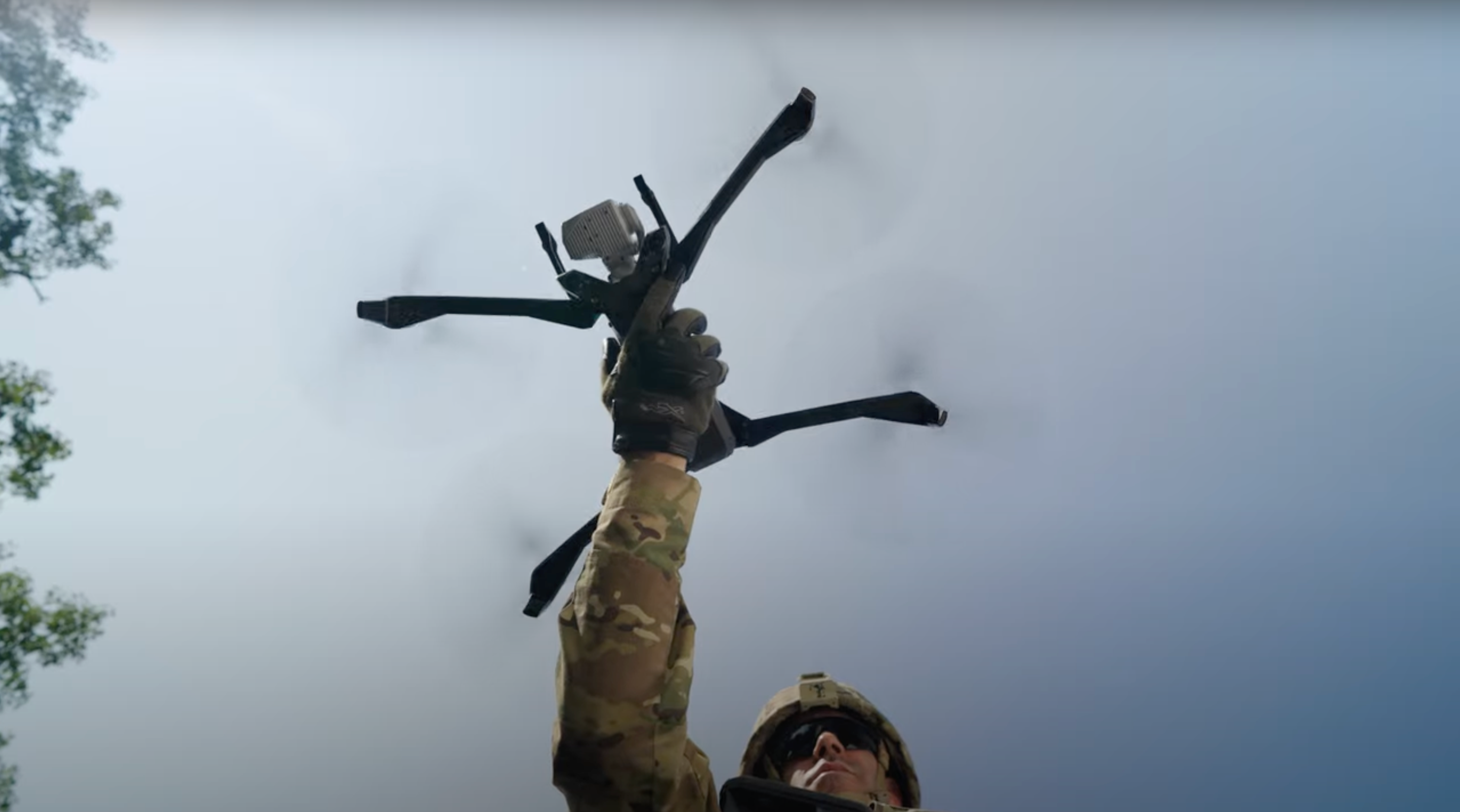
Yes. Skydio is the largest U.S. drone manufacturer, trusted by every branch of the U.S. military and by 29 allied nations. The U.S. Air Forces Central (USAFCENT) selected Skydio Dock for autonomous base security across the Middle East in a $9M+ contract. The X10D is the most widely deployed Group 1 UAS for USAF Security Forces. The U.S. Army placed a $52M+ order — the largest single-vendor tactical sUAS order in Army history. Skydio holds NDAA Section 889 compliance and aligns to SOC 2, ISO 27001, and NIST frameworks.
Can Skydio drones operate in GPS-denied High-Interference RF Environments?
Yes. The Skydio X10 and X10D navigate using computer vision and do not require GPS for stable, autonomous flight — directly relevant to High-Interference RF Environments where GPS signals may be jammed or spoofed. Vision-based navigation operates independently of the electromagnetic environment. In GPS-contested scenarios that would ground competing systems, Skydio drones continue to fly, navigate, and deliver live video. No major competitor documents GPS-denied operation.
How does Skydio address the growing threat of hostile drone incursions at military bases?
Skydio integrates with Dedrone to provide layered counter-UAS capability. Dedrone detects unauthorized drones and identifies pilot locations. Skydio provides immediate aerial response to track and confirm the threat while ground assets mobilize. In 2024, NORAD documented over 350 drone incursions at more than 100 U.S. military installations. Skydio drones address this on two fronts: continuous perimeter surveillance that deters and detects unauthorized UAS activity, and rapid response that reaches the threat faster than any ground-based system.