Drone Dominance has a blind spot.
 Justin Jordan
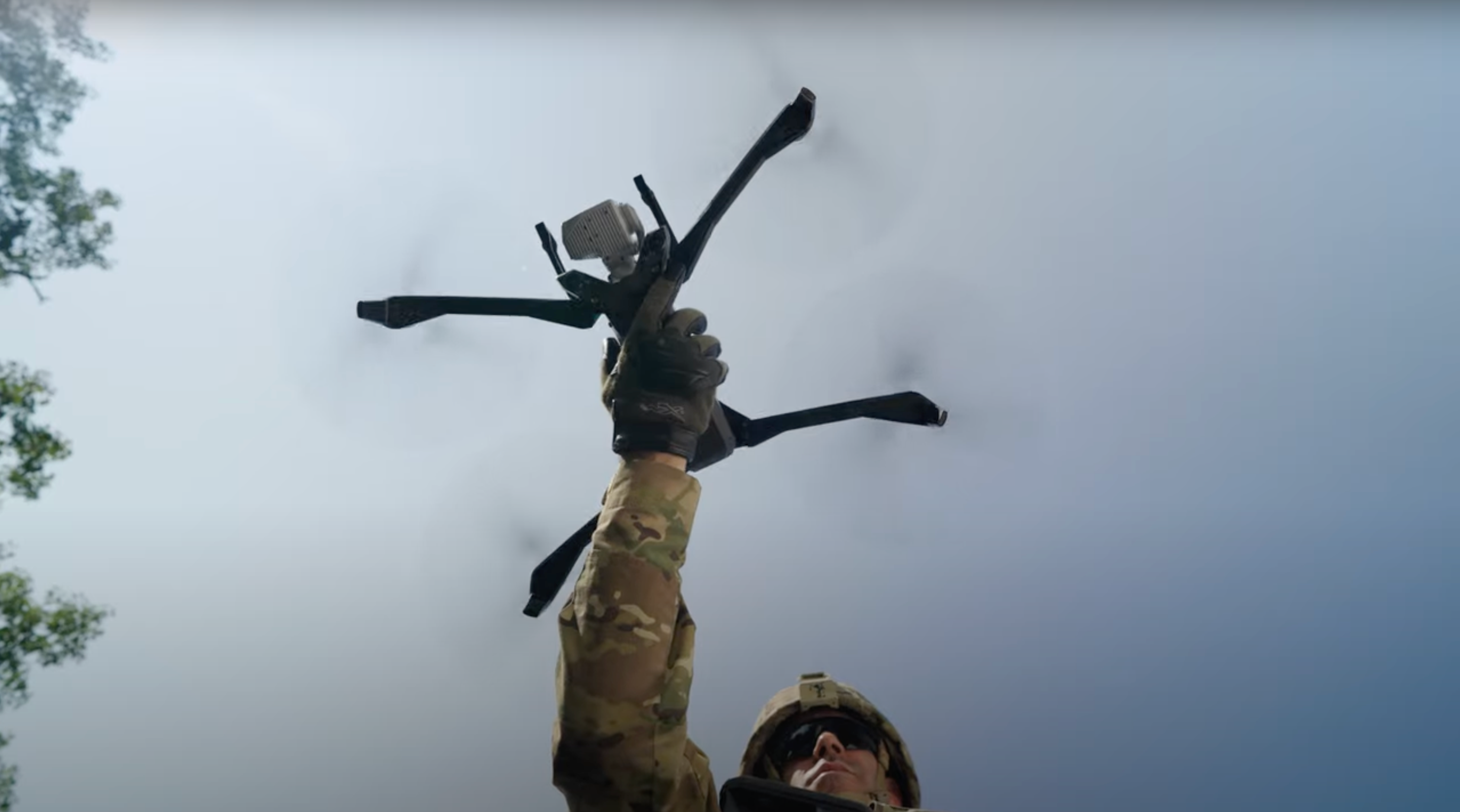
U.S. Army photo by Sgt. Collin Mackall, DVIDS.
The Department of War (DoW) is accelerating efforts to field one-way attack (OWA) drones at scale. Billions of dollars are flowing into attritable, low-cost systems designed for rapid, high-volume deployment. The urgency reflects hard-earned lessons from Ukraine and a clear recognition that battlefield success increasingly depends on small unmanned systems.
But scale alone does not guarantee dominance.
Dominance is not just an inventory problem. It is a systems problem. Today, that system has a critical blind spot: resilient, organic, tactical intelligence, surveillance, and reconnaissance (ISR).
OWA drones are essential. True dominance, however, requires coupling them with organic tactical ISR platforms capable of operating in contested environments. Without this pairing, increasing effector volume yields diminishing returns.
As Drone Dominance evaluations proceed with Phase I Gauntlet trials beginning in February 2026, the critical question is not whether OWA systems are effective—they are. The question is: what enables them to be effective at scale, under sustained pressure, in contested environments?
The answer determines whether dominance is measured by inventory depth or by operational tempo.
The system-level requirement.
Much of the current conversation frames drone dominance primarily as a production challenge: how many OWA drones can be built, how quickly can they be replaced, and at what unit cost.
This reflects a real battlefield truth: OWA systems are lethal, effective, and necessary. But it also obscures the system-level requirement that makes those effects successful and repeatable.
That requirement is organic ISR at the tactical edge. Providing reconnaissance capability resident within the squad, carried into every mission, and employed under the commander's direct control rather than requested from higher echelon.
OWA drones are optimized to deliver rapid, terminal effects. In sensor-to-shooter constructs such as Find–Fix–Track–Target–Engage–Assess (F2T2EA), OWA drones primarily execute the engagement step.

OWA drones do not provide post-impact awareness. When the platform is expended, the sensor is lost. In sustained, contested operations, this creates predictable friction:
- When sensing collapses, commanders pause.
- When target custody is broken, targeting must be rebuilt.
- When effects cannot be assessed, follow-on actions slow or stop.
Operational experience demonstrates that OWA single-drone employment models, where reconnaissance, navigation, identification, and attack are combined into one sortie, impose high cognitive load, offer limited persistence, and are uniquely vulnerable to high-interference signal conditions and attrition. Each loss forces units to reconstitute situational awareness before subsequent actions can occur.
This is the gap drone dominance has not yet addressed.
Operational tempo is set by the hunter, not the killer. The hunter determines how many targets can be discovered, how effectively target custody is maintained, and how many OWA sorties result in confirmed effects.
Without organic ISR, adding effectors generates more sorties but fewer confirmed effects. Operators spend time searching instead of striking. Commanders lose continuity between engagements.
The outcome is not dominance.
Bullets don’t find targets. Hunters do.
The hunter-killer model is not new. Effective military systems have always separated sensing from strike:
- Snipers operate with spotters.
- Artillery relies on forward observers.
- Air-delivered fires depend on JTACs.
Drone operations are no different.
In modern small unmanned aircraft systems (sUAS) employment, ISR platforms are the hunters. OWA systems are the killers.

The hunter finds targets and preserves context across time, maneuver, and attrition. It supports reconnaissance, security, and targeting while enabling commanders to retain continuous situational awareness across distributed formations. Because the hunter underpins decision advantage, it must be employed with lower attrition tolerance than expendable effectors, treated as a preserve-the-force asset.
The killer executes terminal effects. It’s attritable, optimized for terminal maneuver, and accepts higher risk. Its relative simplicity enables rapid replacement without degrading the unit's ISR capability or slowing operational tempo.

Together, the hunter-killer construct supports distributed operations while preserving the commander's ability to see, understand, and act faster than the adversary.
U.S. forces are validating this model through operational exercises. In recent force-on-force trials, opposing teams independently converged on the same approach:
The pattern emerges because it works. Organic ISR enables precision and tempo. When reconnaissance maintains target custody, strike assets execute with confidence across multiple engagements with much higher effect success.
What "good" ISR looks like in contested environments.
Not all small drones are ISR drones. And not all ISR drones are suitable for contested operations.
A critical distinction exists between permissive ISR and contested ISR:
- Permissive ISR: Low-threat environments where commercial quadcopters provide adequate reconnaissance. GPS functions reliably. High-interference signal conditions are minimal. Operators can manually pilot without autonomy.
- Contested ISR: GPS-degraded or GPS-denied environments. Persistent electromagnetic interference. Complex terrain requiring autonomous navigation. Potential adversary counter-UAS efforts. High operator cognitive load.
In permissive environments, inexpensive commercial drones may suffice. In contested environments, they fail quickly.
A successful tactical ISR or Short Range Reconnaissance (SRR)-class system must do more than provide imagery. It must operate as part of the sensor-to-shooter system and support full F2T2EA workflows under real battlefield stress.
Minimum requirements for contested ISR.
At a minimum, a true hunter ISR platform must:
- Maintain persistent electro-optical and thermal sensing
- Operate in GPS-degraded and GPS-denied environments
- Navigate through electromagnetic interference and intermittent communications
- Navigate complex terrain autonomously, indoors and outdoors
- Reduce operator cognitive load through autonomy, enabling operators to focus on the fight, not the flight
- Preserve target track and continuous awareness across multiple engagements
- Integrate cleanly into mission command systems
This is the standard by which ISR should be judged. It’s also where most platforms fail.

Effective hunter employment emphasizes supervising autonomy rather than piloting. Operators must understand GPS-denied navigation behaviors, recognize when autonomy is degraded, manage the effects of link loss and signal disruption, and execute contingency procedures to preserve ISR continuity and platform survivability. This is fundamentally different from the manual control demands of OWA systems.
Integration is the force multiplier.
In challenging battle environments, integration is not a convenience feature. It is a survivability requirement. Integration here refers to decision and awareness integration across the formation, not tight technical coupling between platforms.
Organic ISR value does not stop at the video feed. An unintegrated sensor creates awareness only for the operator. An integrated sensor creates awareness for the unit—and enables decision speed.

Effective integration achieves three outcomes:
1. Shared awareness across the formation. When ISR outputs flow directly into mission command environments such as ATAK and Nett Warrior, hunters do more than observe targets—they drive decisive action. Video, target location, and context become part of the common operating picture. This reduces verbal relay, translation errors, and action delay.

2. Hunter-killer synchronization without role collapse. Integration enables coordination without collapsing functions. Hunters maintain target custody and context. OWA systems execute terminal effects. By keeping these roles distinct but connected, units protect their sensing assets while scaling the effectiveness of their effectors.
3. Reduced operator cognitive load. Integration reduces cognitive burden not by asking warfighters to do more, but by building systems that connect sensing, decision-making, and action without adding friction. Operators supervise missions rather than manage minute-by-minute flight control. They focus on the fight, not the flight.

More attack drones don't help if you can't find targets. Dominance requires integrated ISR platforms that connect sensing to strike—enabling mass effectors to hit confirmed targets rather than search blindly.
Program alignment: SRR and trusted autonomy.
The DoW and allied militaries are already selecting systems that meet these contested-ISR criteria.
The U.S. Army's Short Range Reconnaissance (SRR) program reflects this requirement. SRR is a program of record designed to provide platoon- and company-level formations with organic ISR capability in contested environments. Platforms selected under SRR are NDAA-compliant, feature GPS-denied navigation, and emphasize autonomous operation to reduce operator workload. The following example illustrates the required capability class rather than prescribing a single platform.
Skydio X10D, fielded under Army SRR Tranche 2, delivers stabilized electro-optical and thermal imaging, onboard autonomy with obstacle avoidance, and reliable operation in GPS-degraded conditions. Its autonomy shifts the operator's role from piloting to mission supervision—precisely what contested hunter employment requires.

Other allied forces seeking secure, non-Chinese ISR alternatives have adopted similar platforms, reflecting a broader shift toward trusted, autonomous ISR systems capable of operating under signal degradation and electromagnetic attack.
The dual-use advantage of the Skydio X10D.
Adopting dual-use architectures for ISR, like the X10D, provides a strategic advantage in production scale and system reliability. Unlike low-volume, bespoke government programs, dual-use platforms leverage high-velocity industrial supply chains, enabling rapid technology updates and cost-effective mass production. This shared production base mitigates supply chain risks and ensures systems are field-hardened through widespread adoption rather than isolated testing.
Reframing Drone Dominance.
Operational dominance in contested environments is determined by the ability to maintain target custody over time. The hunter, not the effector, is the center of gravity. Without persistent ISR, adding effectors generates more sorties but fewer confirmed effects. Operators spend time searching instead of striking. Commanders lose continuity between engagements.
Effective OWA employment at scale requires:
- Persistent target identification and tracking
- Reliable target custody across multiple engagements
- Confirmed effects and continuous awareness
- Reduced operator burden through autonomous ISR
These capabilities do not emerge from effector volume alone. They require survivable hunter platforms operating in complement with attritable killers.
Programs that account for the full sensor-to-shooter chain—hunter and killer, integrated and complementary—will outperform programs optimized for effector volume alone. This is not a question of choosing between ISR and OWA. It is a question of coupling them effectively.
This does not argue for slowing OWA investment, but for ensuring Drone Dominance architectures account for persistent ISR as a co-equal enabler.
What dominance requires.
The hunter-killer sUAS model provides a doctrinally aligned approach to small unmanned aircraft employment in contested environments. By preserving persistent ISR through survivable hunters while employing attritable killers for terminal effects, units achieve improved situational awareness, reduced cognitive burden, and increased operational tempo.
You cannot dominate what you cannot see. And you cannot see without an ISR hunter that survives long enough to keep hunting.
The $1 billion investment in OWA systems represents a critical commitment to battlefield lethality. Ensuring that investment achieves its full potential requires equal attention to ISR systems and the persistent sensing that enables precision, confirms effects, and sustains tempo across extended operations.
OWA systems are essential. ISR platforms make them effective. Together, they deliver dominance.
Connect with the Skydio national security team.
The appearance of U.S. Department of War (DoW) visual information does not imply or constitute DoW endorsement.