FAQs about Security Command
Security Command basics
What is Skydio Security Command?
Security Command is Skydio's software for building, running, and scaling a drone security program. It turns Skydio drones into autonomous patrol, automatic detection, and alarm response that a security team runs from a browser. Teams schedule patrols, set detection zones and rules, launch flights from alarm and access events, and keep a record of every flight.
What does Security Command do day to day?
Three things. Autonomous Patrol flies the routes and schedules your team built. Incident Response sends a drone to alarms from your existing systems, so an operator sees what happened before deciding what response it needs, and shares the live stream with whoever responds. Digital Records and Reports generates an auditable record of every flight, for sharing in the moment or reviewing later.
Can one operator run drones across multiple sites?
Yes. One operator commands multiple Skydio drones simultaneously from a single browser window, across as many sites as the program covers. That is how aerial coverage scales without scaling headcount. Operators do not need to be at any site to authorize a flight, watch a patrol, or verify a detection, and they hold a common operating picture across every active mission. A certified remote pilot in command holds authority for each flight and can take manual control at any point, while autonomy handles navigation, obstacle avoidance, route execution, and the return to dock. The practical number of drones and sites depends on the airspace authority your program holds, the mission type, and how your sites are configured.
Is Security Command software, hardware, or a drone-in-a-box system?
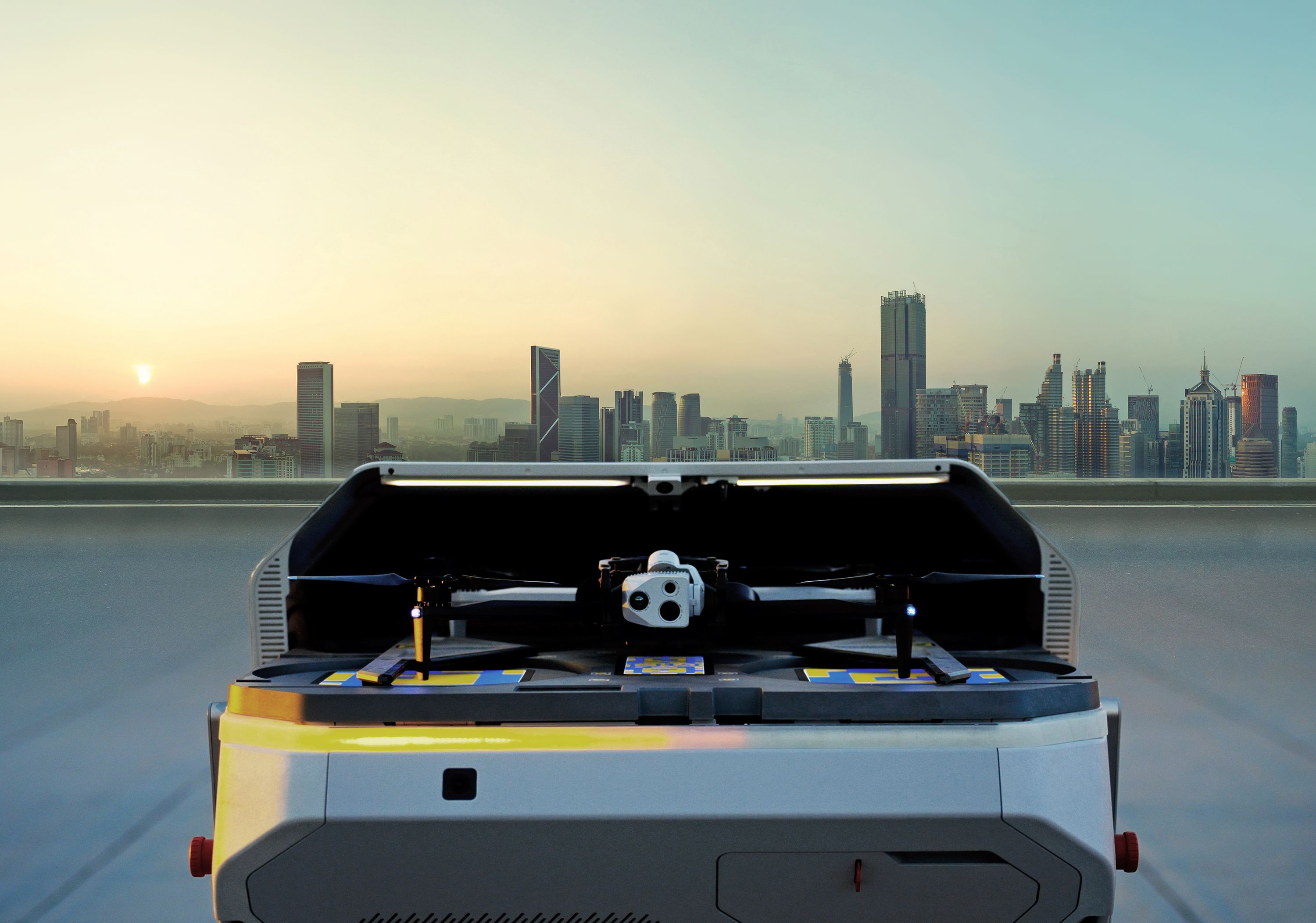
Security Command is browser-based cloud software that commands Skydio hardware: docks, drones, and controller-based flights. It turns that hardware into a workflow a security team runs every shift: patrol scheduling, detection zones and rules, alarm response, operator verification, and a record of every flight.
What hardware does Security Command work with?
Security Command works with every Skydio drone and the Dock for X10. Most security programs run dock-based drones, positioned where the work happens and operated remotely from anywhere. Scheduled patrols and automatic detection require a dock. Controller-based flights run in Security Command, and the R10 covers interior spaces such as warehouses, hangars, and parking structures.
Autonomous patrol and incident response
What is autonomous patrol and how does it work?
Autonomous patrol is a drone flying a defined route on a schedule, instead of a person walking it. Your team builds a route against your site map and sets what the camera does at each point of interest. Then you put it on a schedule: a start and end date, the days it repeats, and a run interval that sets how often the mission list executes, whether that is continuously, once an hour, or once per schedule. That is how a program hits the patrol frequency its SOP requires, without the gaps that come from shift changes, fatigue, or one site running differently than another. Security Command matches the best available drone to each patrol across the sites in your program, so nobody assigns aircraft by hand. Choose what is detected, where, and when with detection zones and rules the drone executes autonomously. Timing and route order can be randomized inside your approved schedule and mission set, so coverage stays consistent without becoming predictable.
Does Security Command work at night?
Yes. Coverage does not change after dark. The X10 carries a thermal camera alongside its visual cameras, so an operator sees heat signatures. NightSense lets the aircraft navigate and avoid obstacles in darkness and low light, which is what makes unattended night patrol possible. A spotlight is there when the operator needs to identify a subject or make the aircraft obvious.
What happens when an alarm goes off?
A drone is overhead before anyone has to walk or drive there. Nobody gets sent to a false alarm, and nobody gets sent in blind. Flights trigger from your existing intrusion detection systems, access control events, fence and gate contacts, or a counter-UAS sensor, and each one arrives as a marker the operator dispatches against in a single click. If the triggering system sends an image or video of what set it off, the operator previews that first. The aircraft is airborne in under 20 seconds, travels at up to 45 mph, and plans its own route around terrain and structures. On scene it streams live color and thermal video. The operator can move the aircraft, zoom, take manual control, lock onto a moving subject with Skydio Shadow, light them with a spotlight, or issue a warning through the speaker. Then they decide which team needs to respond, with what, and how fast.
What happens if an alarm comes in while a patrol is running?
The response takes priority. Security Command interrupts the patrol, sends the aircraft to the alarm location, and the operator works the incident from there. When the response is finished the aircraft returns to its dock. It picks the patrol back up if one is scheduled and the battery has enough charge to start it. Sites that cannot afford a gap in patrol coverage during a response add a second dock. That is one of the main reasons to size a site for more than one.
When something is confirmed, who gets notified?
Escalation paths are defined ahead of time by event type, site, and procedure. When an operator confirms something, live video and the event context route to the people your SOP names, which can include a supervisor, a response team, or local law enforcement. Skydio ReadyLink shares a live stream through a link, so a responding officer can watch on a phone on the way in, with no account and no app to install. Custom notifications and webhooks push detections, flight events, and operational updates to the systems your procedures require.
Does a flight launch automatically, or does a person approve it?
Both models are supported. Which one you run depends on the airspace authority your program holds. A remote operator can authorize each launch from a central location, and that is how most programs start. Where the operating authority allows it, flights can launch directly from a trigger with no person in the loop. Skydio’s regulatory team scopes which model your sites qualify for during program design.
Can a drone deter an intruder without dispatching anyone?
Yes. The X10 carries a spotlight and a speaker, and the operator uses both remotely. Lighting a subject and issuing a verbal warning gives the team a response that does not require sending a person to the scene, which matters most after dark and on large sites where the drive alone takes several minutes. Scheduled patrol is a deterrent on its own, because an aircraft overhead on an unpredictable schedule is a presence people notice.
How much ground can one drone cover?
One X10 has a maximum flight time of 40 minutes and a top speed of 45 mph. What determines coverage is how often you need to return to each point, more than the total acreage. A perimeter lap every hour is a different program from a lap every fifteen minutes, and the second needs more aircraft. Perimeter length, the number of points on the route, and your required revisit interval set how many drones and docks a site takes. Sites that need coverage without charging gaps add docks, grouped as a Dock Hive, for persistent coverage with 24/7 availability. Skydio sizes this during the site survey.
Detection and detection zones
What can Security Command detect?
Security Command detects people, vehicles, potential perimeter breaches, climbing aids, unattended items, and other anomalies inside the detection zones you define. Detections are zone based. Alerts come from the areas and hours you set, and nowhere else. When the system detects something, the mission pauses and the aircraft locks on. The operator gets a visual and audible alert carrying the video clip that triggered it, what was detected, which zone it happened in, and a marker on the site map. Hold visual on it, or dismiss it and the drone picks the patrol back up in one click. If the subject moves, Skydio Shadow follows moving people and vehicles on its own, so the operator watches the situation without flying the aircraft.
What if an operator sees something the system did not detect?
Operators can flag it themselves. Point the camera at it, use one keystroke, and Security Command captures a shareable observation with the video clip, an editable title and description, and the location. Share it to the distribution list your procedures name for that type of incident. Recipients get the title, description, location, and the site, mission, drone and time, and anyone with access can open the full observation in Security Command.
What are detection zones and rules?
A detection zone is an area you draw on your site map where the system should look for activity. During a patrol, the drone evaluates what it sees against those zones. Activity inside a zone generates an alert. Activity outside them does not. An exclusion zone is the inverse: an area where you want no alerts, and it overrides any detection zone it overlaps. You can also set the hours and days each zone is active, so detection follows the operating hours of the site. Detection zones typically follow the fence line, the yard, gate approaches, and restricted areas. Exclusion zones cover known sources of nuisance alerts such as a public sidewalk, an access road, or a neighboring lot. Zones are drawn as ground areas on your site map, and a change you make takes effect on the next flight.
How accurate is detection, and what about false alarms?
Skydio does not publish a single accuracy figure. Detection performance depends on distance, lighting, weather, and what else is in the scene. A number measured at one site does not transfer to another, and a single published figure usually describes a controlled test. Detection zones and rules decide what is detected, where, and when. Anything inside an exclusion zone is suppressed, and every alert arrives with the video that caused it. An operator confirms or dismisses in seconds without sending anyone to find out.
Does adding drones mean more alerts for my team to manage?
Detection zones mean alerts come only from areas you chose. Exclusion zones silence known nuisance sources, and zone schedules silence the hours when normal activity would trip them. Every alert carries video, so the operator resolves it on screen. Your alarm count does not drop. What drops is how many alarms need someone to drive out and look.
Does Security Command use facial recognition or detect weapons?
No to both. Security Command does not perform facial recognition and does not offer weapon detection. Detection establishes what is present inside an area you defined, not who any person is, and the system does not identify individuals. Third-party analytics platforms integrated with Skydio provide their own detection capabilities, which are the partner’s and not Skydio’s.
Cost, staffing, and getting started
What does a Security Command program cost, and how do I build the case?
Start from what coverage costs you now. The inputs that matter are guard hours spent on routine patrol, contracted patrol spend, alarms per month that require a physical response, your current time to verify an alarm, and the cost of incidents nobody saw. On the Skydio side, cost is driven by how many docks a site needs, which follows from site size, patrol frequency, and the hours you need covered. Pricing has three parts. Aircraft and dock hardware, the Security Command software subscription, and services including site survey, regulatory filing, training, and integration work. Skydio builds a site-specific model during evaluation.
Do I need certified drone pilots on staff?
A Part 107 certified remote pilot must be in command of each flight under current FAA rules. That does not mean your security officers need to become pilots. Programs typically certify a small number of people who operate from a desk, because flights are remote and routes are pre-planned. Skydio Academy runs the certification path through self-paced online, virtual instructor-led, and in-person options. Skydio Paraverse is a cloud-based simulator running the same software as the field system, so teams rehearse patrol routes and validate dock placement before any live flight. Skydio can also provide operators while a program gets established.
What does a site need before the first patrol?
Before the first autonomous patrol you need the dock installed and connected, your site mapped, detection zones and rules configured, patrol routes built, operators trained, and airspace authorization in place. Controller-based flights skip the dock installation. Dock power, mounting, and network requirements are scoped during the site survey.
What are the limitations of a drone security system?
Four things to plan around. Detection requires connectivity, so network design shapes capability. Weather holds happen, and a program needs a plan for those hours. A single dock has charging gaps, so continuous coverage takes more than one. And airspace authorization usually sets the date of your first autonomous flight, ahead of installation.
Why do drone security programs fail?
Usually the hardware arrived without an operating model around it. No standard operating procedures, no alarm integration, no trained operators, no airspace authority. The drone flew, and then nobody knew what to do with it. Security Command is built around the workflows a security team already runs, and Skydio scopes the program against those workflows before hardware ships. That includes SOP development, regulatory filing, integration work, and ongoing program support.
Working with your existing systems
Do I have to replace my cameras, access control, or alarm system?
No. Security Command adds a layer to what you already run. Fixed cameras are good at high-risk static points. That is why they sit at entry control points and along fence lines. A drone covers the blind spots between them and gives you a camera that moves to the incident. Cameras, access control, and intrusion detection keep doing what they do well, which is telling you something happened. Security Command answers the next question. What is actually happening, and does it need a person? Day-to-day work also stays where your team already is. Operators can view drone video, escalate, and dismiss events inside their VMS, while flight control stays in Skydio so flight authority and safety behaviors remain with the system responsible for them.
What does Security Command integrate with?
Security Command connects to the systems a security operation already runs. For video management, drone video streams into Genetec Security Center, Milestone XProtect, and Verkada as a live camera feed. For triggers, flights launch from intrusion detection sensors, access control events, and alerts from AI camera platforms including Ambient.ai, so an event on a fixed camera puts an aircraft over the location. For situational awareness, Axon Fusus shares live drone video into real-time operations and response workflows. For counter-drone response, a counter-UAS sensor detects an unauthorized aircraft and Security Command launches a drone to track it. Anything else connects through open APIs and webhooks, so any platform capable of sending an alert can start a flight, and flight events and notifications can be pushed to the systems your procedures require.
How does drone video get into Genetec, Milestone, or Verkada?
Drone video appears as a live camera feed inside your VMS. Operators watch it next to fixed cameras without switching applications. Events in the VMS can also trigger a flight, so an alarm firing in the platform your team already watches puts an aircraft in the air. Most VMS platforms pull an RTSP stream while drones publish over RTMP, so the connection runs through a translation layer Skydio configures during deployment. Configuration varies by platform and version, and Skydio provides an integration guide for your environment.
Operating it
How does Security Command keep flights safe and compliant as a program scales?
Every flight runs through the same checks no matter how many sites you have. Security Command runs automated pre-flight checks before each scheduled patrol, covering weather, temporary flight restrictions, and aircraft readiness, and holds the flight if any of them fail. Operator authorization is built into the launch step where your operating authority requires it. Geofences and airspace guardrails keep the aircraft inside the area you approved. The dock carries ADS-B, so the system is aware of crewed aircraft nearby, and deconfliction behavior is configurable.
What does an operator see in Security Command?
Security Command runs in a browser. A patrol view shows the state of every patrol you have running, with clear calls to action on the ones that need attention. Open a patrol and three things sit on screen at once. The drone panel shows which aircraft are ready, battery state, the view from the dock camera, and current weather at the site including wind and gusts. The map shows the flight path, patrol routes, detection zones, geofences, and airspace layers. The video panel streams live color video with a thermal inset and a telemetry strip showing altitude, ground speed, wind, and heading. Launch, redirect, manual control, and return to dock all happen from the same screen.
Who uses Security Command day to day?
The primary user is typically a SOC or GSOC operator, who monitors patrols, triages detections, and runs incidents to resolution. A security program manager defines patrol coverage, site operating rules, and SOPs, and reviews the after-action data for gaps. A Part 107 pilot or supervisor confirms flight readiness and steps in on safety, compliance, or a dynamic security event. Two more groups consume the output without operating anything: the responding guard or officer, who gets live video on a mobile device while approaching a confirmed incident, and leadership, who watch the stream during a real threat and read the records afterward.
How does the drone navigate and avoid obstacles?
Skydio Autonomy handles it, and it is the reason unattended patrol works. The aircraft fuses camera data from six navigation cameras with inertial sensors to know where it is and hold position without a GPS lock. It builds a live three-dimensional model of its surroundings, senses obstacles out to 20 meters with true 360 degree coverage, and routes around them with no operator input. This runs onboard and does not require GPS, a stored map, or a connection, which matters at sites where GPS is unreliable: between tall structures, under dense tree cover, alongside large metal buildings, or anywhere GPS is being jammed or spoofed. NightSense extends the same obstacle avoidance into darkness. Obstacle avoidance is reduced in low light without NightSense, and heavy dust or precipitation degrades the visibility it relies on.
Conditions and connectivity
Can security drones fly in rain, snow, or wind?
The Dock for X10 launches and lands in winds up to 12 m/s, 27 mph, and operates from minus 4 to 122 degrees Fahrenheit. The X10 handles gusts up to 12.8 m/s, 28.6 mph, and operates from minus 4 to 113 degrees Fahrenheit. The aircraft flies in rain or snow up to 0.25 inches per hour, and the dock holds in standby through heavy precipitation up to 4 inches per hour. Security Command checks conditions before each scheduled patrol and holds the flight when weather is outside those limits, then launches as soon as conditions clear. Conditions are monitored in flight, and a mission can return early if they deteriorate. Expect some weather holds through the year.
What connectivity does Security Command need, and what happens if it drops?
A Dock connects over ethernet, with two PoE RJ45 ports. Skydio Connect gives the aircraft two paths, whether it launches from a dock or a controller. Connect SL is a point-to-point radio link reaching 12 km in clear line of sight, 6 to 12 km in rural settings, 2 to 6 km in suburban ones, and 1 to 2 km where interference is strong. Connect 5G runs wherever cellular coverage is available. Connect Fusion switches between them automatically, so coverage does not depend on a single path. If the link drops mid-flight the aircraft keeps flying, because navigation and obstacle avoidance run onboard and not over the network. Visual Return-to-Home brings the aircraft back in the event of a lost link, and live video and operator control resume if the connection is restored first. Remote piloting and continuous live video depend on network connectivity, and autonomous detection is evaluated in the cloud, so it requires a connection.
Records and proving coverage
What record does each patrol create?
Every flight is logged automatically, without bias. Video, still imagery, GPS-tagged telemetry, timestamps, and the route flown are captured and stored for each mission, with hash validation establishing integrity from the moment of capture. A supervisor can replay any patrol and see exactly what the drone saw, where, and when. Hashing verifies footage has not been altered, and coordinates and timestamps establish precisely where and when activity occurred.
What reports does Security Command produce?
Every patrol and every incident response produces a Security Operation Report. It collects what happened, where, and the data the operation generated, including markers, detections, video and photos, and the operator can add context before submitting it. Nobody writes it. In most security programs patrols and responses are self-attested and logged by hand, which is why leadership has so little visibility into what happened on the ground.
Can I search and export detection history?
Yes. Detection reporting in Security Command is a table of every detection, which you can search, filter, and export to CSV. That is where a supervisor answers how many detections a site had last month, which zones they came from, and what the operator did about each one. It also turns a year of patrols into something you can analyze for patterns.
Can I prove coverage for an audit, an insurer, or a compliance review?
Yes. Every patrol is logged with time, location, and video. You can show that an area was covered on a given schedule, which is a different thing from signing a log that says it was. That record supports internal audit, insurance claims, regulatory review, and incident investigation. When a required round gets missed, you find out. When it gets made, you can prove it.
Regulations and airspace
What FAA authority do I need, and do I need a BVLOS waiver?
Commercial drone operations in the United States run under FAA Part 107, and a certified remote pilot must be in command of each flight. Night flight is permitted under Part 107 with the required aircraft lighting. Beyond visual line of sight, or BVLOS, means flying where the pilot cannot see the aircraft directly, which covers most useful security patrol because the value of the drone is covering ground nobody is standing next to. BVLOS requires specific FAA authorization. Programs commonly begin with line-of-sight operations or a visual observer while the waiver process runs, then expand once authorization is in place. Skydio's regulatory team handles the filings, including waiver applications and the supporting operational documentation. Part 108, the FAA's proposed rule for routine BVLOS, has not taken effect. Until it does, BVLOS operations run on waivers and specific authorizations.
Can a drone fly over property I do not own?
Not without addressing it specifically. Flights are geofenced to property you control. Sites with non-contiguous parcels, public roads running through them, or buildings separated by land someone else owns need that handled in the operating authority. It is a common situation and a solvable one, and it belongs in program design. Camera behavior at each point of a patrol route is also defined when the route is built, which lets you plan coverage that faces inward at sensitive boundaries.
Security, privacy, and compliance
Is this employee surveillance, and do I have to notify staff?
Security Command is built for perimeter and site security: patrolling boundaries, verifying alarms, and getting eyes on an incident. Flights are geofenced to property you control, and detection zones are typically fence lines, yards, gates, and restricted areas, not places where people work. Skydio does not offer facial recognition and does not provide tools for tracking identified individuals. On notice, requirements vary by jurisdiction and this is a question for your legal and HR teams. Most organizations post notice that aerial patrols operate, the same way they post notice of camera coverage, and notice generally strengthens deterrence. Employee monitoring rules are stricter than general premises security in many states and across Europe, so scope the program as perimeter and asset security and document that scope.
How is data protected, and who controls footage?
All data is encrypted in transit and at rest. Role-based access, single sign-on, and audit logging control who can operate drones, view live video, access stored footage, change site settings and detection zones, and review activity, with every action logged against a user. You choose where footage lives: Skydio’s US-hosted cloud, a private cloud, or on premises. On premises is not the same as air-gapped. It still involves network, DNS, and firewall configuration, and capabilities evaluated in the cloud, including autonomous detection, require connectivity. Skydio does not sell or share customer data. Retention, access, and identity configuration are documented at the Skydio Security Trust Center.
What security certifications does Skydio hold?
Skydio aligns to leading security standards, including SOC 2, ISO 27001, and NIST frameworks. Because procurement requirements vary by sector, current certification and compliance documentation is published and kept current at the Skydio Security Trust Center.
Can the drone be hacked, jammed, or spoofed?
Command and video links are encrypted and authenticated, which prevents interception and unauthorized command injection. The aircraft uses trusted boot, so unsigned software will not run. Navigation is visual and does not depend on GPS, so GPS spoofing cannot redirect the aircraft. And if a control link is interrupted, Visual Return-to-Home brings the aircraft home on its own. A lost link is a recovery event, not an opening for someone else to take control.
How Security Command compares
Is Security Command the same as DFR Command?
No. DFR Command and Security Command serve different operators. DFR Command supports public safety agencies running drone as first responder programs, where flights are dispatched against 911 calls across a jurisdiction. Security Command supports enterprise and critical infrastructure security teams protecting their own sites, where flights run as scheduled patrols and responses to alarms on property the organization controls. The regulatory posture, the workflows, and the buyers are different.
Is Security Command a counter-drone system?
No. Counter-drone systems detect and mitigate unauthorized drones flying over your site. Security Command flies your own drone to patrol the site and verify activity on the ground. The two are deployed together. A counter-UAS sensor detects an incursion and Security Command sends a drone to respond. Depending on the detection method, that response can go to the unauthorized aircraft’s current location, its launch point, or the estimated pilot location. One limit up front: commercial operators cannot use kinetic or jamming mitigation. The response is observation, and guiding security or law enforcement to the pilot.
How does Security Command fit the five D’s of physical security?
Deter, detect, deny, delay, defend is the layered model most security programs are built on. Security Command works on three of the five. Deter: a drone patrolling overhead is a visible presence, and the operator can add a spotlight and a verbal warning. Detect: the drone reaches ground that fixed cameras and foot patrols do not cover, and surfaces activity inside the zones you define. Defend: when a threat is real, the drone gets eyes on it first, so the response is informed and nobody walks in blind. Deny and delay stay with your barriers, locks, and access control. Security Command does not replace those.
Why Skydio for a drone security program?
Autonomy first. A Skydio drone is a flying robot. It navigates with onboard vision and avoids obstacles without a GPS lock, and that is what makes unattended patrol work at a site full of structures, trees, and interference. Then scale. Skydio is the largest US drone manufacturer, trusted by critical infrastructure operators and every branch of the US military. Then supply chain. Skydio drones are designed, assembled, and supported in the United States, and they comply with NDAA Section 889. Federal buyers require that, and so does a growing share of critical infrastructure.
By industry
What kinds of sites is Security Command built for?
Sites with long perimeters, remote corners, and more ground than a foot patrol can cover on schedule. That includes correctional facilities, data centers, distribution centers and logistics yards, utilities and energy sites, construction sites, healthcare campuses, and manufacturing and industrial plants. If your post orders require a perimeter patrol on a set interval, and your team spends its shift verifying alarms, that is the work Security Command automates.
How is Security Command used at correctional facilities?
Perimeter security and alarm verification. Autonomous patrols cover the fence line on a schedule while officers stay on post. A drone responds to perimeter alarms, so an officer is not dispatched to a fence to find out what set it off. Detection zones along the fence line surface people, climbing aids, and unattended items during the patrol, and Shadow holds the aircraft on anyone who moves. Every flight is logged with video, timestamps, and telemetry, and a supervisor can replay any patrol to produce a documented record of perimeter coverage a walking patrol cannot. Facilities also use aerial video for yard overwatch and to support transfers.
How are security drones used at data centers?
Large perimeters, long fence lines, and remote utility yards are exactly the geography fixed cameras cover badly and guards cover slowly. Autonomous patrol covers the full site boundary on a schedule, and every lap is logged with video and timestamps for internal audit. Alarm response puts a camera over a generator yard or a substation corridor within seconds of a sensor firing, at any hour, without sending a technician into an unlit area.
How are security drones used at distribution centers and logistics yards?
Trailer yards, truck courts, and long fence lines are hard to cover on foot and expensive to cover with guards. Autonomous patrol sweeps the yard and perimeter on a schedule, including the overnight and weekend stretches when the yard is emptiest. When an alarm fires, a drone is over the location in seconds and the operator sees what triggered it before anyone gets dispatched. The flight record behind each response is what loss prevention uses for investigations and cargo claims.
How are security drones used at utilities and energy sites?
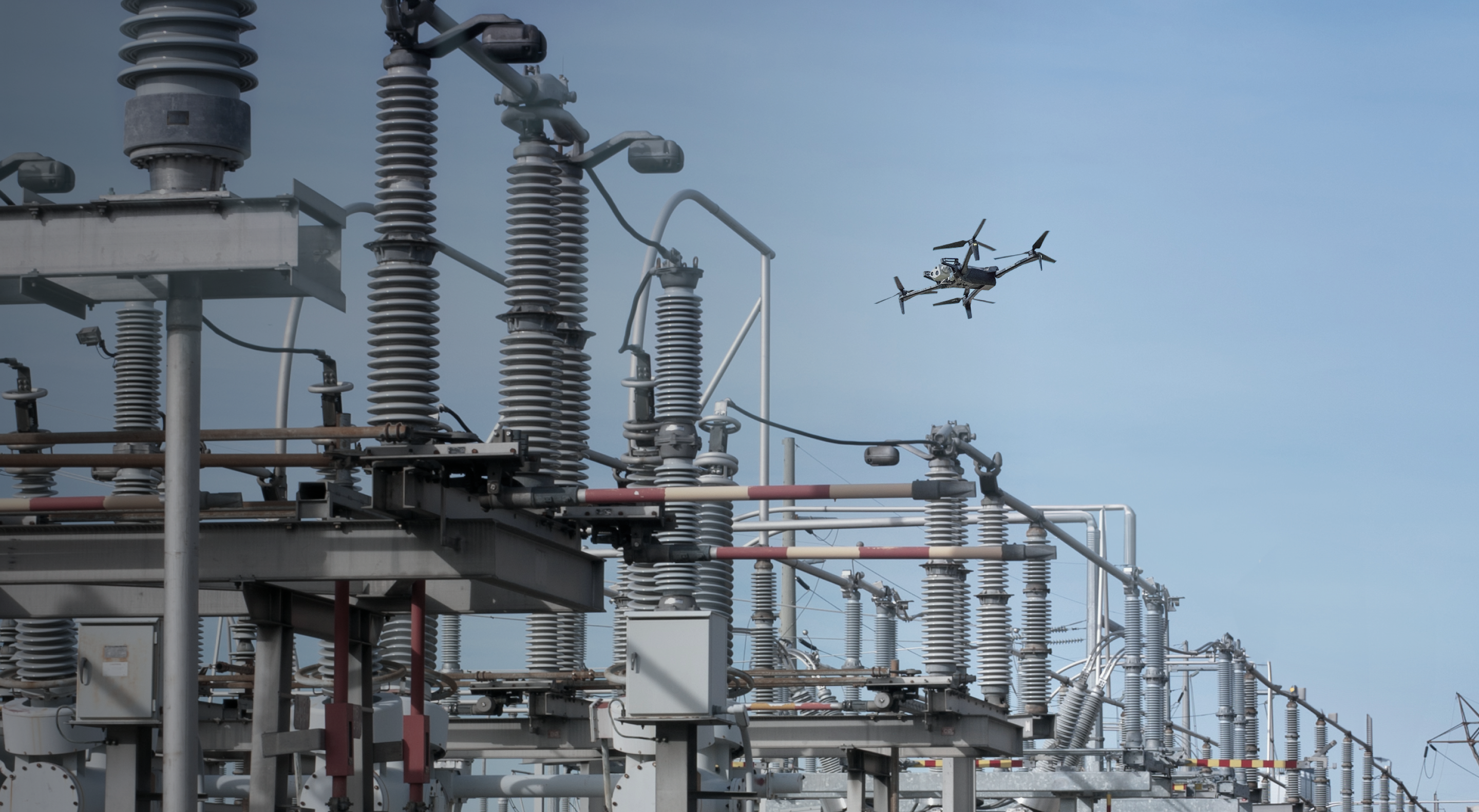
Substations, generating stations, and remote facilities are often unstaffed, widely dispersed, and a long drive from anyone who could respond. Autonomous patrol gives each site consistent coverage without a vehicle roll. Alarm response puts eyes on a remote asset in seconds. Sites without reliable cellular service can run over satellite or a point-to-point radio link.
How are security drones used on construction sites?
Active sites change constantly, which makes fixed camera placement a recurring cost and guard coverage inconsistent. Autonomous patrol covers the full footprint, including areas fixed cameras no longer reach, and routes get updated as the site evolves. Overnight and weekend patrols cover the stretches when the site is empty. Because every flight is dated and logged, the same footage supports an insurance claim and a record of site conditions.
How are security drones used at hospitals and healthcare campuses?
Healthcare campuses combine large parking structures, multiple buildings, ambulance bays, and public access that never closes. Autonomous patrol covers parking decks and campus perimeters on a schedule. Alarm response gets eyes on a loading dock or a remote lot before security staff leave the building. Detection zones are set on perimeters and access points, not clinical or patient areas, and that scope should be documented when the program is designed.
How are security drones used at manufacturing and industrial plants?
Plants carry long perimeters, outdoor storage of high-value material, rail spurs, and tank farms that fixed cameras cover unevenly. Autonomous patrol runs the perimeter and outdoor storage areas on a schedule without pulling anyone off the floor. Alarm response puts a camera over a remote corner of the property in seconds, day or night. Security and EHS teams get the same dated record of perimeter and yard conditions.