Skydio's Three-Aircraft DFR Family Covers Indoor, Outdoor, and Long-Range Response
 Noreen Charlton

The strongest DFR programs are built around the mission, not a single aircraft.
DFR began with a powerful idea: send a drone to a call for service and give officers critical information before they arrive.
From the start, DFR has been an incident-driven response model. Flights are tied to calls for service or defined public safety operations, not random patrols, and last only as long as the mission requires.
As DFR has matured, agencies have expanded what they expect it to support. Programs now operate across larger jurisdictions and support vehicle pursuits, extended incidents, difficult-terrain searches, and indoor response. The mission set has expanded; that foundation has not.
Yet much of the conversation about the future of DFR has been reduced to a contest over one aircraft and its specifications. Which drone flies fastest? Which stays airborne longest? How many square miles can one drone cover?
Those are useful questions when evaluating an aircraft. They are not a strategy for building a DFR program.
Law enforcement does not rely on one perfect vehicle. Patrol cars, motorcycles, bicycles, BearCats, and helicopters each serve a different purpose. A helicopter’s speed does not make a patrol car obsolete, and a BearCat’s protection does not make it the right vehicle for every call. The mission determines the vehicle. DFR is no different.
There is no one perfect drone for DFR because there is no single DFR mission.
DFR is an operating model, not an aircraft
Aircraft specifications affect what a drone can accomplish, but they do not measure the performance of the entire program.
Program planning must also account for where calls occur, how frequently they overlap, how quickly an aircraft can reach them, how much time remains once it arrives, and whether it is suited to the environment.
Expecting one aircraft type to meet every operational demand forces an agency to build a DFR program around its limitations.
Range is not coverage
A large circle on a map is an easy way to communicate how far a drone might fly. It is not a complete picture of DFR coverage.
Coverage is the ability to provide a reliable response when and where calls occur. Distance matters, but so do response time, aircraft availability, useful time overhead, redundancy, and the ability to support incidents occurring at the same time.
An aircraft’s range matters only if it is available and can arrive in time to help. Availability is part of coverage. One centrally located aircraft may be able to reach a large portion of a jurisdiction. Its distance from each call still affects how quickly it arrives and how much flight time remains once it gets there.
A patrol vehicle may be capable of reaching every address in a district, but that does not mean one vehicle can cover every call. DFR capacity works the same way: once an aircraft is assigned to an incident, it is no longer available for the next call.
Aircraft capability is not program capacity. One describes what a drone can do on a mission; the other, how many calls the program can support.
None of this makes aircraft performance unimportant. Greater speed and distance can be decisive when a vehicle is already moving, or a call occurs far from a dock. Endurance determines how long the aircraft can remain useful once it arrives. Those capabilities address different needs than a distributed response network’s ability to handle overlapping calls.
Build the program around where calls actually happen
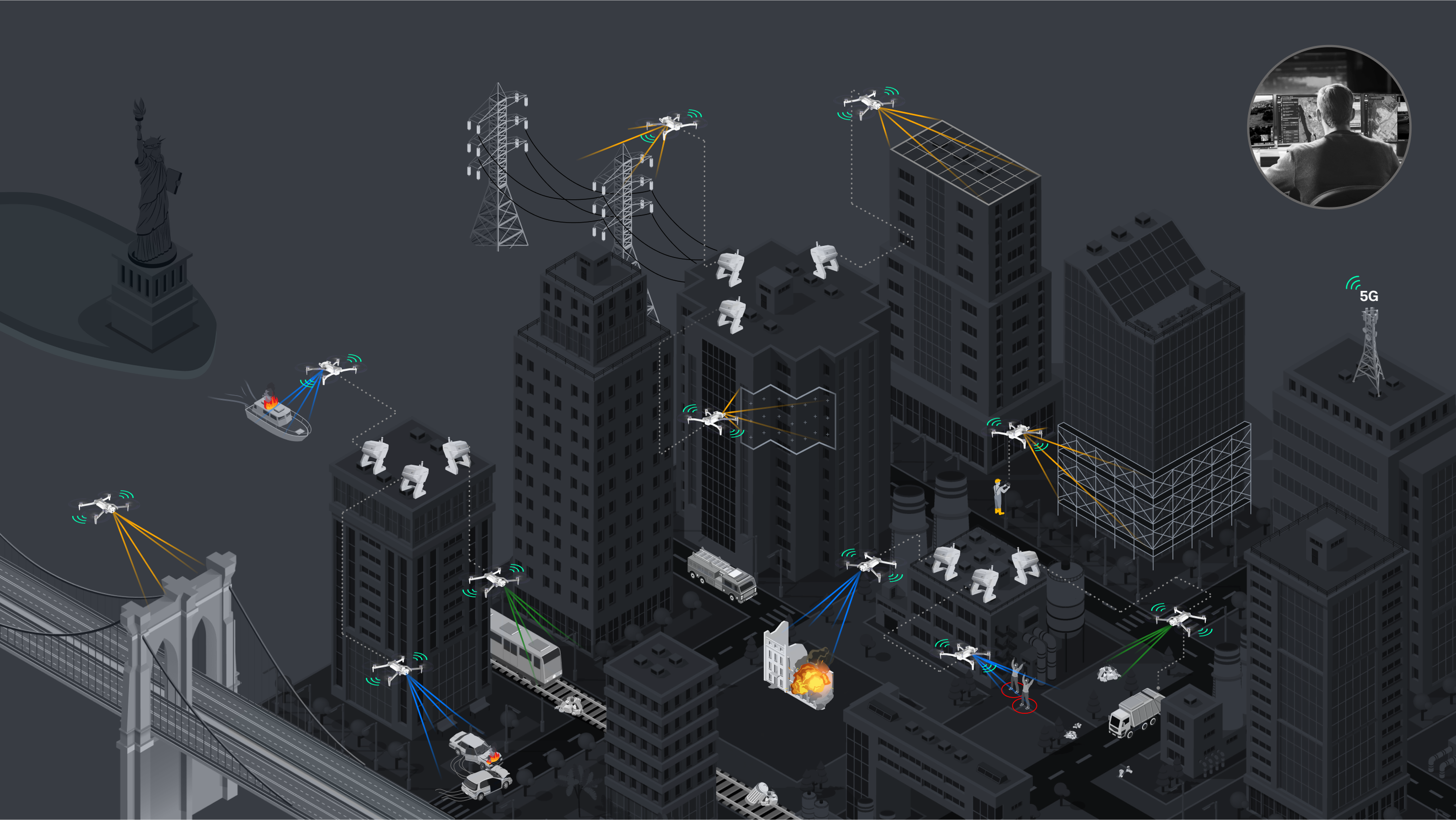
Distributed deployment is not an inefficient version of a centralized model. In areas with dense call volume, positioning drones closer to demand shortens response time. Multiple aircraft also provide redundancy and remain available when incidents overlap.

The San Mateo Police Department took that approach. The department analyzed more than 27,000 Priority 1 and 2 calls to understand where incidents occurred, how long aircraft remained overhead, and how often calls created simultaneous demand. That analysis produced a full-deployment model projected to reach 86% of those calls in under two minutes.
Large, lower-density jurisdictions present a different infrastructure challenge. Call volume may not justify placing docks throughout the jurisdiction, and each site requires power, network connectivity, permitting, and preparation. Multiple long-endurance aircraft operating from a strategic location can support missions across a larger area with fewer sites.
Different missions demand different aircraft
Distributed daily response does not solve every outdoor mission. That is why Skydio built F10 Lightrunner.
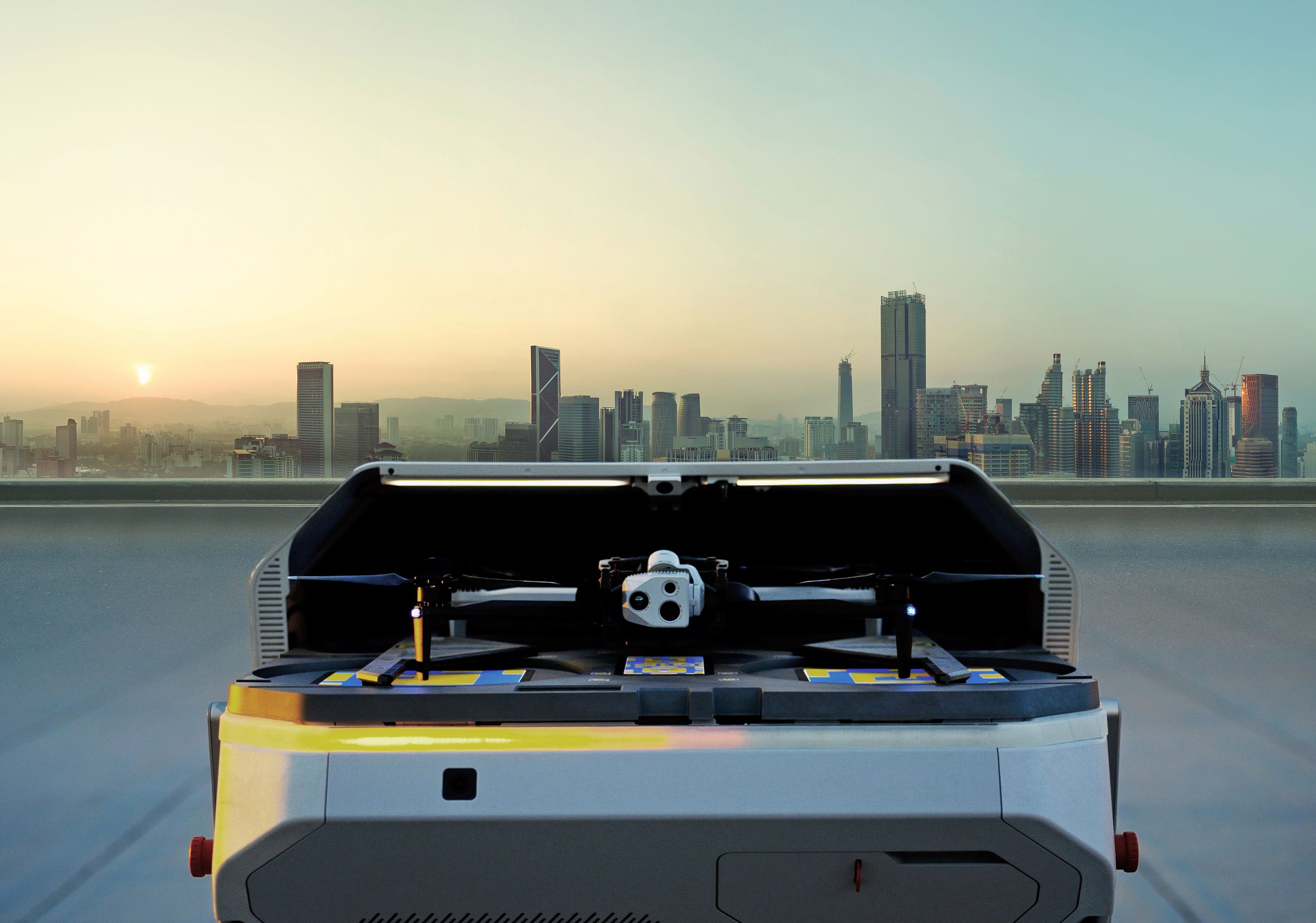
F10 Lightrunner is the fixed-wing member of the Skydio DFR family. Like X10, it launches from a dock with a single click in DFR Command, without a runway or dedicated ground crew. It flies at speeds up to 100 mph, with 120 minutes of flight time.
That operating model matters as much as performance. Launching from a dock removes the need to assemble a ground crew before each response. F10 brings fixed-wing performance into an incident-driven response model, launching from a dock for a dispatched call or defined public safety operation.
Crewed aviation remains essential when a mission requires transporting people or heavy payloads. When the primary requirement is a camera overhead, F10 can reduce helicopter use and give agencies without an air unit an always-ready aerial support option.
Pursuits and fast-moving incidents
Pursuits can unfold and conclude within minutes, creating risk across the roadway. Command staff make consequential decisions inside that window, often without an aerial picture of what is actually happening. To inform those decisions, an aircraft has to launch immediately and reach a vehicle already in motion.
F10 can intercept a moving vehicle and give supervisors timely information about its location, direction, speed, and behavior. When policy and circumstances permit, that visibility can reduce the pressure on officers to remain close behind and help agencies position resources ahead of the vehicle.

Extended incidents and protecting daily capacity
Agencies may need sustained aerial visibility for hours during a barricade, a search for a suspect, or a planned public safety operation at a festival or stadium.
The agency needs sustained visibility without losing daily DFR coverage elsewhere. Every X10 assigned to a long-duration incident is one fewer aircraft available for the next call.
F10 holds the scene so X10 can keep responding.
Large-area search
A missing or endangered person can create a widening search area while resources are still being assembled. Ground teams require time to cover difficult terrain, while short-endurance aircraft may not remain on station long enough to complete the search plan.
F10 can cover large search areas, including open terrain, roads, trails, and riverbanks, while supporting K9 teams and other ground resources. Its onboard thermal camera can help teams identify heat signatures in low-light conditions and through gaps in wooded terrain. It reaches the search area quickly and stays long enough to work it.
Where F10 fits in DFR
F10 was not built to replace X10. It gives agencies another option when an incident is too far, too fast, or too long to absorb without stretching X10 capacity and limiting response to the next call.
Larger outdoor aircraft built for longer-range and extended-duration missions should be evaluated against F10, not treated as replacements for X10 and the distributed response capacity it creates.
A faster, longer-endurance aircraft is still one aircraft, and it can still serve only one call at a time.
One connected DFR system
Building around a family of flying robots does not mean creating separate programs.
- X10 remains the core response aircraft for daily DFR operations, positioned near areas with the highest call demand to support rapid, repeated response.
- R10 carries DFR indoors for alarms, open doors, building searches, welfare checks, and barricades, continuing the response where outdoor aircraft cannot operate.
- F10 expands the mission set when distance, speed, endurance, standoff, or time overhead demand more.
The entire family operates through Skydio DFR Command, connecting fleet operations with the tools agencies already use for dispatch, real-time crime center workflows, live video distribution, and evidence management.
The system can grow with new aircraft and response capabilities without requiring a separate technology stack for each one.

Build around the calls you need to answer
The next era of DFR will be defined not by the largest numbers on a specification sheet, but by how effectively each aircraft is matched to the mission.
If a vendor's answer to every mission is the same drone, it is building around the aircraft it has, not the missions you face.
There is no one perfect drone for DFR. The answer is a complete DFR system built to send the right drone first.